
player
Andrea Pirlo: The Regista Who Controlled the Game
Andrea Pirlo's evolution into a deep-lying playmaker, his Milan and Juventus honours, 2006 World Cup influence and all-time midfield case.
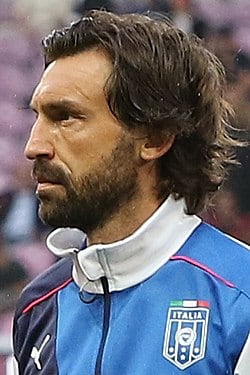
Summary
Pirlo made the deepest midfield position an attacking platform. His scanning, first touch and passing range allowed Milan, Juventus and Italy to build through pressure without rushing the next decision.
Quick facts
- Primary role
- Deep-lying playmaker (regista)
- Major clubs
- AC Milan, Juventus
- National team
- Italy — 116 appearances
- World Cup title
- 2006
- Champions League titles
- Two — 2003 and 2007
- Champions League appearances
- 108
From attacking midfielder to the modern regista
Pirlo did not begin as the player most people now picture. He emerged at Brescia as a gifted attacking midfielder, then struggled to claim that role consistently at Inter. The decisive shift came during a loan back at Brescia, where Carlo Mazzone moved him deeper. Carlo Ancelotti preserved that idea after Pirlo joined AC Milan in 2001.
The change was more than a new starting coordinate. In front of the defence, Pirlo could see the whole pitch and make possession advance before opponents had reset. He did not defend space like a conventional ball-winner, so Milan balanced him with more physical midfielders. In return, he gave the team a clean first pass, switches to either wing and deliveries that bypassed an entire press.
UEFA’s centurion profile calls him the ideal deep-lying playmaker. That description explains why his influence cannot be reduced to goals or assists: the important action was often the pass before the defence became vulnerable.
Milan success and a second peak at Juventus
Pirlo spent ten seasons at Milan and won the Champions League in 2003 and 2007. UEFA records 108 appearances in the competition across Inter, Milan and Juventus. His free-kick helped create Milan’s opening goal in the 2007 final, when the club reversed its defeat to Liverpool two years earlier.
His 2011 move to Juventus looked like a late-career gamble. Instead, Pirlo became the organiser of a side that won four consecutive Serie A titles during his four seasons in Turin and reached the 2015 Champions League final. The Juventus club profile gives that revival its wider context: Pirlo arrived after consecutive seventh-place finishes and immediately helped turn control into a title-winning habit.
That second peak matters to his ranking case. It showed that the Milan system had not created the player; his reading of space could survive a new coach, structure and stage of his career.
Italy in 2006 and the value of patience
At the 2006 World Cup, Pirlo scored Italy’s first goal of the tournament against Ghana and repeatedly shaped decisive moments. FIFA credits him with four assists and three player-of-the-match awards, including the final. His delayed pass for Fabio Grosso in the semi-final against Germany remains a precise example of his method: he waited until the defensive line committed, then released the ball into the opening.
In the final, his corner produced Marco Materazzi’s equaliser and he converted Italy’s first penalty in the shootout. Pirlo received the Bronze Ball for the tournament, while Italy won its fourth world title. That run places him naturally in the discussion of the greatest World Cup players, even though his international legacy also includes the Euro 2012 final.
Why Pirlo belongs among the great midfielders
Pirlo ranks in our best football midfielders of all time list because he changed what control from deep could look like. He could slow a frantic match, accelerate it with one diagonal pass or punish a foul with elite set-piece technique.
The caveat is structural: a team had to protect the spaces around him. But that was not a weakness hidden by great teammates; it was a trade that elite sides deliberately accepted. Pirlo’s passing made the whole team more press-resistant, and his calm gave possession a destination rather than simply preserving it.
Sources
Sources checked
FAQ
What position did Andrea Pirlo play?
Pirlo became a deep-lying playmaker, or regista, after beginning higher up the pitch. From in front of the defence he dictated tempo and supplied every line.
How many Champions League titles did Pirlo win?
He won the Champions League twice with AC Milan, in 2003 and 2007.
What did Pirlo achieve at the 2006 World Cup?
He helped Italy win the tournament, scored against Ghana, created decisive goals and was named player of the match in the final.