
player
Diego Maradona: Argentina, Napoli and the 1986 Peak
Diego Maradona's career through Argentina, Napoli and the 1986 World Cup, with the carrying, creation and pressure resistance behind his peak.
Summary
Maradona's 1986 peak became shorthand for his greatness, but the complete case also includes how he carried the ball, created under contact and concentrated a team's attacking responsibility.
Quick facts
- Primary role
- Attacking midfielder / second forward
- Defining clubs
- Argentinos Juniors, Boca Juniors and Napoli
- National team
- Argentina
- 1986 World Cup
- Champion, captain, Golden Ball, five goals and five assists
- Napoli peak
- Serie A titles in 1987 and 1990; UEFA Cup in 1989
- Playing profile
- Central ball carrier, creator and set-piece threat
The short answer
Diego Maradona became the symbol of the 1986 World Cup, but one tournament is not the whole player. His career case begins with a rare ability to receive under pressure, carry the ball through contact and remain responsible for the final pass or shot at the end of the move.
That responsibility was unusually concentrated. Maradona could drop toward midfield to start an attack, escape the first defender, draw the next one and then create around the penalty area. Argentina in 1986 and Napoli at the end of the decade provide the clearest team evidence, but the skills had been developing since his first senior seasons in Buenos Aires.
Our best football players of all time ranking compares that peak and career with other candidates. This profile first explains how his football worked and why teams were prepared to build so much of their attack around him.
Argentinos Juniors and Boca formation
Maradona made his professional debut for Argentinos Juniors at 15. The early setting demanded more than youth-football flair. He received against senior opponents who could close space and use contact, so protecting the ball became inseparable from moving it forward.
His short strides and low centre of gravity helped him turn without exposing the ball. The left foot kept touches close enough to invite a challenge and then move away from it. That was not dribbling for decoration. Beating the first opponent changed the numbers in front of him and forced another defender to leave position.
The move to Boca Juniors in 1981 put that game inside a club carrying much greater public pressure. Maradona helped Boca win the Argentine league before leaving for Barcelona. The period was brief, but it established a recurring career pattern: the team’s attacking identity and the player’s authority quickly became difficult to separate.
Barcelona to Napoli
Barcelona signed Maradona in 1982. His two seasons in Spain contained a Copa del Rey win, goals and major disruption, including illness and a severe ankle injury. The football was often brilliant, but the spell did not produce the stable platform expected from a record transfer.
Napoli signed him in 1984. The change of context was enormous. The club had never won Serie A and competed against richer northern powers. Maradona did not solve that difference alone—Careca, Ciro Ferrara, Fernando De Napoli and others were essential—but he gave the team a central reference for progression and chance creation.
Possessions could begin with Maradona moving toward the ball and end with him closer to goal. Defenders had to decide whether to follow him away from their line. If they stepped out, he could turn the space behind them into a running lane. If they stayed, he could receive and face the next action.
How Maradona carried a team forward
Maradona’s dribbling depended on control under pressure more than pure straight-line speed. He often carried the ball just far enough from his body to draw a tackle, then used a small touch or body lean to move beyond it. His balance allowed him to continue after contact that would have ended another player’s run.
The carry and the pass strengthened each other. A midfielder who moved across to stop the dribble opened an angle for a teammate. A defender worried about the through ball gave Maradona another step toward goal. Because both threats came from similar body positions, opponents could not read his intention early.
He also gave teams a direct set-piece threat and could finish from the edge of the area. Yet the most important feature was the sequence of responsibilities. He was not only the number ten waiting for a final pass. He could help secure the ball, break a line and still make the decisive action.
That style carried risk. Losing the ball after drawing several players could expose teammates, and a structure built around one creator could become dependent on his availability and form. At its best, however, the same concentration gave the team a clear route through pressure.
Mexico 1986: more than one match
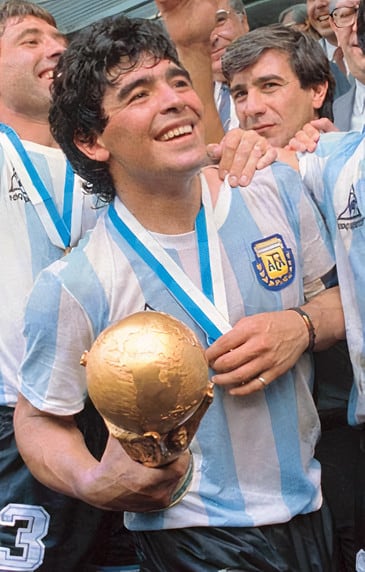
Maradona captained Argentina throughout the 1986 World Cup. FIFA records five goals, five assists and the Golden Ball, with decisive contributions across the knockout rounds. Those figures matter because they show that the tournament was not built only around two famous moments against England.
He scored twice in the quarter-final. The first goal, punched past Peter Shilton and later called the “Hand of God,” was an unpunished handball. It belongs in an accurate account without being defended or allowed to erase the football that followed.
Four minutes later, Maradona received inside his own half, turned away from pressure and carried roughly 60 yards through the England defence before rounding Shilton. FIFA’s retrospective describes him beating four defenders during the move. The goal is remembered because every part of his carrying game survived at full speed: close control, balance, direction changes and a calm finish.
The tournament continued. Maradona scored both goals against Belgium in the semi-final, then created the winning goal in the 3-2 final against West Germany by releasing Jorge Burruchaga through the centre. That final pass is essential to the 1986 story. After West Germany recovered from 2-0 down, Maradona still found the action that decided the World Cup.
His place in the greatest World Cup players discussion therefore rests on a complete campaign: production, captaincy and the ability to decide matches through both carrying and creation.
Napoli: individual control connected to team success
Napoli won its first Serie A title in 1986/87 and another in 1989/90. The club also won the 1988/89 UEFA Cup, beating Stuttgart 5-4 on aggregate in the final. UEFA’s history credits Maradona’s inspiration and leadership while documenting a campaign that also required Careca’s goals and a strong supporting team.
That balance is important. Describing Napoli as a one-man side understates the teammates and organisation needed to win a league. Ignoring how strongly the attack revolved around Maradona misses what made the period exceptional.
He gave Napoli a way to control difficult matches without controlling every phase. One protected touch could relieve pressure; one carry could move the team from a defensive position into attack. His free kicks and final passes added routes against opponents who defended deep. The trophies show that those actions could support repeatable team achievement, not only individual highlights.
The 1989 UEFA Cup adds a different kind of evidence. Napoli overturned a two-goal first-leg deficit against Juventus, eliminated Bayern Munich and then beat Stuttgart over two final legs. Maradona scored from the penalty spot in the home leg of the final and captained the side through the European run.
Evidence, controversy and mythology
Maradona’s career cannot be made tidy. The 1986 handball, disciplinary incidents and later doping sanctions are part of the record. So are injuries, unstable periods and a life outside football that often overtook coverage of the player.
Acknowledging those facts does not require turning every football discussion into a moral verdict. The analytical evidence remains clear: close control under contact, progressive carrying, disguised passing, set pieces and an unusual willingness to demand the ball when a match tightened.
Mythology grows fastest when those skills are replaced by vague language about passion or genius. The stronger explanation is more concrete. Maradona repeatedly moved teams forward from central areas where losing the ball was dangerous and escaping pressure was valuable. In his best periods, he could perform that work from the first touch to the final action.
Ranking and comparison context
The Maradona vs Messi comparison asks how two Argentine careers and roles should be weighed against each other. The Pelé vs Maradona comparison addresses a different cross-era argument. Neither question needs to be settled inside a career profile.
Maradona’s own case is complete enough: development in Argentina, a difficult Barcelona interval, team-changing success in Naples and one of the strongest individual World Cup campaigns on record. Mexico 1986 is the peak evidence, not a substitute for the rest of the career.
Sources
Sources checked
FAQ
What position did Diego Maradona play?
Maradona played as an attacking midfielder or second forward. He often started centrally behind the front line, with freedom to drop for the ball, carry through midfield and create near the penalty area.
Why was Maradona's 1986 World Cup so important?
He captained Argentina to the title, won the Golden Ball and produced five goals and five assists. His influence stretched across the tournament rather than only the famous quarter-final against England.
Which clubs did Diego Maradona play for?
His senior career included Argentinos Juniors, Boca Juniors, Barcelona, Napoli, Sevilla and Newell's Old Boys before a final period at Boca.
What made Maradona's dribbling and playmaking distinctive?
His low centre of gravity, close left-footed control and balance let him absorb contact while changing direction. Because he could carry, pass or shoot from similar positions, defenders could not protect only one outcome.