
player
Franck Ribéry: Bayern's Relentless Left-Wing Creator
Franck Ribéry's Bayern career, 2013 treble, France record, partnership with Arjen Robben and place among the greatest left wingers.
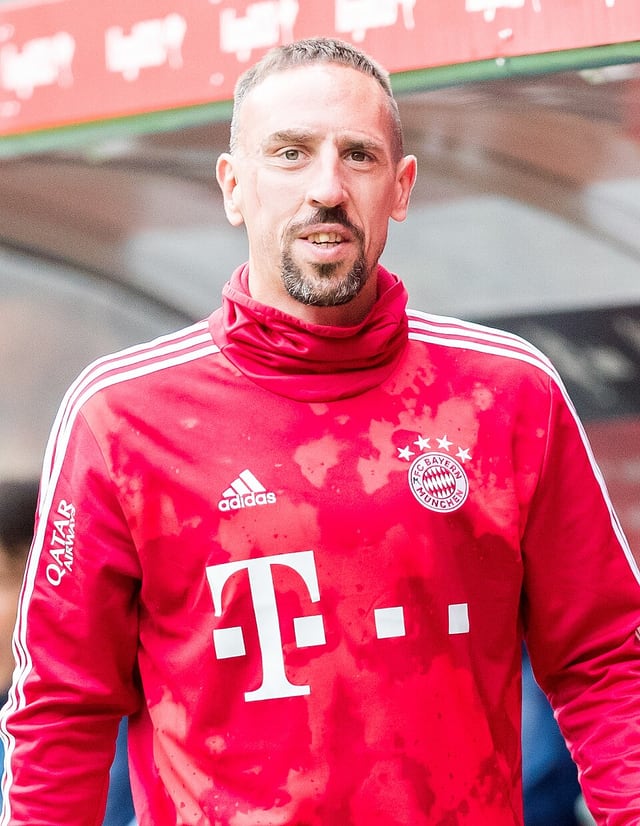
Summary
Speed and close control made Ribéry dangerous on the left. What lasted at Bayern was the value of his dribbling to those around him: it left them with better chances.
Quick facts
- Primary role
- Left winger and wide creator
- Preferred foot
- Right
- Bayern years
- 2007–2019
- Bayern record
- 425 competitive appearances / 124 goals
- France record
- 81 caps / 16 goals
- Peak individual award
- UEFA Best Player in Europe, 2012/13
A long route to Bayern
Two seasons at Marseille had established Franck Ribéry at the highest level when Bayern Munich signed him in 2007. His earlier clubs in France included Boulogne, Alès, Brest and Metz; a short Galatasaray spell came before Marseille. In Bayern he found a lasting home. He stayed for twelve seasons and left in 2019.
Bayern’s figures are 425 competitive appearances and 124 goals. The scoring contribution is substantial. Goals alone, though, leave much of the job unaccounted for. When an organised defence needed moving, Bayern often put the ball at Ribéry’s feet. Follow his run and a defender could open a passing lane; bring a second defender over and someone in the middle could be released.
He collected nine Bundesliga titles, the first in 2007/08 and the last in 2018/19. His goal against Eintracht Frankfurt on the final league day of his farewell season helped Bayern secure that last title. Fiorentina and Salernitana followed in Italy. Ribéry retired in 2022.
How the left wing worked
A right foot on the left suggests an attacker cutting inside. Ribéry offered more than that. He could burst along the outside, come back into a combination or carry the ball diagonally towards the penalty area. Short touches and a low centre of gravity let him change direction without having to halt the move first.
We see the dribble as usually the start of something, with the defence’s next response the important part. After a full-back lost the opening duel, Ribéry could pick out a striker, pass into an overlap or make a quick exchange to keep the ball moving. The same position thus served him against a packed penalty area and against a team caught in transition.
With Arjen Robben, Bayern Munich had this threat on both wings. Their first game together was against Wolfsburg in August 2009. Ribéry supplied Robben’s two debut goals, as the Bundesliga’s account records. Their careers soon became intertwined; the routes they preferred towards goal stayed distinct.
The 2013 treble and European award
Ribéry’s form and Bayern’s achievements came together most strongly in 2012/13. Jupp Heynckes led the side to the Bundesliga, German Cup and Champions League. At Wembley against Borussia Dortmund, Ribéry helped make the opener. Later came his backheel in the move that produced Robben’s late winner.
UEFA chose him ahead of Lionel Messi and Cristiano Ronaldo as its Best Player in Europe for that season. Third place in the FIFA Ballon d’Or was a different result in a separate award. The distinction matters when discussing his 2013 reputation: the outstanding treble campaign supports it without any need to confuse the two prizes.
France and the limits of the record
May 2006 was the month of his first senior France appearance; March 2014 was his last. The French Football Federation lists 81 caps and 16 goals. He played every one of France’s seven matches at the 2006 World Cup, which ended with the team in the final. An international title comparable to Bayern’s Champions League success eluded him.
Injury interruptions in his later club seasons have to count when we compare him with players whose campaigns were more uninterrupted. Those interruptions don’t erase the length of time Bayern could build attacks around Ribéry’s ability to get past the first defender.
His place among the left-wing greats
Fifth is Ribéry’s position in our best left wingers of all time ranking. He filled a recognisable role on the left and influenced elite club football for a decade. His case also rests on a season in which Europe’s strongest team repeatedly relied on his creativity.
Some names above him supplied more as wide penalty-box scorers. Ribéry’s particular strength lay earlier in the possession, before the shot. He drew pressure and escaped it, giving a teammate a cleaner next action and making possession dangerous before the final shot.
Sources
Sources checked
FAQ
Was Franck Ribéry a left winger?
Yes. The right-footed Frenchman made his defining Bayern contribution from the left. From there he could beat the full-back or come inside to combine and create.
How many Bundesliga titles did Franck Ribéry win?
Nine, all with Bayern. He won them between 2008 and 2019 and left as the Bundesliga's record champion.
Did Franck Ribéry win the Ballon d'Or in 2013?
No: third place was his finish in the 2013 FIFA Ballon d'Or vote. He did win the separate UEFA Best Player in Europe award for 2012/13.