
player
Jonathan David: The Striker Who Finds the Second Gap
Jonathan David's Gent, Lille, Juventus, Atlético Madrid and Canada career, with his movement, scoring record and World Cup 2026 hat-trick explained.
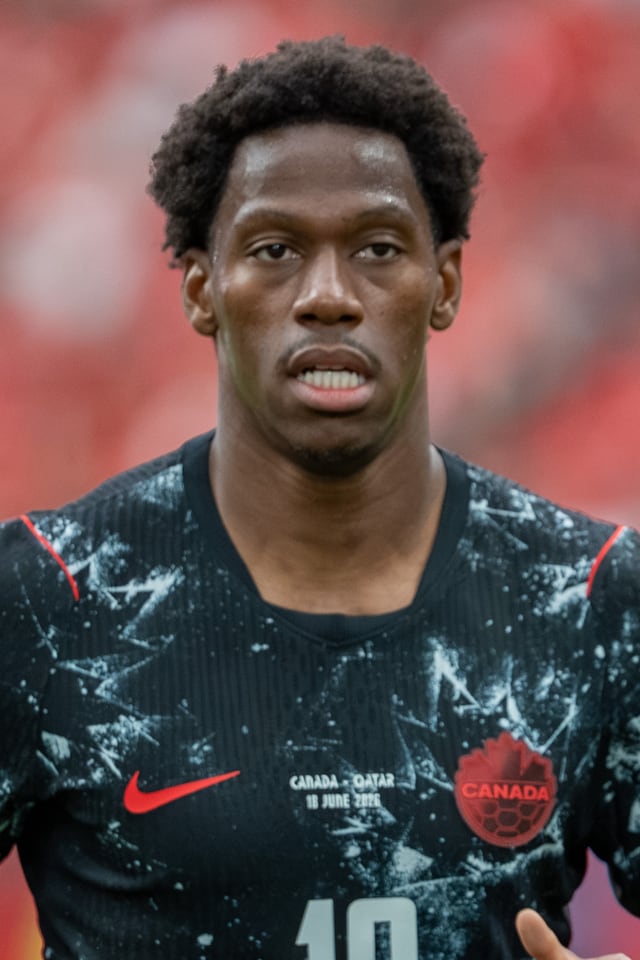
Summary
Jonathan David scores by changing his route at the last moment. He can begin between centre-backs, drop toward the ball and then attack the space their first reaction has opened.
Quick facts
- Position
- Centre-forward / second striker
- Current club
- Atlético Madrid, number 15 (on loan from Juventus for 2026/27)
- Date of birth
- January 14, 2000
- Height
- 1.75 m
- Lille record
- 109 goals and 30 assists in 232 matches
- Juventus 2025/26 league record
- 35 Serie A appearances, six goals and four assists
- Canada record
- 82 appearances and 42 goals (checked August 1, 2026)
- World Cup 2026
- Three goals, all in Canada's 6-0 win over Qatar
The first run is often a decoy
Jonathan David starts between two centre-backs, checks toward the ball and makes one of them follow. He does not need the pass. The useful action comes next: a quick turn into the strip of grass the defender has just left.
That second movement explains more of his scoring than a catalogue of finishes. David is not built to pin a large defender for an entire attack. He prefers to make the defender choose, watch the response and leave before the choice can be corrected.
The same habit travelled from Belgium to France and Italy, and now follows him into Spain with Atlético Madrid. The surroundings changed. The small calculations did not.
Current profile
David is an Atlético Madrid forward on loan from Juventus for the 2026/27 season and Canada’s record scorer as of September 5, 2026. Atlético list him wearing number 15. He remains under contract to Juventus beyond the loan under the five-year agreement he signed in July 2025.
His first Serie A season was useful without matching the scale of his Lille peak. The Juventus profile records 35 league appearances, six goals and four assists in 2025/26. Those numbers belong beside the context: a new league, changing attacking combinations and a striker learning when Italian defences would follow him and when they would hold their line. The movement of Kenan Yildiz from the left gave David one of the inside runners he could release or occupy space for.
The Juventus club profile covers his parent club and its current rebuild. This page stays with the player: how a forward who rarely overwhelms opponents through size built a career by finding space a fraction earlier.
Brooklyn, Port-au-Prince and Ottawa
David was born in Brooklyn on January 14, 2000, to Haitian parents. His family moved to Port-au-Prince when he was three months old and to Ottawa when he was six. Canada Soccer records his first organised football with Gloucester Dragons at ten, followed by Ottawa Gloucester SC Hornets and Ottawa Internationals.
That route matters because there was no famous European academy smoothing every step. David was seventeen when he crossed the Atlantic to join Gent. The move required patience before it produced proof. He spent a season preparing, then scored on his senior debut in August 2018.
Gent gave him room to learn several forward jobs. He could play near a striker, arrive from underneath or become the central reference. Juventus’s career record credits him with 37 goals and 15 assists in 83 matches over two seasons. He also finished as the Belgian league’s leading scorer in 2019/20.
The total was large, but the variety mattered more for the next move. Lille were not buying a fixed penalty-box target. They were buying a player who could help an attack connect and still appear at the end of it.
Lille began with three quiet months
David joined Lille in August 2020 and did not score his first club goal until November. A clean career summary can make that delay disappear. It should stay in the story.
New strikers often receive two bad instructions at once. They are told to remain calm, then judged after every goalless match. David’s early touches became hurried and his runs sometimes arrived before teammates were ready to pass. Lille kept selecting him.
The first goal came against Lorient. The season then changed shape. David scored 13 times across all competitions as Lille held off Paris Saint-Germain to win Ligue 1. His late winner away to PSG in April was especially revealing. He did not wrestle control of the attack; he moved through a transition, arrived in the right lane and finished before the defence recovered.
That title supplied an answer to the slow start. It also gave David a demanding standard for the next four years. He had shown he could contribute to a champion. Lille now needed him to become the scorer the attack could expect every season.
Five seasons made the record harder to dismiss
David scored 109 goals and supplied 30 assists in 232 Lille appearances. The club places him third on its all-time scoring list, behind Jean Baratte and André Strappe, and describes him as its leading scorer of the twenty-first century.
The yearly sequence shows why the record is stronger than one hot season: 13 goals in 2020/21, then 19, 26, 26 and 25 across all competitions. Lille also note that he scored at least 13 league goals in five consecutive seasons.
Availability supported the production. David appeared in 232 of Lille’s 239 matches during his five years and made 200 starts. That does not mean he played well every week. It means coaches could keep building plans around his presence, a valuable trait for a striker asked to coordinate pressing and combinations as well as finish.
He left in 2025 after his contract expired. The farewell was not a case of Lille inventing importance for a departing player. The totals already made it visible: two trophies, four European campaigns, 109 goals and a place on the club’s historical podium.
He creates the gap before attacking it
David’s movement is easiest to see when he does not receive the first pass. He may begin on a centre-back’s shoulder, drop five metres and offer a short option. If the defender steps out, David can release the ball with one touch and spin behind him. If the defender stays, he has space to turn.
That is the two-part problem. The defender must protect depth without giving David freedom between the lines. A midfielder can take over the dropping run, but that handoff needs to happen quickly. Any hesitation creates the second gap.
Inside the box, David changes speed instead of sprinting at one pace. He can pause near the penalty spot while a defender tracks the first runner, then accelerate toward a cutback. Near the six-yard line, he looks for the blind side rather than standing directly in front of the marker.
The movements are small enough to disappear from a highlight until the ball arrives. Then the finish looks simple. The simplicity was prepared.
A partner can make his game clearer
David can lead the line alone, but he is not limited to that structure. Juventus’s technical assessment described him as a number nine who can work beside a less mobile striker. That pairing can give him more freedom to move away from the centre.
With another forward occupying the centre-backs, David can receive in an inside channel, combine and attack the box later. With quick wingers around him, he can drop and release them before turning toward goal. His short passing is not ornamental. It changes which defender has to find him next.
There is a trade-off. Dropping too often can leave the box empty, especially if the wide players also want the ball to feet. A mobile striker still needs to decide when the team requires a fixed reference. David’s best matches contain both actions: helping the attack arrive, then making sure somebody is there to finish it.
Pressing depends on the angle, not the sprint total
David works without the ball, but effort alone is not a tactical description. His first pressing run usually tries to remove a return pass while steering the centre-back toward one side. The winger and nearest midfielder can then close the next options.
If the striker runs straight at the ball, the defender may pass on either side of him. A curved run reduces the choice. David’s speed helps him reach the action, but the starting angle makes the press useful.
He can also drop onto a holding midfielder when the opponent builds with an extra player centrally. That responsibility suits his scanning. It can, however, pull him farther from goal when possession is recovered. The team needs a nearby runner so the first counterattack does not wait for him to cover thirty metres.
Finishing early is part of the advantage
David often shoots before a defender has settled into a block. He can open his body for a side-foot finish, poke the ball around an advancing goalkeeper or strike across goal after a short diagonal run.
He is comfortable enough on either foot to accept chances from both sides of the box. Juventus’s 2025/26 league breakdown recorded four left-footed goals, one right-footed goal and one header. One season is too small to define his entire technique, but it shows why a defender cannot simply force him onto one side and consider the action solved.
Penalties have also contributed to his totals. That should be stated rather than treated as a flaw or hidden in an all-competition number. Taking penalties reliably is a skill; it is different from creating open-play shots. David’s broader case survives the separation because the movement, pressing and non-penalty finishes remain visible.
Europe added a record beyond Lille
David’s club career has included Champions League football with Lille and Juventus. UEFA’s May 2026 count placed him on 12 Champions League goals, level with Christian Pulisic and behind only Javier Hernández among CONCACAF players.
Across all UEFA club competitions, UEFA listed David first among CONCACAF scorers with 25 goals. That record joins performances for Gent, Lille and Juventus rather than resting on one campaign.
European totals do not turn him into a Champions League-era great. They establish something narrower and worth keeping: his scoring translated beyond domestic leagues, and it did so across three clubs.
Serie A asked a different question
David signed for Juventus on July 4, 2025, with a contract through June 2030. He arrived after five years of reliable production and entered a league where defenders were less likely to chase every dropping movement.
His first five months produced five goals and three assists in 26 appearances across competitions. The league season ended at six goals and four assists. That is a modest rise from the January snapshot rather than the late scoring rush Lille supporters had seen before.
It would be easy to write that season as either failure or adaptation. Neither label does enough work. David appeared in 35 Serie A matches and learned a new set of distances. The finishing return was below his French standard. Both facts can be true.
Juventus then sent him to Atlético Madrid on a season-long loan on September 1, 2026. The move changes the immediate test from a second Serie A campaign to adapting those movements to Atlético’s structure and La Liga defenders; it does not erase the evidence or limitations of his first Juventus season.
Canada gave him responsibility early
David made his senior Canada debut in September 2018 and scored twice. Canada Soccer listed him at 82 appearances, 72 starts, 42 goals and 18 assists on August 1, 2026. Because he remains active, those numbers need the date attached.
His international role grew alongside a generation led by Alphonso Davies. David became the central scorer, but Canada did not ask him only to wait in the box. He linked transitions, pressed from the front and moved into channels when Davies or a winger carried the ball forward.
The 2022 World Cup brought no goals and three defeats for Canada. That blank matters. David reached the tournament as an established club scorer and left without the international moment many expected.
Canada then finished fourth at the 2024 Copa América. David scored the winner against Peru, the country’s first Copa América victory, and worked in a team willing to press stronger opponents. The run offered evidence that Canada could survive tournament football even when possession was uneven.
The home World Cup turned one match into history
Canada opened World Cup 2026 with a draw against Bosnia and Herzegovina. The second group match took place against Qatar at BC Place in Vancouver.
David scored in the 29th minute, added another in first-half stoppage time and completed his hat-trick in second-half stoppage time. Canada won 6-0. It was the men’s national team’s first World Cup victory.
The three goals were not spread across a long run, and the World Cup 2026 Golden Boot ranking does not pretend otherwise. David finished with three tournament goals, all from one match. FIFA’s final statistics record 16 attempts, nine on target and those three goals.
That concentration changes the interpretation, not the value. A hat-trick against nine-man Qatar is not proof that David dominated every opponent. It is still the match that delivered Canada’s first win, in a home World Cup, after the scoreless experience of 2022.
Canada later exited against Morocco. The run did not reach the quarterfinal stage tracked in our dark-horse review. David’s tournament remains memorable because one group match crossed a national line that had stood through two previous World Cup appearances.
What the scoring record says and what it does not
David’s career totals establish repeatability. Thirty-seven Gent goals, 109 for Lille, a CONCACAF European record and 42 for Canada are too large to explain as one favourable season.
They do not settle every question about the highest club level. His first Juventus campaign fell below his Lille scoring rate. He has not won the Champions League, and Canada’s 2026 run ended well before the medal matches.
The useful conclusion is more specific. David is a mobile, durable forward whose scoring depends on reading reactions and reaching useful spaces early. He can support a press and combine outside the box, but his value still rises or falls with how often those movements end in shots.
The Atlético loan will test the adjustment in a new structure and league. Defenders know his first movement. David’s career has been built on finding the one after it.
Sources
Sources checked
- Juventus - Jonathan David joins Atlético Madrid on loan
- Atlético Madrid - Jonathan David 2026/27 first-team profile
- Juventus - Jonathan David first-team profile
- Juventus - Jonathan David signs through 2030
- Juventus - Jonathan David technical profile
- LOSC - Jonathan David leaves after 109 goals
- Canada Soccer - Jonathan David national-team profile
- FIFA - David's World Cup hat-trick against Qatar
- FIFA - World Cup 2026 player statistics
- UEFA - leading CONCACAF performers in European competition
FAQ
Which club does Jonathan David play for?
Jonathan David plays for Atlético Madrid on loan from Juventus for the 2026/27 season and wears number 15. His Juventus contract runs through June 30, 2030.
How many goals did Jonathan David score for Lille?
David scored 109 goals in 232 appearances across all competitions for Lille. The club lists him third among its all-time scorers and first in the modern era.
How many goals has Jonathan David scored for Canada?
Canada Soccer listed David at 42 goals in 82 senior appearances on August 1, 2026. He is an active player, so both totals need a date whenever they are quoted.
What happened in Jonathan David's World Cup 2026 hat-trick?
David scored in the 29th minute, first-half stoppage time and second-half stoppage time as Canada beat Qatar 6-0. It was Canada's first men's World Cup win.
What type of striker is Jonathan David?
He is a mobile centre-forward who can also play near another striker. His strengths are scanning, short combinations, double movements, pressing and finishing before a defender or goalkeeper can reset.
Did Jonathan David win Ligue 1?
Yes. He won Ligue 1 with Lille in 2020/21 and the Trophée des Champions in 2021.