
player
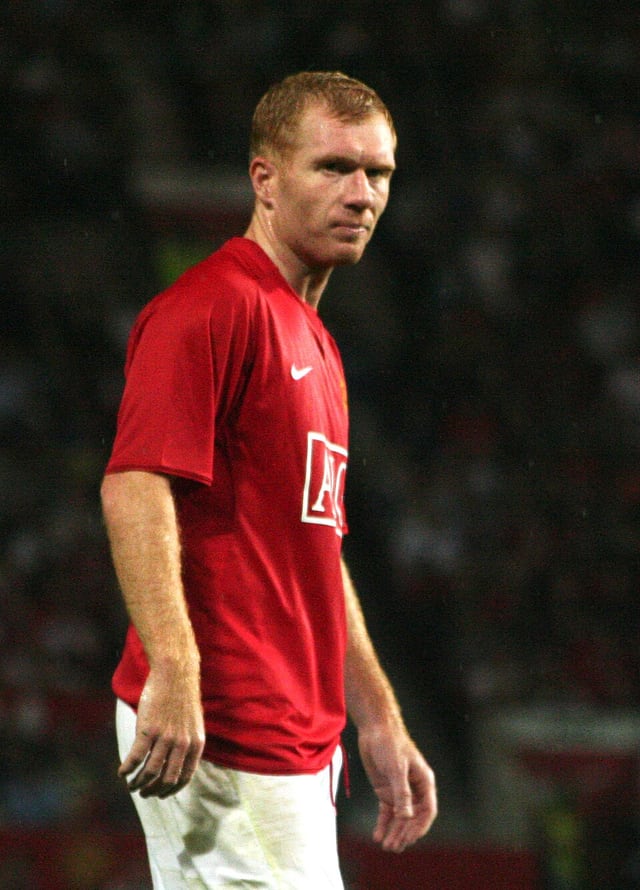
Paul Scholes: Manchester United's Midfield Metronome
Paul Scholes's Manchester United career, passing style, major honours, defining European nights and place among the greatest midfielders ever.
Summary
Scholes evolved from a goalscoring attacking midfielder into a deep controller whose scanning, first touch and passing range set Manchester United's rhythm.
Quick facts
- Primary role
- Central midfielder and deep playmaker
- Senior club
- Manchester United
- United record
- 718 appearances / 155 goals
- Premier League titles
- 11
- Champions League titles
- 1999 and 2008
- Midfielders ranking
- #15 in The Top Football's all-time list
From academy finisher to one-club mainstay
Paul Scholes came through Manchester United’s academy and made his senior breakthrough in 1994. He initially looked closer to a supporting forward than the deep playmaker remembered from his later years: sharp around the penalty area, alert to second balls and capable of arriving beyond the striker.
The role changed, but the club did not. Manchester United records 718 appearances, 155 goals and 25 trophies across 19 seasons. Eleven Premier League titles place Scholes inside every phase of the club’s domestic dominance under Sir Alex Ferguson, from the mid-1990s emergence of the academy group through the final championship of 2012/13.
The Manchester United club profile gives that longevity its institutional setting. Scholes was not simply present for one great side; he adjusted as teammates, formations and the speed of the league changed around him.
The position changed; the passing picture did not
Young Scholes attacked the box and finished moves. The older version often started them. From a deeper position, he scanned before receiving, opened his body with the first touch and moved pressure with short combinations or long diagonals. His passing was not decorative accumulation. It altered where the next duel would take place.
He could still shoot from distance and arrive late when space appeared, but the mature game was built on rhythm. A fast pass into feet invited the next action; a switch to the opposite flank punished a narrow defence. Because he released the ball early, opponents often struggled to get close enough to test his lack of size or pace.
That evolution matters to his all-time case. Scholes was not the same midfielder for 19 seasons. He found a second elite role when his physical profile and the team’s needs changed, preserving influence through decision speed rather than relying on the movements of his youth.
European nights and the retirement return
Scholes belonged to Manchester United’s 1999 Champions League-winning campaign but missed the final against Bayern Munich through suspension. Nine years later, he supplied his defining European action on the pitch: a long-range goal against Barcelona that decided the 2008 semi-final. He then started the final against Chelsea as United won on penalties in Moscow.
The sequence belongs in the greatest Champions League players context because it shows both longevity and consequence. Scholes remained relevant across two title-winning European eras even though his role had changed between them.
He first retired in 2011, then returned midway through the following season when Ferguson needed midfield depth. The comeback could have been a sentimental coda. Instead, he contributed to another title challenge and stayed through the 2012/13 championship before retiring for good. It is a small but revealing part of the profile: the manager still trusted his reading of the game after months away.
Why Scholes closes the all-time Top 15
Scholes is No. 15 in our best football midfielders of all time ranking. His case rests on technical consistency, role evolution and sustained importance to a serial-winning team rather than international tournament dominance. England used him in several midfield arrangements, but his clearest tactical identity was always at club level.
The ranking does not place him above the era’s most complete box-to-box players or the controllers who defined national-team systems. It does recognise an unusually durable intelligence. Scholes could decide the pace of a match without carrying the ball for long, and he learned to influence games from farther away as his career developed. That combination of adaptation and precision earns the final place in the list.
Sources
Sources checked
FAQ
What type of midfielder was Paul Scholes?
He began as an advanced, goalscoring midfielder and later became a deeper controller, using quick combinations and long diagonal passes to organise possession.
How many games did Scholes play for Manchester United?
Manchester United records 718 appearances and 155 goals across his senior career.
Did Scholes play in both Champions League-winning finals?
No. He missed the 1999 final through suspension, but started the 2008 final after scoring the decisive semi-final goal against Barcelona.