
player
Steven Gerrard: Liverpool Captain and Complete Midfielder
Steven Gerrard's Liverpool career, England record, defining finals, box-to-box playing style and place among the greatest midfielders ever.
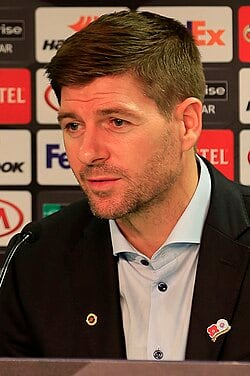
Summary
Gerrard combined running power, long passing, tackling and decisive shooting in a Liverpool career that repeatedly asked him to solve different midfield problems.
Quick facts
- Primary role
- Box-to-box and central midfielder
- Major clubs
- Liverpool, LA Galaxy
- Liverpool record
- 710 appearances / 186 goals
- England record
- 114 caps / 21 goals
- European peak
- Champions League winner and captain, 2005
- Midfielders ranking
- #12 in The Top Football's all-time list
Liverpool from academy player to captain
Steven Gerrard joined Liverpool’s youth system at nine and made his senior debut against Blackburn Rovers in November 1998. What followed was not simply a long one-club spell. It was a career in which the local academy graduate became the player Liverpool most often trusted when a match needed force, invention or emotional direction.
The club’s official record gives him 710 appearances and 186 goals from 1998 to 2015. He became captain in 2003 and held the armband for more than a decade. Liverpool’s 2001 cup treble accelerated that rise: Gerrard contributed to the League Cup and FA Cup wins, then scored in the 5-4 UEFA Cup final against Alavés.
His final playing stop was LA Galaxy, but the career is defined by Anfield. The Liverpool club profile supplies the wider context for a player whose peak years crossed several managers, tactical systems and versions of the team.
A midfielder built for several jobs
Gerrard is often described as a box-to-box midfielder, and the label catches the running power, tackling and ability to arrive around the penalty area. It does not quite cover his tactical range. He played centrally in a pair, from the right, behind a striker and later as the deepest midfielder in Liverpool’s 2013/14 title challenge.
The common thread was vertical impact. He could break a line with a driven pass, carry through pressure or shoot before a defence had reset. His long passing also let Liverpool change the point of attack without building through several safe touches. The trade-off was that his game invited risk; he was less interested in circulating possession for its own sake than in finding the action that moved a match forward.
That makes Gerrard different from the pure tempo controllers near the top of the all-time list. His claim is not that he played their game better. It is that he could influence more phases than most midfielders while carrying an unusual share of his team’s responsibility.
Istanbul, Cardiff and England
The 2005 Champions League final remains the centre of the story. Liverpool trailed AC Milan 3-0 at half-time before Gerrard’s 54th-minute header began a six-minute recovery to 3-3. Liverpool won the shootout, and the captain lifted the European Cup. The following year, he helped turn another final: two goals against West Ham, including the long-range stoppage-time equaliser, preceded Liverpool’s FA Cup shootout win.
Those moments connect him naturally to the greatest Champions League players debate, but the international record adds scale. The FA records 114 England appearances, 21 goals and 38 matches as captain across six major tournaments. England did not produce an equivalent trophy run, so his international case rests on longevity and responsibility rather than a defining team honour.
Why Gerrard ranks among the all-time midfielders
Gerrard is No. 12 in our best football midfielders of all time ranking. The position recognises a rare combination: elite passing range, recovery power, shooting, leadership and the capacity to change roles without losing his attacking threat.
He does not have the league-title collection of several peers, and that matters in a comparison built partly on sustained team control. Yet reducing the case to the missing Premier League medal would ignore what made him exceptional. Few midfielders were asked to be creator, runner, ball-winner and late-match solution so often, and fewer still produced as many defining cup moments while doing it.
Sources
Sources checked
FAQ
What type of midfielder was Steven Gerrard?
He was primarily an all-action central midfielder, but he also operated as a holding player, an advanced midfielder and from the right when Liverpool needed a different balance.
What was Gerrard's defining Liverpool match?
The 2005 Champions League final is the clearest answer: as captain, he scored the first Liverpool goal in the comeback from 3-0 down against AC Milan.
How many times did Gerrard play for England?
Gerrard won 114 senior England caps, scored 21 goals and captained the national team 38 times.