
player
Alfredo Di Stefano: The Forward Who Ran the Whole Match
Alfredo Di Stefano's career from River Plate and Millonarios to Real Madrid, with the all-phase movement behind five consecutive European Cups.
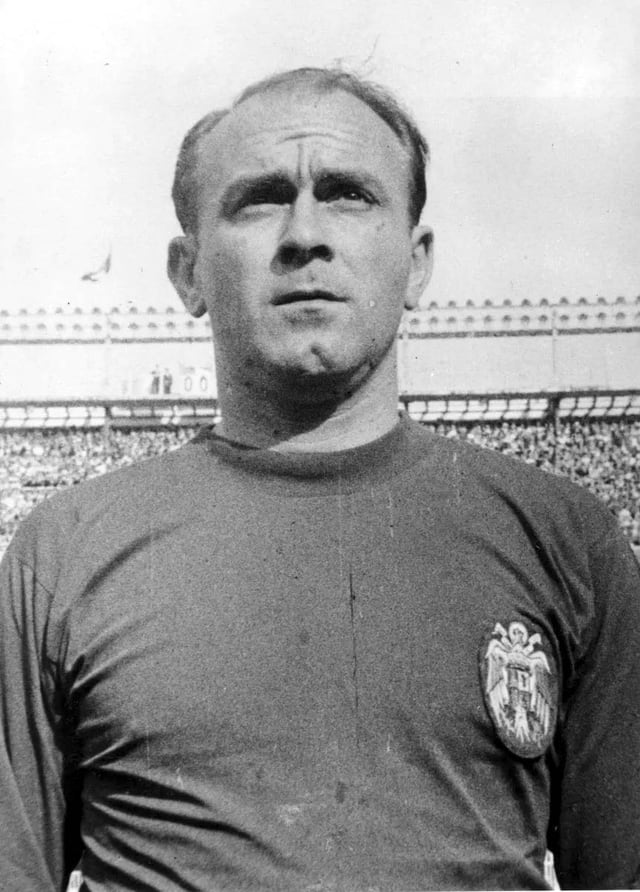
Summary
Di Stefano came toward the ball to organise the next action, followed the move forward and still arrived where a striker was expected to finish.
Quick facts
- Primary role
- Forward / attacking organiser
- Defining club
- Real Madrid, 1953-1964
- Real Madrid record
- 308 goals in 396 competitive appearances
- European Cups
- Five consecutive titles; scored in every final, 1956-1960
- Spain
- 23 goals in 31 internationals
- Profile
- All-phase forward who linked midfield work to penalty-area finishing
The forward who refused to wait up front
Alfredo Di Stefano is listed as a forward, which is correct and still leaves most of the job unexplained. He came back toward midfield when Real Madrid needed a route out, carried or passed the ball into the next area, and then kept running. By the time the move reached the box, he was often there to finish it.
Real Madrid records 308 goals in 396 competitive appearances between 1953 and 1964. He was no wandering midfielder who happened to score. The movement had a destination.
Old descriptions often say Di Stefano appeared everywhere. He was not collecting positions for effect. He moved because an attack needed a receiver, a defender needed pressing or a teammate needed the space he was standing in.
The result was a forward who could influence the beginning and end of the same move. Real Madrid won the first five European Cups with him at the centre of the team, and UEFA records a Di Stefano goal in every final.
River Plate came before the Blond Arrow
Di Stefano was born in Buenos Aires on 4 July 1926. He entered River Plate’s system and made his senior debut at 19, then spent time on loan at Huracan before returning.
River already had a celebrated attacking tradition. A young forward had to understand combinations as well as the path to goal. Di Stefano learned to receive among teammates who changed positions and expected the ball back quickly. Real Madrid’s official profile says he won the Argentine league and finished as its leading scorer at 21.
The River years did not yet contain the player Madrid supporters would know, but the outline was there. Di Stefano wanted contact with the match. If service disappeared, he went looking for it rather than remaining between two centre-backs.
Millonarios made the route to Madrid complicated
A strike in Argentine football changed the next part of his career. Di Stefano moved to Millonarios in Colombia, where a breakaway professional league was attracting leading South American players.
The football suited him. Millonarios played with enough freedom for Di Stefano to drop, accelerate and exchange positions without losing his place as the main scoring threat. European audiences saw that version of him when the Colombian club toured abroad.
His eventual move to Spain produced a dispute between Real Madrid and Barcelona. The paperwork, competing claims and proposed compromise have been argued over ever since. Di Stefano joined Real Madrid in 1953, and that is where the eleven seasons covered here begin.
That episode belongs to the history of El Clasico, but it should not swallow the player. The transfer mattered because of the eleven seasons that followed, not because confusion itself proves greatness.
What all-phase football looked like
Watch one Madrid attack and Di Stefano may begin beside the centre-forward. Watch the next and he is receiving near a half-back, turning into open grass. After releasing the ball, he moves again instead of admiring the pass.
Coming short pulled a marker away from the back line. If the defender followed, another forward could enter the gap. If the defender stayed, Di Stefano had room to face the play and choose the next pass. Either response gave Madrid information.
He also worked back when possession changed. Real Madrid’s own profile describes a forward who attacked and defended, but effort alone was not the point. Winning the ball closer to midfield let him start against opponents whose shape was not yet settled.
Then came the second run. Di Stefano could begin a move deep, send it wide and arrive late enough that the centre-backs had already turned toward the cross. His goals and his organising work were parts of one sequence.
Five European Cups, five final goals
The European Cup began in 1955/56. Real Madrid won it, then won the next four as well. Di Stefano played and scored in each final.
Five wins can flatten into a single line, so the changing team matters. Hector Rial, Raymond Kopa, Joseito and later Ferenc Puskas all carried different attacking responsibilities. Paco Gento gave the side genuine width on the left. Di Stefano connected those options through the centre instead of demanding that every move end immediately at his feet.
The Real Madrid club profile covers the dynasty in the longer institutional story. At player level, the repeated final goal is the cleanest measure. Different opponents, different match states and five occasions on which Di Stefano still reached the decisive area.
The run also grew beside the Santiago Bernabeu. The stadium expanded while the competition turned Madrid into Europe’s reference club. Team, building and tournament grew at the same time.
The 1960 final showed the partnership
Real Madrid beat Eintracht Frankfurt 7-3 at Hampden Park in the fifth final. Puskas scored four. Di Stefano scored three.
That division is worth stating because the game is sometimes reduced to whichever legend a retelling prefers. Puskas supplied the larger total. Di Stefano’s hat trick included the equaliser after Frankfurt had taken the lead, then two more in a second half that broke the match open.
Their partnership worked because neither forward needed one fixed lane. Puskas could move toward his left foot and shoot early. Di Stefano could come from deeper, combine and continue. Gento’s width stopped the whole attack from collapsing into the centre.
Seven goals did not come from seven isolated pieces of brilliance. Madrid kept moving Frankfurt’s defenders until a scorer received the ball with the next action already available.
The reign ended in the 1962 final, when Benfica recovered from a Puskas hat trick to win 5-3. Eusebio scored the last two goals, a direct handover from Madrid’s first European dynasty to Benfica’s young forward.
Eight league titles kept the dynasty honest
European finals provide the photographs, but Real Madrid also won eight Spanish league titles during Di Stefano’s eleven seasons. The club counts 18 trophies across the spell, including the five European Cups, one Spanish Cup and the 1960 Intercontinental Cup.
League football asked for something different from a final. Opponents could defend deep, repeat the same physical contest and return a few months later with a better plan. Di Stefano’s range helped Madrid avoid one attacking routine. He could advance the move through midfield when the direct route disappeared, then join the box after the defence shifted.
Five Pichichi awards show that the extra work did not pull him too far from goal. The organiser still finished enough attacks to lead the league repeatedly.
Real Madrid’s 396/308 line is the safest scope to use here. Some historic archives publish larger totals that include friendlies or other non-competitive matches. Adding them together would create a number that belongs to no recognised record.
Three international routes, no World Cup appearance
Di Stefano’s international career does not fit the usual one-country line. He played for Argentina, appeared for a Colombia representative side during the Millonarios period and later represented Spain after taking Spanish nationality.
Those records cannot be added without qualification. The Colombian matches sit outside the recognition used for ordinary FIFA international totals. UEFA gives the clear Spain line: 23 goals in 31 appearances.
He never played at a World Cup final tournament. Di Stefano travelled with Spain to Chile in 1962, but a knee injury kept him out of every match.
The absence limits one part of an all-time comparison. It also explains why the club evidence carries so much of his case. Di Stefano’s greatest stage arrived every spring in the European Cup rather than every four years with a national team.
The awards followed the Madrid seasons
Di Stefano won the Ballon d’Or in 1957 and 1959. In 1989, France Football awarded him the one-off Super Ballon d’Or, with the trophy recognising the career rather than one new season.
Awards can confirm how a player was viewed in his time, but they do not explain the football. Two Ballon d’Or wins tell us that Di Stefano’s contemporaries saw the scale of his influence. The match still shows what the votes were responding to: the drop toward the ball, the pass forward and the run that completed it.
The Super Ballon d’Or arrived long after retirement. It belongs to the reception of his career, not to a third peak that needs adding to the player record.
Espanyol closed the playing career
Di Stefano left Real Madrid after the 1964 European Cup final and joined Espanyol. He played two more seasons before retiring.
The ending was quieter than the Madrid years. That is useful. Great careers do not always provide a final scene that explains everything. His reputation had already been built through eleven seasons in which Real Madrid changed from a major Spanish club into the first European Cup dynasty.
He later worked as a coach and became Real Madrid’s honorary president. Those chapters belong to the club’s memory. They should not be used as extra evidence for the playing ranking.
Why Di Stefano completes the all-time Top 10
Di Stefano is tenth in our ranking of the best football players of all time. The position is not a reward for being the oldest Madrid name people remember.
The case joins an elite scoring record to work that happened well before the shot. He helped Madrid progress the ball, changed the position of defenders and returned to finish. Five goals in five European Cup finals put that range under the highest club pressure available in his era.
There are fair limits. He has no World Cup tournament record, and the European Cup required fewer matches than the modern Champions League. The greatest Champions League players ranking has to account for that format difference.
Modern Real Madrid greatness often points first to Cristiano Ronaldo, whose scoring scale belongs to another competition structure. Di Stefano’s route was different. He did not wait for Madrid to become Europe’s dominant club and then add goals. His football was part of how that identity was built.
Sources
Sources checked
- Real Madrid - Alfredo Di Stefano legend profile
- Real Madrid - Alfredo Di Stefano centenary and club totals
- UEFA - Di Stefano on five European Cup wins
- UEFA - Alfredo Di Stefano obituary and Spain record
- UEFA - Ballon d'Or winners archive
- CONMEBOL - River Plate academy tradition
- FIFA - Di Stefano's 1962 World Cup injury
FAQ
How many goals did Alfredo Di Stefano score for Real Madrid?
Real Madrid records 308 goals in 396 competitive appearances between 1953 and 1964. Broader historic totals can include non-competitive matches and should not be mixed with that official club line.
How many European Cups did Alfredo Di Stefano win?
Di Stefano won the first five European Cups with Real Madrid from 1956 to 1960. UEFA records that he scored in all five finals.
What position did Alfredo Di Stefano play?
He was a forward, but he regularly dropped into midfield to receive and organise before moving into scoring positions again.
Which national teams did Alfredo Di Stefano represent?
Di Stefano represented Argentina and Spain, and he also appeared for a Colombia representative side during his Millonarios years. Records for those Colombian matches are not treated consistently, so this profile keeps each scope separate.
Did Alfredo Di Stefano play at the World Cup?
No. Di Stefano never appeared in a World Cup final tournament despite his international career with Argentina and Spain.