
player
Eusebio: The Forward Who Made Defenders Turn Early
Eusebio's career with Benfica and Portugal, from the 1962 European Cup final to nine goals at the 1966 World Cup, with his pace and shooting explained.
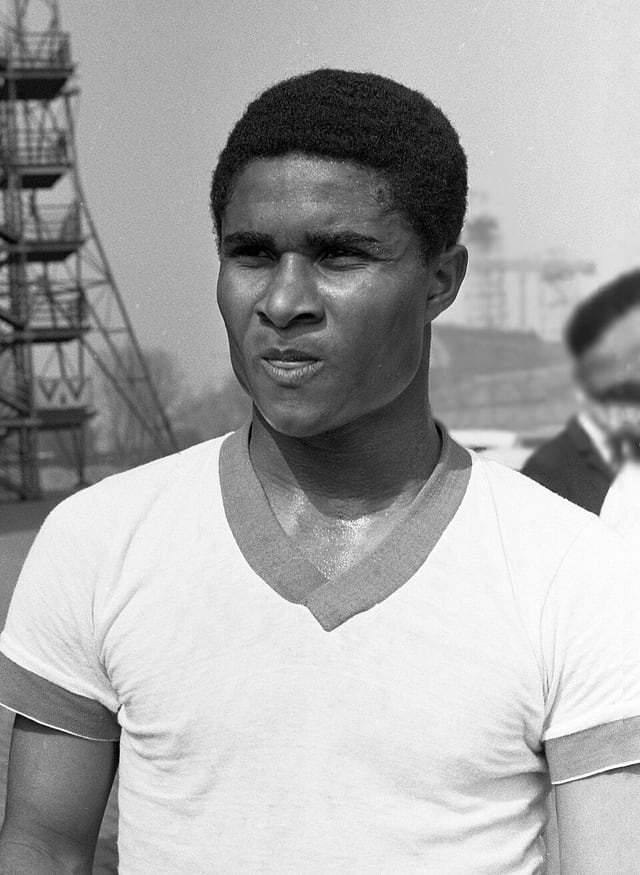
Summary
Eusebio's first steps made the defender turn toward goal. Once that happened, he could run past, brake into shooting space or attack the gap the turn had opened.
Quick facts
- Primary role
- Forward / centre-forward
- Defining club
- Benfica, 1960-1975
- Portugal
- 41 goals in 64 internationals
- World Cup 1966
- Nine goals in six matches; Portugal finished third
- European Cup
- Winner in 1962; two goals in the final
- Individual record
- Ballon d'Or winner in 1965
The first steps changed the defender’s decision
Eusebio could look like a simple problem from a distance. He was fast, strong and carried a fierce right-foot shot. The difficulty was deciding which threat to protect against first.
If a defender retreated, Eusebio could stop before the back line settled and shoot through the space in front of him. If the defender stepped toward the ball, the first burst opened a route behind. Turning to run was not a solution either. It shifted the defender’s weight away from the next change of direction.
His acceleration mattered beyond sprint speed. Eusebio made the opponent commit while he still had more than one action available. He could continue toward goal, move the ball across the defender or strike before the goalkeeper had a clear view.
The goals came with force, but the force was usually prepared by the run. His first steps created the separation. The long stride then carried him through it, and the shot arrived while the defence was still recovering from the first choice.
Mafalala came before Lisbon
Eusébio da Silva Ferreira was born on 25 January 1942 in Lourenço Marques, the city now called Maputo, in Mozambique. He grew up in the Mafalala neighbourhood and played for Sporting Clube de Lourenço Marques before moving to Portugal.
Benfica’s own history places his arrival in Lisbon in December 1960. The transfer became tangled in a dispute with Sporting, whose Mozambican affiliate had developed him. Stories about secrecy followed the deal for years. Benfica had secured an 18-year-old forward whose pace already looked unusual.
The move demanded more than a change of league. Lisbon brought colder weather, a different daily life and a club already strong enough to win the 1961 European Cup without him in the final. Eusebio was joining the champions, not a side waiting for one young player to make it relevant.
He did not need long to become central. Benfica had clever passers and experienced forwards around him. They could give Eusebio the ball before a defence was set, then follow the space his run pulled open.
His stride did not lock him into one route
Power runners can become predictable when every touch pushes the ball into the same lane. Eusebio could adjust during the burst. His upper body stayed strong enough to absorb contact while the next touch changed the angle.
The right foot supplied most of the famous shots. He hit through the ball with little need for a long preparation, which made attempts from outside the box dangerous even when defenders had closed some of the space. A goalkeeper seeing the swing late had less time to move behind the line of the shot.
He also attacked the penalty area as a centre-forward. Speed did not strand him on the wing. After releasing the ball, he continued toward goal and looked for the return pass. Benfica could use him as the runner who stretched the back line or the scorer arriving through the middle.
There was a practical rhythm to it: draw the turn, test the retreat, then choose. The same player who had just run beyond a defender could stop on the next attack and use the room that fear of the run had created.
The 1962 final put the whole attack on display
Real Madrid entered the 1962 European Cup final with the competition’s original dynasty behind them. Ferenc Puskas scored a first-half hat trick in Amsterdam. Benfica still went into the break only 3-2 down.
Mario Coluna equalised after half-time. Eusebio then won and converted a penalty to put Benfica ahead before scoring again with a right-foot drive. The final ended 5-3.
The opponent gives the match extra weight. Madrid still had Puskas and Alfredo Di Stefano, two forwards who had shaped the first five editions of the European Cup. Benfica did not edge past them through one isolated counterattack. They recovered from three Puskas goals and kept attacking until the older side could no longer hold the pace.
Eusebio was 20. The two goals did not begin his career, but they changed the audience for it. A young forward from Mozambique had decided the European Cup final against the most recognisable club attack of the era.
Benfica stayed close to Europe after the win
The 1962 trophy was Eusebio’s only European Cup victory. Benfica returned to the final in 1963, 1965 and 1968 but lost to AC Milan, Inter and Manchester United. That record matters because one medal can hide how often the club returned to the last match.
UEFA records 59 Eusebio goals in 78 European club competition appearances. The rate belongs beside the repeated deep runs, not as a detached number collected in early rounds.
Domestic honours filled the seasons between those finals. UEFA credits his Benfica era with eleven Portuguese league titles and five Portuguese Cups. Some Benfica commemorative pages use a different league-title count, so this profile keeps the UEFA honours scope instead of combining two club summaries.
The same care is needed with goals. Benfica publishes a broad total of 638 goals in 614 matches for the club. That archive count includes a wider match set than a modern competitive database. It is a valid Benfica all-match record, but it should not be relabelled as 638 competitive goals.
The 1965 Ballon d’Or sat inside the peak
Eusebio won the Ballon d’Or in 1965 after finishing runner-up in 1962. He would finish second again in 1966.
The award gives a useful reading of how European voters saw him during the Benfica peak. It does not need to carry the argument alone. By 1965, opponents had already faced the acceleration, the long-range shot and the penalty-area runs through several European campaigns.
The voting also came before his most famous international tournament. That order is worth keeping. The 1966 World Cup confirmed Eusebio to a wider public; it did not create a reputation from six matches.
Portugal’s 1966 run took more than one comeback
Portugal arrived at the 1966 World Cup for the country’s first appearance in the finals. The team won all three group matches, beating Hungary, Bulgaria and holders Brazil.
Eusebio scored once against Bulgaria and twice against Brazil. The Brazil match was not a ceremonial meeting between famous names. Portugal won 3-1 and eliminated the two-time defending champions.
The quarter-final against Korea DPR became the tournament’s wildest test. Portugal trailed 3-0 after 25 minutes at Goodison Park. Eusebio scored four times as the match turned into a 5-3 win.
He added a penalty against England in the semi-final, though Portugal lost 2-1, then scored again in the third-place victory over the Soviet Union. The complete line was nine goals in six matches. Portugal finished third, which remains the country’s best men’s World Cup finish.
A nine-goal run through every round puts him prominently in the greatest World Cup players discussion. The case includes group-stage pressure, a historic comeback, a semi-final goal and the match that secured third place.
Four goals against Korea DPR did not repeat one finish
The comeback is often compressed into the number four. The sequence says more.
Eusebio’s first goal came from a direct run through the middle. The second was a penalty before half-time. After the break he accelerated into the area and was fouled for another penalty, which he converted. The fourth arrived after another forward run, a low finish that completed his personal part of the recovery.
Two penalties did not make the performance passive. His carries forced defenders into desperate challenges inside the box. He kept attacking the same unsettled line even after the score had moved from crisis to possibility.
FIFA records that only Just Fontaine, Sándor Kocsis and Gerd Muller have scored more than nine goals in one men’s World Cup. That comparison describes tournament concentration, not total career quality. Eusebio needed six matches to leave a scoring mark that still sits near the top of the single-edition list.
Forty-one goals tell the longer Portugal story
UEFA gives Eusebio 41 goals in 64 Portugal internationals. The 1966 tournament accounts for nine of them, leaving a much larger national-team record outside England.
Portugal did not become a permanent tournament qualifier during his career. The team missed the 1970 and 1974 World Cups and did not reach a European Championship finals with him. International evidence from the era therefore arrives in qualifying matches and friendlies as well as one exceptional summer.
Later Portugal forwards worked in a different tournament structure. The Cristiano Ronaldo World Cup profile covers five finals and a much longer international calendar. Eusebio’s case is more concentrated: fewer caps, one World Cup, and an extraordinary share of Portugal’s best finish.
The later career moved away from Benfica
Eusebio left Benfica in 1975 after fifteen seasons and continued playing in North America and Portugal. He appeared for teams in the North American Soccer League and ended his playing career in the United States in 1978.
Those stops extended the career but do not add much to the ranking case. The decisive evidence had already been produced in Lisbon and with Portugal. Late moves should not be used to turn a focused Benfica story into a padded club list.
He remained closely identified with Benfica after retirement and later served as a club ambassador. That public role explains why Benfica still calls him its king. The playing profile rests on the earlier work: the run that forced a turn, the shot that followed and the goals that carried the club and national team through their defining tournaments.
Why Eusebio is fifth among the all-time strikers
Eusebio sits fifth in our ranking of the best football strikers. The position weighs a sustained Benfica peak, elite European scoring and one of the strongest individual World Cup tournaments.
The four players above him have different advantages. Ronaldo Nazario offers a more destructive dribbling peak, Pele a broader creative role, Muller a larger body of penalty-box scoring and Marco van Basten a different kind of technical control over awkward service.
Eusebio’s answer was pressure on the first defensive decision. Retreat and he could shoot. Step up and he could run behind. Turn early and he could change the route while your weight was moving the wrong way.
The shot is the image most people keep. The few steps before it explain why the shot was available.
Sources
Sources checked
FAQ
How many goals did Eusebio score for Portugal?
UEFA records 41 goals in 64 senior internationals for Portugal.
How many goals did Eusebio score at the 1966 World Cup?
Eusebio scored nine goals in six matches, won the tournament scoring title and helped Portugal finish third.
Did Eusebio win the European Cup?
Yes. He scored twice as Benfica beat Real Madrid 5-3 in the 1962 European Cup final.
How many Ballon d'Or awards did Eusebio win?
Eusebio won the Ballon d'Or once, in 1965. He was runner-up in 1962 and 1966.
What was Eusebio's playing style?
He was a direct forward with explosive acceleration, a long running stride and a powerful right-foot shot. His pace forced defenders to turn early, which also opened room for him to stop and shoot.