
player
Andrés Iniesta: The Midfielder for the Tightest Spaces
Andrés Iniesta profile covering Barcelona, Spain's 2010 World Cup winner, EURO 2012 award, playing style and all-time ranking case.
Summary
Iniesta escaped pressure through balance, touch and timing, then carried the ball into the space that an opponent thought had already been closed.
Quick facts
- Primary role
- Central and attacking midfielder
- Defining club
- Barcelona, 2002–2018
- Barcelona record
- 674 appearances and 32 trophies in the current legend-page count
- Major club honours
- 9 La Liga titles and 4 Champions Leagues
- Defining goal
- 2010 World Cup final winner
- Individual landmark
- EURO 2012 Player of the Tournament
Barcelona’s solution between the lines
Andrés Iniesta arrived at La Masia at 12 and made his Barcelona first-team debut in 2002. The early years demanded patience, but by the second half of the decade he had become one of the team’s essential midfielders. His partnership with Xavi and, later, Sergio Busquets gave Barcelona complementary kinds of control: circulation behind him, security underneath him and Iniesta’s ability to enter the next line with the ball.
Barcelona’s current legend page records 674 appearances and 32 trophies across 16 first-team seasons, including nine league titles and four Champions Leagues. A separate club statistics archive displays a higher match total because it uses a broader fixture scope. This profile keeps the current legend-page count rather than treating unlike categories as interchangeable.
The Barcelona club profile shows how that individual career overlapped with two treble-winning sides. Iniesta was not merely present through the era; his movement helped its positional structure work under pressure.
The World Cup goal and a complete Spain cycle
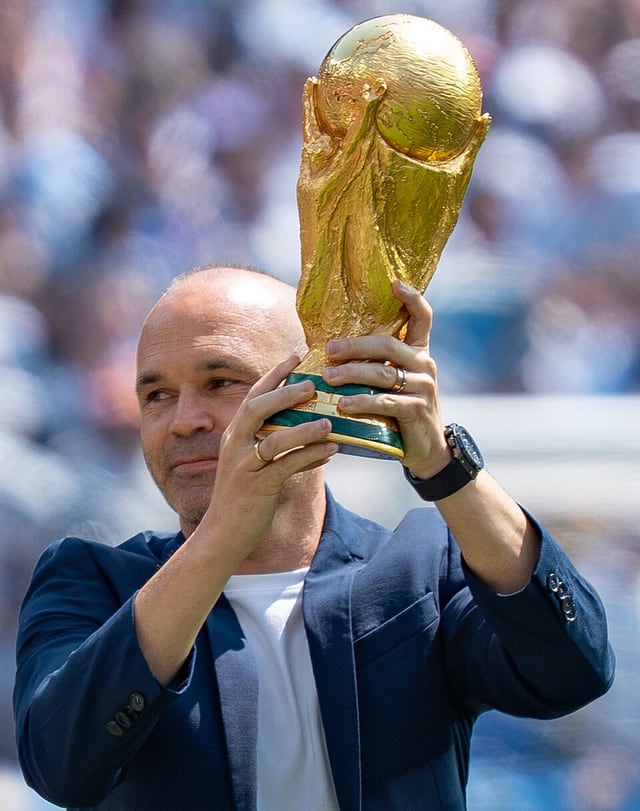
Iniesta started throughout Spain’s victorious EURO 2008 campaign, but his defining international moment came two years later. The 2010 World Cup final remained scoreless until the 116th minute, when Cesc Fàbregas found Iniesta on the right side of the penalty area. His finish against the Netherlands gave Spain its first men’s world title.
That one goal can overshadow the wider tournament cycle. Iniesta’s close control helped Spain sustain possession against compact opponents, and he remained central when the team retained its European title in 2012. UEFA named him Player of the Tournament after six performances in which his effect was larger than a line of one assist and no goals.
The combination explains his place among the greatest World Cup players: one of football’s highest-leverage goals, supported by the work required to reach that moment rather than standing alone from it.
Playing style: escaping the closed door
Iniesta’s first touch often changed the geometry of an attack. He could receive with an opponent close behind, shift his balance without exposing the ball and emerge facing the next line. His dribbling was less about a winger’s isolated duel than surviving congestion and turning a crowded central zone into forward momentum. Pedri now faces related problems for Barcelona, but the comparison remains technical while his active career is still developing.
He also understood when not to force the action. Short combinations allowed him to move a defender before accelerating into the gap that followed. Near the penalty area, the same calm supported disguised passes and cut-backs; deeper, it helped Barcelona and Spain play through a press without abandoning their shape.
Those qualities mattered in the Champions League, where Iniesta won four titles and produced the stoppage-time goal at Chelsea that sent Barcelona to the 2009 final. Pressure resistance became outcome, not merely aesthetics.
Why Iniesta ranks third among all-time midfielders
Our best football midfielders of all time ranking places Iniesta third, immediately behind Xavi. The gap is deliberately narrow. Xavi receives the edge for controlling the tempo of whole matches; Iniesta offered the more direct route through a defensive line and the stronger collection of decisive scoring moments.
His case combines longevity, tactical flexibility and final-stage nerve. He could serve as an advanced central midfielder, move toward a No. 10 role or begin from the left without becoming a conventional winger. In each version, he made pressure an opportunity to eliminate an opponent from the play.
The ranking does not depend on arguing that Iniesta carried those great teams alone. It rewards the difficulty of his job inside them. Barcelona and Spain asked him to receive where space was smallest, protect the shared structure and still create separation. Few midfielders have made all three tasks look so compatible.
Sources
Sources checked
FAQ
What position did Andrés Iniesta play?
Iniesta was most often an advanced central midfielder, but he could also operate as a No. 10 or begin from the left before moving into central spaces.
What was Iniesta's most important goal?
His 116th-minute goal against the Netherlands won the 2010 World Cup final and gave Spain its first men's world title.
How many trophies did Iniesta win with Barcelona?
Barcelona's current legend profile credits him with 32 trophies, including nine league titles and four Champions Leagues.