
player
Pedri: The Midfielder Who Sees the Next Pass Early
Pedri's Barcelona and Spain career, with his scanning, tempo control, injury setbacks, major honours and 2026 World Cup title explained.
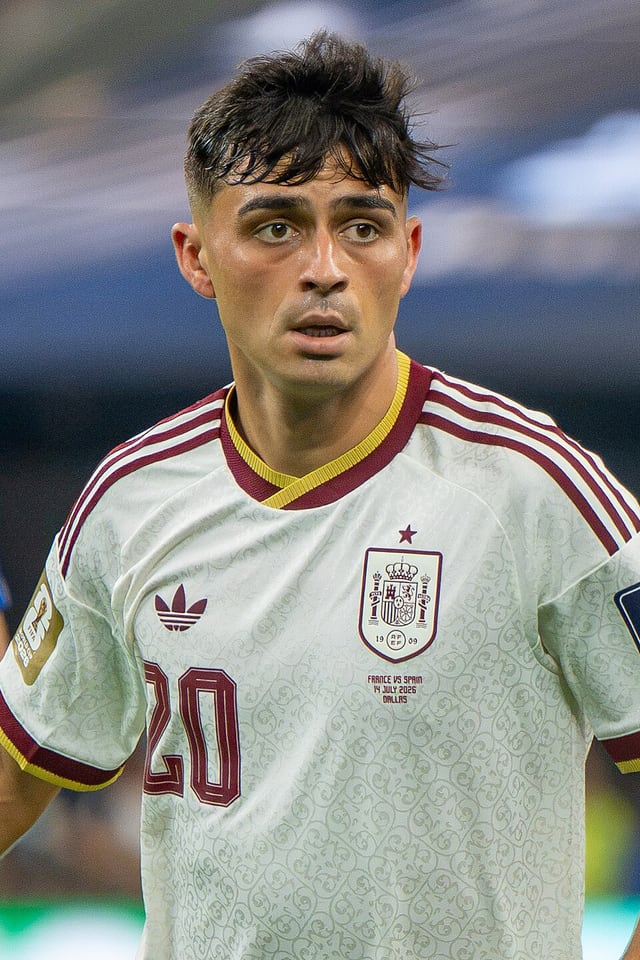
Summary
Pedri controls difficult midfield spaces by looking before the ball arrives, preserving several passing options and changing tempo without needing a highlight action.
Quick facts
- Position
- Central midfielder
- Current club
- FC Barcelona, number 8 (checked September 30, 2026)
- Contract
- Through June 30, 2030
- Barcelona record
- 250 competitive appearances and 29 goals at the September 9, 2026 milestone
- Barcelona honours
- Three La Liga titles, two Copas del Rey and three Spanish Super Cups
- Spain honours
- EURO 2024 and World Cup 2026 winner; played in the 2022/23 Nations League campaign
- Individual awards
- EURO 2020 Young Player, 2021 Golden Boy and 2021 Kopa Trophy
The useful action happens before the ball arrives
Pedri looks over one shoulder, then the other. The pass is still travelling. By the time it reaches him, he has already built a rough map: teammate inside, opponent closing from behind, winger free on the far side.
The first touch can look ordinary because the difficult work happened earlier. He nudges the ball away from pressure and plays into a lane that appeared for half a second. Barcelona keep moving. The crowd sees a simple pass; the midfielder has solved three decisions without stopping possession.
FIFA asked Pedri about that habit during the 2026 World Cup. He described scanning as building a mental picture of teammates, opponents and available time, while leaving room to improvise if the picture changes. It is a concise explanation of his game.
He can dribble, shoot and create near the penalty area. His clearest identity is the ability to make crowded midfield feel less crowded. That skill took him from Tenerife to Las Palmas, then into Barcelona’s first team at seventeen and Spain’s midfield at eighteen.
Tegueste was far from the usual academy route
Pedro González López was born in Tegueste, Tenerife, on 25 November 2002. He began with his hometown club and later played for Juventud Laguna before joining Las Palmas’ academy in 2018.
The Canary Islands sit a long way from Spain’s largest football centres. Pedri was not moving through La Masia or Real Madrid’s system while scouts tracked every youth match. Las Palmas gave him a route that was local, senior and fast.
He made his first-team debut in August 2019, aged sixteen. The second division placed him against grown players who could close space with experience rather than academy athleticism. He responded by becoming Las Palmas’ most-used player in 2019/20: 34 league appearances and four goals.
Barcelona had already acted. The clubs agreed a transfer in September 2019, but Pedri stayed in Las Palmas for the season. That extra year matters. He arrived at Camp Nou with a full professional campaign behind him, not only a promising collection of youth clips.
Barcelona expected a prospect and found a starter
Pedri joined Barcelona in August 2020. The squad still contained Lionel Messi, Sergio Busquets and other players who had lived inside elite possession football for years. Ronald Koeman could have introduced the newcomer gradually.
Instead, Pedri played 52 times in his first season, the highest total at the club. He was small, seventeen and new to the level, yet his decisions made him safe to select. He rarely held the ball to prove that he belonged. He moved it at the speed the situation asked for.
The first season ended with a Copa del Rey. It also created a workload that would later need scrutiny. Pedri went from Barcelona to EURO 2020, then to the delayed Tokyo Olympics. The 2020/21 cycle reached 74 matches for club and country.
The number became part of his story because the following seasons brought muscle injuries and interrupted rhythm. It would be too neat to blame every problem on one crowded year. It would also be careless to discuss his development without recognising how quickly football asked him to carry an adult schedule.
EURO 2020 announced the international version
Spain selected Pedri for EURO 2020 before his nineteenth birthday. He became the country’s youngest player at a European Championship and started every match as the team reached the semi-finals.
UEFA named him Young Player of the Tournament and included him in the official team of the competition. The praise was not a promise about what he might become. It was a judgment on the football he had already played against senior international midfields.
Spain used long spells of possession, but Pedri did not simply add safe passes. He carried the ball through open lanes, received between pressure lines and helped connect Busquets to the forwards. When Italy pressed in the semi-final, his composure remained visible even though Spain lost the shootout.
The same year brought the Golden Boy and Kopa Trophy. Three awards can make a teenager sound finished. Pedri was not. He had completed an exceptional first senior cycle and was about to learn how much availability shapes a career.
Scanning is a tool, not a trick
Players scan for different reasons. A defender may check the striker before a cross. A winger looks for the full-back’s balance. Pedri uses the habit to preserve choices in the busiest area of the pitch.
He often receives side-on. That stance keeps the passer in view while opening the field ahead. If an opponent approaches from his blind side, the first touch can take the ball across the body. If the central lane stays open, he can play forward immediately.
The value is not measured by head turns. Looking only helps if the player remembers the picture and updates it after the ball moves. Pedri links the information to touch and timing. A pass that seemed available a second earlier may close; he can recycle without treating the change as failure.
That patience is different from passivity. He will draw a marker close, wait for the weight to shift and release the ball into the space the opponent has left. The move may be five yards. Its effect can remove an entire line.
He changes tempo without announcing it
Some midfielders accelerate a match with a long carry or a first-time vertical pass. Pedri can do both. He also changes pace through smaller choices.
A controlled touch may slow the press long enough for a full-back to advance. A quick return pass can pull the same opponent away from the next receiver. When Barcelona need to settle after losing control, he offers a position where the ball can rest without the attack becoming static.
This is where comparisons with Xavi and Andrés Iniesta begin, and where they should be handled carefully. Xavi controlled complete matches over many title-winning seasons. Iniesta combined tight-space escape with defining final-stage moments. Pedri shares parts of their education and technical vocabulary; he has not yet reproduced their careers.
The comparison is useful at the level of role. Like those midfielders, he treats possession as a way to organise the team rather than an individual count of completed passes.
The final third asks for a different risk
Pedri is often described as a controller, which can hide his work nearer goal. He can slide passes between full-back and centre-back, carry into the box and arrive for cutbacks.
His finishing record is modest beside attacking midfielders who live around the penalty area. Barcelona recorded 29 competitive goals when he reached 250 appearances on September 9, 2026. The figure reflects his role and availability as well as technique.
When he shoots from distance, the best attempts come after a balanced setup rather than a rushed swing through traffic. Nearer goal, he can disguise the direction of a pass until the defender commits. The same scanning that helps him escape midfield pressure also tells him which runner has moved out of sight.
He does not need to become a high-volume scorer to matter. A few more goals can punish opponents who retreat to block his passes. The threat makes the creative lane easier to reopen.
Injuries interrupted the middle of the rise
Pedri’s second Barcelona season fell to 22 appearances. Later campaigns also contained hamstring and thigh problems, including a 2023/24 season limited to 34 games in all competitions.
The interruptions changed how his career was discussed. When fit, he looked central to Barcelona. When absent, the team missed the player who connected its phases. Admiration began to carry a condition: could the body sustain the role?
EURO 2024 supplied another hard moment. Pedri started Spain’s tournament but was injured early in the quarter-final after a challenge from Toni Kroos. Spain beat Germany, then France and England to become European champions. Pedri received the medal without being able to finish the run on the pitch.
That should not be used to remove him from the title. He played in the campaign and was part of the team. It should remain in the record as an injury that stopped his individual tournament after four starts.
Hansi Flick gave him continuity and responsibility
The 2024/25 season changed the availability question. Barcelona’s November 2025 FIFPRO recap credits Pedri with 59 appearances and only one missed match under Hansi Flick. The team won La Liga, the Copa del Rey and the Spanish Super Cup.
Flick’s football could move quickly, so midfield control did not mean slowing every attack. Pedri had to support a high press, recover position after turnovers and recognise when the first forward pass was available.
The healthier season restored repetition. Technique can be visible in one match; influence needs weeks of the same decisions. Pedri could build relationships with the players around him instead of restarting after another absence.
Barcelona renewed his contract through June 2030 in January 2025. By the following season he had become one of the longer-serving first-team players and a dressing-room voice despite being only twenty-three.
The club record now contains substance
Pedri reached 250 competitive Barcelona appearances against Feyenoord on September 9, 2026. The club’s milestone report records 29 goals and an assist for Raphinha in that match.
Those 250 games break down as 169 in La Liga, 44 in the Champions League, 19 in the Copa del Rey, 11 in the Spanish Super Cup and seven in the Europa League. This dated competitive total excludes friendlies and will rise with later appearances.
His honours included three La Liga titles, two Copas del Rey and three Spanish Super Cups. Those totals include the league and Super Cup won in 2025/26, even though an injury cost him a month before his February return.
The trophies do not turn every season into a smooth rise. They show that Pedri moved from gifted newcomer to a midfielder with repeated responsibility across several Barcelona teams.
Spain built the 2026 title around control
Spain entered World Cup 2026 as European champion. The attack drew attention through Lamine Yamal, Nico Williams and the forwards, while Pau Cubarsí emerged as the tournament’s Best Young Player. The team’s larger strength was control across the pitch.
Pedri’s scanning fit that aim. FIFA’s tournament feature used his own explanation of how he built the picture before receiving. Spain could circulate until the opponent stepped out, then move through the opening without turning every possession into a sprint.
He was not the uninterrupted centre of the final. Luis de la Fuente used him from the bench against Argentina. Pedri still forced Emiliano Martínez into a save as Spain pressed for the goal.
Ferran Torres scored in the 106th minute, and Spain won 1-0. The medal gave Pedri a senior World Cup title beside EURO 2024. His Nations League record needs a distinction: he played in Spain’s 2022/23 league phase, but injury kept him out of the 2023 finals. Unlike the European Championship, the 2026 World Cup ended with him available to contribute in the decisive match.
Third among the 2026 young-player group
Pedri is third in our young World Cup 2026 players ranking, behind Yamal and Cubarsí. Arda Güler sits fifth after Türkiye’s early exit limited his tournament case. The list uses an editorial age curve rather than FIFA’s formal award rules, so an established twenty-three-year-old remains eligible.
His case is quieter than a dribble compilation. Spain’s title run needed players who could keep the team in the right areas, regain its shape and decide when an opening was real. Pedri performed that work inside the champions.
He is not yet in our all-time midfield Top 10. The greatest midfielders ranking asks for longevity, defining tournament influence and years at the centre of elite teams. Pedri has major trophies and an unusually early body of work. The remaining argument is duration.
That is a fair place to leave an active career. The vision is established, the club trust is secured through 2030 and the biggest team medals have arrived. What comes next depends on how often Barcelona and Spain can put that scanning, touch and judgment on the pitch.
Sources
Sources checked
- FC Barcelona - Pedri reaches 250 appearances, September 9, 2026
- FC Barcelona - Pedri first-team profile
- FC Barcelona - Pedri's 2024/25 season in the FIFPRO recap
- FC Barcelona - Pedri contract through 2030
- UEFA - EURO 2020 Team of the Tournament
- RFEF - Pedri Spain profile
- FIFA - How Pedri scans before receiving
- FIFA - Spain win the 2026 World Cup final
- UEFA - Pedri missed the 2023 Nations League finals through injury
- UEFA - Spain's 2022/23 Nations League campaign
- UEFA - Pedri named EURO 2020 Young Player
FAQ
Which club does Pedri play for?
Pedri plays for FC Barcelona and wears number 8. He signed a contract extension in January 2025 that runs through June 30, 2030.
What position does Pedri play?
He is a central midfielder who can play as an interior, deeper connector or advanced number 8. His role changes with the structure around him.
How many games has Pedri played for Barcelona?
Barcelona recorded Pedri's 250th competitive appearance against Feyenoord on September 9, 2026. He had scored 29 goals by that milestone; friendlies are excluded.
How does Pedri play?
He scans repeatedly before receiving, opens his body to keep several passes available and changes the speed of possession with small touches rather than constant dribbling.
Did Pedri win the 2026 World Cup?
Yes. Pedri was part of Spain's title-winning squad and came off the bench in the final, drawing a save from Emiliano Martínez before Spain won 1-0 after extra time.
Which individual awards has Pedri won?
He won the EURO 2020 Young Player award, the 2021 Golden Boy and the 2021 Kopa Trophy after his breakthrough season.