
player
Bukayo Saka: Arsenal's Right-Wing Reference
Bukayo Saka's career from Hale End to Arsenal and England, with a close look at his right-wing role, decision-making and 2026 World Cup impact.
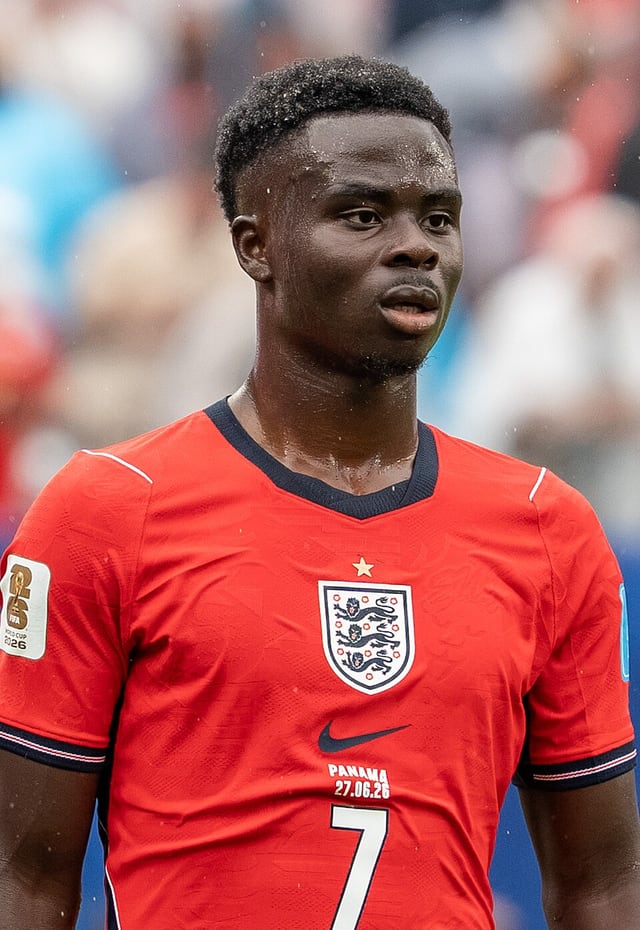
Summary
Saka's value comes from repeatable decisions under pressure. He can hold the touchline, combine inside, attack the box or make the final pass, which makes him more complete than the standard left-footed winger who only cuts in to shoot.
Quick facts
- Primary role
- Right winger / forward
- Current club
- Arsenal, number 7 (checked 23 September 2026)
- England record
- 56 senior appearances and 17 goals (checked 23 September 2026)
- World Cup 2026
- Third place; hat trick in the bronze-medal match
- Profile
- Left-footed creator and scorer who carries responsibility from the right
The current answer
Arsenal and England both start Bukayo Saka from the right, but the position label tells only part of the story. At the September 23, 2026 check, England’s official profile showed 56 appearances and 17 goals, and the Premier League squad list showed him wearing number 7 for Arsenal.
There are still moments when Saka is isolated against a full-back, although Arsenal ask much more of him than that duel. A difficult possession will often find its way to his side. He may have to keep it alive in traffic, create the chance or arrive in the area to finish the move himself.
Defenders know the familiar danger: Saka receives on the right, shifts the ball onto his left foot and comes inside. Yet setting up only for that move is risky. He can run outside, use an overlap or slip a pass back into midfield. The difficulty is not one unstoppable trick. It is that he rarely shows the defender his decision too early.
That role grew out of Hale End and is part of the wider Arsenal profile. Saka was not signed as a finished specialist. He came through the academy, filled gaps in the senior side and gradually became the player Arsenal looked for when the right side had to make something happen.
Hale End and the full-back apprenticeship
Saka had been at Arsenal since the age of eight when, in November 2018, he made his senior debut against Vorskla Poltava in the Europa League. He had not yet turned 18. Hale End had prepared him for senior football, though not for one fixed position.
Injuries opened his first-team route on the left, including spells at full-back and wing-back, rather than immediately on the right wing. Those matches put him on the defensive side of the duel he would later attack. He saw how a full-back uses the touchline, when an overlap becomes difficult to hand over and what it feels like to turn toward your own goal with a winger following.
You can still see that education in his attacking choices. Saka notices when a defender has closed his hips or started to follow the runner outside. At that point he does not always take another touch. Often the pass is the better way to exploit what he has seen.
The defensive work stayed with him too. He can bend a pressing run to close the pass inside, follow an opposing full-back and help keep the ball on one side of the pitch. This is not a story about a defender being converted into a forward; his left foot, close control and eye for the final action were obvious early. Playing deeper simply taught him more about the space he now attacks.
Becoming Arsenal’s right-sided reference
The right wing eventually became Saka’s regular starting point, not a fixed address. On one attack his boots are almost on the chalk; on the next he has moved into the half-space and left the outside lane for the right-back. When Arsenal are pressed, he will come short and offer the simple pass too.
Opponents prepare for all of this, which is why a second defender often reaches him so quickly. Saka seldom treats the double team as an invitation to force a dribble. He is happy to return the ball, move a few yards and receive it again after one of the defenders has turned away.
That short exchange can be enough. A wall pass buys half a metre, while an overlap keeps the full-back busy. Once the covering winger glances inside at a pass to midfield, Saka has his cue to move.
By May 2026, Saka had started 200 Premier League matches; only three players had reached that mark at a younger age, according to the league’s analysis. The same review found that his carries regularly ended with a shot or a chance created. Defenders have had years of video and repeated meetings in which to study him. His answer has been to keep reading their adjustments rather than insist that yesterday’s route will open again.
What Saka does with the ball
The first touch is the starting point. A hard pass toward the touchline does not have to pin Saka there. He can cushion it to protect the ball, nudge it forward at once or leave it close enough to tempt the defender toward him.
His best bursts often come after a pause. He slows the duel until the defender plants a foot, then accelerates across it. Since he is willing to use the outside lane, the full-back cannot simply guard the route onto his left foot.
If Saka goes outside, he can cross while moving or reach the byline for a cutback. If he comes infield, he can combine, pass behind the defence or keep carrying toward goal. He is most awkward to contain when both options remain alive until the final touch.
Receiving half-turned helps. From that angle he can see the central runner as well as the space down the line; receiving with his back to goal gives the defence time to squeeze around him. His finishing has also become a larger part of the job. He arrives at the far side of the box, shoots after carrying inside and takes penalties. A defender who treats him only as a provider soon gives him room to score.
The triangle around him
Saka is rarely operating alone, even when the camera frames him against a full-back. Arsenal usually place a midfielder nearby and send a right-back or another runner outside. The three players give each other different angles.
The inside pass can come straight back around the corner. The run outside forces the full-back to glance away from Saka. He waits to see who follows which movement and then uses the space left behind.
The support works in both directions. Because Saka can shield the ball, teammates have time to reach him. He can also occupy two defenders and open a central lane without ever getting the return pass. Arsenal may come down the same side repeatedly, but each picture is a little different: the full-back is a step closer, the overlap starts earlier, or the box is not yet ready for a cross. Saka notices.
Workload, injuries and availability
The role is demanding on the body. England’s update before the World Cup said hip and Achilles problems held Saka to 25 Premier League starts in Arsenal’s title-winning 2025/26 season. Arsenal managed his minutes during the run-in while also going deep in Europe.
That lost time should not be confused with a decline in his ability. It did, however, show how much of Arsenal’s right-sided attack depends on him. The Premier League found that the team’s win rate was higher when he played that season. A win-rate split cannot assign every result to one footballer, but the tactical difference was plain: with Saka available, Arsenal could hold the ball under pressure on the right and still threaten the area.
Repeated accelerations, contact and sharp turns add up over a season. Arsenal can always hand Saka another awkward possession and hope he fixes it. The harder long-term question is how often they should need him to.
England and World Cup 2026
Saka’s senior England career began in October 2020. He first offered Gareth Southgate a versatile squad option, then established himself in the attack and played at two European Championships as well as the 2022 and 2026 World Cups.
The 2026 tournament did not end when England lost its semifinal 2-1 to Argentina. There was still a bronze medal to play for, and a startling 6-4 win over France followed. Saka scored three. England Football described third place as the men’s team’s best World Cup finish since the 1966 title, while the hat trick put Saka alongside Geoff Hurst as only the second England player to score three in a men’s World Cup knockout game.
Those goals deserve space in his record, though this profile is not another tournament table. Our Golden Ball review compares his completed tournament with the other leading performances. The players-to-watch retrospective looks back at the story he produced.
For Saka, the match was a larger-stage version of a familiar responsibility. England needed the right-sided forward to make the final choice, just as Arsenal had done for years. This time, three of those choices ended in goals.
How to evaluate Saka
Goals and assists are the obvious place to start with Saka, but they leave out plenty. They do not record the awkward pass he keeps under pressure, the second defender he draws across or the decision to recycle the ball and let Arsenal attack again.
Watch what happens when the direct route is closed. Deep blocks can crowd his path inside, double teams can send him backwards and a heavy workload can take away some sharpness. Saka does not dominate every match. He remains useful because he can change the problem: combine instead of dribble, go outside instead of in, or create room for the teammate beside him.
Arsenal and their opponents both know where he is likely to begin. After more than 200 Premier League starts, the surprise is not his position. It is that defenders still have to wait to learn what he will do from it.
Sources
Sources checked
- Premier League - Saka academy pathway and senior breakthrough
- Premier League - Arsenal squad and shirt numbers
- England Football - Bukayo Saka player profile
- England Football - France 4-6 England bronze-match report
- England Football - Saka's 2026 World Cup fitness update
- Premier League - Saka's importance to Arsenal
- UEFA - Bukayo Saka player profile
FAQ
What position does Bukayo Saka play?
Saka is primarily a right winger. He starts wide on his left foot but can move inside as a creator or scorer. Earlier in his Arsenal career he also played on the left and at full-back.
Which club does Bukayo Saka play for?
England's official player page lists Arsenal as Saka's current club, while the Premier League squad list shows him as Arsenal's number 7. Both were checked on September 23, 2026.
How many goals has Bukayo Saka scored for England?
England Football records 17 goals in 56 senior appearances as of September 23, 2026. Those are national-team totals and should not be combined with his Arsenal record.
Did Bukayo Saka score a hat trick at World Cup 2026?
Yes. Saka scored three times as England beat France 6-4 in the third-place match. England finished the tournament with its best men's World Cup result since 1966.
What are Bukayo Saka's main strengths?
His strongest qualities are decision-making, close control, changes of pace, left-footed delivery and the ability to create or finish from the same right-sided position. He also works consistently without the ball.