
player
Florian Wirtz: The Turn That Opens the Next Pass
Florian Wirtz's Leverkusen, Liverpool and Germany career, with his half-turn creativity, unbeaten Bundesliga season and World Cup record explained.
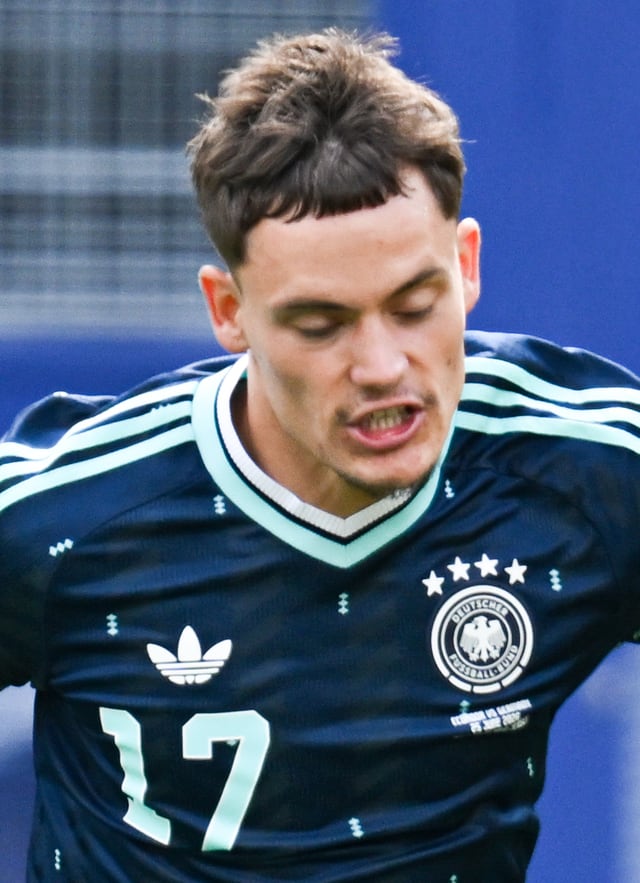
Summary
Florian Wirtz receives on the half-turn, draws the first defender and releases the next pass early enough to keep an attack moving rather than merely decorate it.
Quick facts
- Position
- Attacking midfielder / left-sided creator
- Current club
- Liverpool, number 7 (checked September 30, 2026)
- Date of birth
- May 3, 2003
- Leverkusen record
- 197 matches, 57 goals and 64 assists
- 2023/24 season
- 18 goals, 20 assists and an unbeaten Bundesliga-DFB Pokal double
- Liverpool 2025/26
- 51 appearances, seven goals and eight assists
- World Cup 2026
- Four appearances and three assists; Germany exited in the round of 32
The turn matters because the ball keeps moving
Florian Wirtz receives with a midfielder behind him. The first touch rolls away from pressure, the shoulders rotate and the next pass leaves before the defender can recover. Nothing in the sequence needs a long sprint. One opponent has been removed and the attack has kept its speed.
That is the practical value of Wirtz’s technique. He can dribble, shoot and produce highlight passes, but his best work is often a small turn that changes which side of the defence has to react.
Bayer Leverkusen built an unbeaten championship team around those connections. Liverpool bought him to find the same pockets in a faster, more physical league. Germany gave him creative responsibility at World Cup 2026 and received three assists, yet still went home in the first knockout round.
The career already contains records, a serious knee injury, a historic double and a major transfer. The football underneath is quieter: look before receiving, escape on the first touch and decide before the space closes again.
The route began near Cologne
Wirtz was born on 3 May 2003 in Pulheim, near Cologne. He played for SV Grün-Weiss Brauweiler before spending a decade in 1. FC Köln’s youth system.
Leverkusen signed him in January 2020, when he was sixteen. Moving between local rivals attracted attention, but the sporting logic was clear. Bayer had a visible path into a senior side willing to use young technical players.
He made his Bundesliga debut in May, two weeks after turning seventeen. In June he scored against Bayern Munich and became the youngest Bundesliga goalscorer at that time.
Age records move when another prospect arrives. Their real significance is the trust required to create them. Wirtz was not introduced only as a late runner on the wing. Leverkusen allowed him to receive in central attacking spaces, where losing the ball could expose the team and choosing the wrong pass could end a promising move.
His technique had to be joined by speed of thought. Senior defenders did not give him the pause available in youth matches.
Early Leverkusen football established the role
Wirtz settled as an attacking midfielder who could move left, combine centrally and arrive near the penalty area. The number ten label was useful, but he did not stand in one fixed pocket waiting for service.
He would drop beside a midfielder to help the ball advance, then accelerate into the space opened by the forward line. If a defender followed, Wirtz could play around the pressure with a short pass. If the defender held position, he could turn and carry.
Liverpool’s later factfile records 69 appearances across his first two Leverkusen seasons. By eighteen, he was no longer being protected as a novelty. He was part of the regular structure and had earned senior Germany selection.
The rise created an obvious projection toward the 2022 World Cup. Then one challenge changed the calendar.
The ACL injury removed 272 days
Wirtz tore the anterior cruciate ligament in his left knee against Köln on 13 March 2022. Leverkusen’s medical update ruled him out for several months; the club’s German match report records his return against Rangers on 10 December after 272 days away.
The injury cost him any chance of playing at World Cup 2022. It also interrupted a stage when a young creator usually builds match rhythm through repetition.
Rehabilitation is sometimes folded into a clean comeback story: injury, hard work, return, success. The football consequences are less tidy. Wirtz had to trust the knee when changing direction, rebuild the conditioning needed to press and relearn the timing of teammates who had continued playing without him.
He returned to competitive Bundesliga action in January 2023. Leverkusen were now coached by Xabi Alonso, whose positional game gave Wirtz clear relationships around the ball rather than asking him to create from isolation.
The lost year did not disappear. It became part of the player who led the next one.
Alonso gave every movement a nearby option
Leverkusen’s 2023/24 side stretched opponents with wing-backs and placed several technical players inside. Granit Xhaka could start attacks from deeper midfield. Álex Grimaldo and Jeremie Frimpong supplied width and runs. The forwards occupied centre-backs while Wirtz moved between those references.
The structure suited him because a turn always had somewhere to go. He could release Frimpong outside, combine with a central forward or carry toward the box while Xhaka protected the next phase.
Wirtz did not become a passenger inside a clever system. He gave it the action that converted spacing into penetration. When an opponent stepped toward him, the pass went into the space the defender had left. When the opponent stayed compact, he could dribble across the line and force another decision.
Leverkusen also pressed aggressively after losing the ball. Wirtz’s running helped keep attacks alive, although the deeper midfielders and defenders carried much of the recovery security.
The team kept finding late answers because its creators remained willing to repeat the pattern after earlier moves had failed.
Eighteen goals, twenty assists and the first title
Wirtz finished 2023/24 with 18 goals and 20 assists across all competitions, the highest involvement total in the Leverkusen squad. In the Bundesliga alone, he recorded 11 goals and 11 assists in 32 appearances.
The title-clinching match gave the season a theatrical ending. Wirtz came off the bench against Werder Bremen and scored a hat-trick in a 5-0 win, confirming the first German championship in Leverkusen’s history.
The club then completed all 34 league matches without defeat, the first unbeaten season in Bundesliga history. A DFB Pokal win added the domestic double. The only competitive loss of the campaign came against Atalanta in the Europa League final.
That loss belongs in the record because “invincible season” can be stretched too far. Leverkusen were invincible in the league, not across every competition. The achievement remains extraordinary without improving it through loose wording.
The Bundesliga named Wirtz its Player of the Season. Leverkusen supporters chose him too. The awards matched the work: scoring, creation and central responsibility inside the best season the club had produced.
One more Leverkusen year proved it was not a single spring
Wirtz stayed for 2024/25. Leverkusen did not repeat the unbeaten title, but he delivered 16 goals and 15 assists across the season.
Germany’s football journalists later voted him Footballer of the Year for 2025. The honour also recognised what followed the championship: he carried elite production into another campaign while transfer attention followed every month.
His final Leverkusen totals were 197 appearances, 57 goals and 64 assists. He left with the Bundesliga, DFB Pokal and German Supercup.
Those totals set a demanding reference for the next club. Liverpool were not buying only potential. They were buying a twenty-two-year-old who had already been the central creator of a championship team.
That difference made the first English season easier to judge harshly.
Liverpool changed the speed and the reference points
Liverpool completed the transfer in June 2025 and announced a long-term contract. Wirtz took number 7 and joined a squad that had just won the Premier League.
The Premier League offered less time on his first touch, but the deeper adjustment concerned relationships. At Leverkusen, years of work had taught teammates where his turn would lead. At Liverpool, he had to learn the runs, pressing cues and preferred passing feet around him while opponents treated him as a major signing from the first week.
He could begin as the central attacking midfielder, drift left or drop closer to buildup. Each role changed who held the width and who attacked the penalty area after he received.
Liverpool’s official player data gives him 51 appearances, seven goals and eight assists in 2025/26, checked on 30 September 2026. Fifteen direct goal contributions is not a failed first season. It is below his final Leverkusen level and leaves room to ask how often Liverpool placed him in the locations where he is most decisive.
The numbers also need their all-competition scope stated. They are not a Premier League-only line.
The second Liverpool season begins with another coach
Andoni Iraola replaced Arne Slot before 2026/27. In Liverpool’s August interview, Wirtz described the summer as a new start and acknowledged that the team had things to improve.
A coaching change can help a creator and unsettle him at the same time. A different pressing model may place Wirtz nearer the opponent’s goal after turnovers. New buildup rules may also ask him to receive in unfamiliar zones.
The useful question is whether Iraola can make the relationships clear. Wirtz does not need complete freedom. He needs nearby runners whose movements make his quick decisions valuable.
If the left-back overlaps, he can move inside. If the left winger stays wide, he can arrive as a central number ten. If the striker drops, Wirtz can run beyond. A vague instruction to “find space” would waste the detail that made Leverkusen work.
Liverpool’s current squad still lists him as number 7 on 30 September 2026. The early months of a new competitive season offer a limited basis for a verdict on that reset.
Scanning gives the first touch its purpose
Wirtz looks over his shoulders before the ball arrives. The scan tells him where the nearest pressure is coming from, but it also identifies the second action: a teammate outside, a central run or the empty lane he can carry into.
Without that picture, a half-turn is only technique. With it, the touch becomes a pass around the first defender.
He often receives on the back foot, allowing the ball to travel across his body. That opens the field and reduces the number of touches needed to face goal. If the defender closes the expected side, Wirtz can roll away through the other.
The risk appears when he trusts the picture for too long. Spaces change while the pass travels. A defender who was two metres away can arrive, especially in England, and a clever turn becomes a central turnover.
His adjustment is not to stop receiving under pressure. It is to refresh the picture and accept the simple return pass when the original route has closed.
The dribble serves the pass
Wirtz is comfortable carrying the ball, but his dribbling differs from Jamal Musiala’s tight-space game. Musiala may keep the ball through several small changes until a defender loses balance. Wirtz more often uses one change of direction to open the next pass.
That makes their Germany partnership useful rather than redundant. Musiala can destabilise a packed area through close control. Wirtz can move across the next line and release the runner created by that disruption.
The difference is not absolute. Wirtz can beat several players, and Musiala can combine quickly. It describes their most repeatable route through a defence.
Wirtz’s final pass is strongest when the attack is still moving. He can slide the ball between full-back and centre-back or return it into a runner’s path without forcing the teammate to slow down.
The assist belongs to the last touch. The creative action may have started with the turn several seconds earlier.
Goals arrive through timing, not a striker’s volume
Wirtz can score from distance, but he is most valuable when he arrives after the defence has reacted to another player.
He moves toward the edge of the box, pauses while the first line drops and then enters the finishing space for a cutback or second ball. The delay prevents a midfielder from tracking him all the way without giving up ground elsewhere.
His hat-trick in the title-clinching Bremen match showed several kinds of finish, including a strike from outside the area. The EURO 2024 opener against Scotland showed a simpler version: Joshua Kimmich’s cutback reached him near the edge of the box, and a first-time shot found the bottom corner.
He was 21 years and 42 days, then Germany’s youngest EURO scorer. Against Spain in the quarter-final, he came off the bench and scored an 89th-minute equaliser before Germany lost in extra time.
Two tournament goals did not make him a forward. They showed that a creator can arrive as the spare attacker when the move is built properly.
Germany’s creative pair carried larger expectations
Wirtz made his senior Germany debut in 2021. The ACL injury removed World Cup 2022, so EURO 2024 became his first senior finals.
By the next cycle, he and Musiala were treated as the centre of Germany’s attacking future. The label “Wusiala” made the partnership marketable, but the tactical question remained serious: how do two players who both want inside spaces receive without bringing extra defenders toward each other?
Julian Nagelsmann often placed them on different sides behind the striker, with licence to rotate. One could receive while the other attacked the space created by the first movement.
Before World Cup 2026, Wirtz produced two goals and two assists in a 4-3 friendly win over Switzerland. The performance gave Germany a clear example of how his scoring and passing could carry the same attack.
The tournament gave him creation. It did not give Germany the run expected of it.
Three World Cup assists ended in the round of 32
Germany opened World Cup 2026 with a 7-1 win over Curaçao, then beat Ivory Coast before losing to Ecuador. Wirtz started as one of the team’s advanced creators.
He finished the tournament with three assists across four appearances, tying a group of the leading providers behind the very top of FIFA’s final assist table. He also took ten shots and did not score.
The knockout match against Paraguay ended 1-1 after extra time. Germany lost the penalty shootout 4-3 and went out in the round of 32.
Wirtz was part of the starting attacking line. Three assists are useful individual evidence; elimination in the first knockout round is the team evidence that limits his final ranking.
That is why he sits seventh in our young World Cup 2026 players ranking. The order values what happened at the tournament. It does not erase the Leverkusen title season or decide whether he will have the better club career than players placed above him.
The next step is influence when the first route closes
Opponents know where Wirtz wants to receive. A holding midfielder can stay close, the full-back can narrow the inside channel and the centre-back can resist stepping out. The first half-turn may not be available.
His next development is not a new trick. It is maintaining influence when the preferred picture has been removed.
He can drop deeper to help Liverpool escape pressure, then move forward before the defence resets. He can draw a marker away and let another midfielder use the pocket. He can press the turnover that gives him a better attacking position than a slow buildup would have provided.
The first Liverpool season supplied a base: 51 matches, seven goals and eight assists. The second begins with a different coach and no need to recreate Leverkusen action for action.
Wirtz’s best football has never depended on holding the ball longest. It depends on seeing the next action early. Liverpool now need to make that early picture clear often enough for the turn to matter.
Sources
Sources checked
- Liverpool FC - Florian Wirtz first-team profile
- Liverpool FC - Wirtz 2025/26 all-competition statistics
- Liverpool FC - Wirtz completes his transfer
- Liverpool FC - Wirtz factfile and Leverkusen totals
- Liverpool FC - Wirtz begins second season under Andoni Iraola
- Bayer Leverkusen - Wirtz completes Liverpool move
- Bayer Leverkusen - 2023/24 Player of the Season numbers
- Bayer Leverkusen - Wirtz ACL injury
- Bayer Leverkusen - December 2022 comeback after 272 days
- DFB - Wirtz wins Germany's 2025 Footballer of the Year award
- DFB - Wirtz's two goals and two assists against Switzerland
- UEFA - Wirtz scores in Germany's EURO 2024 opener
- FIFA - World Cup 2026 assist leaders
- FIFA - final World Cup 2026 player attacking statistics
- DFB - Germany eliminated by Paraguay
FAQ
Which club does Florian Wirtz play for?
Wirtz plays for Liverpool and wears number 7. He joined from Bayer Leverkusen in June 2025 on a long-term contract and entered his second season under head coach Andoni Iraola.
What position does Florian Wirtz play?
He is an attacking midfielder who can play as a number ten, a left-sided creator or an advanced central midfielder. His best work usually comes between the opposition's midfield and defence.
How did Florian Wirtz perform in his first Liverpool season?
Liverpool's official all-competition player data lists 51 appearances, seven goals and eight assists in 2025/26, checked September 30, 2026. The season established him in the team without matching his most productive Leverkusen campaign.
What did Florian Wirtz win with Bayer Leverkusen?
He won the Bundesliga and DFB Pokal in 2023/24, when Leverkusen completed the first unbeaten league season in Bundesliga history, and added the 2024 German Supercup.
How did Florian Wirtz perform at World Cup 2026?
Wirtz supplied three assists across four appearances, placing him among the tournament's leading creators. He did not score, and Germany lost to Paraguay on penalties in the round of 32.
What makes Florian Wirtz effective?
He scans before receiving, turns away from the first marker and combines quickly. His dribbling is valuable because it opens a pass or shot without slowing the whole possession.