
player
Jamal Musiala: Close Control in Crowded Spaces
Jamal Musiala's career from English academies to Bayern and Germany, with a detailed look at his dribbling, close control and attacking role.
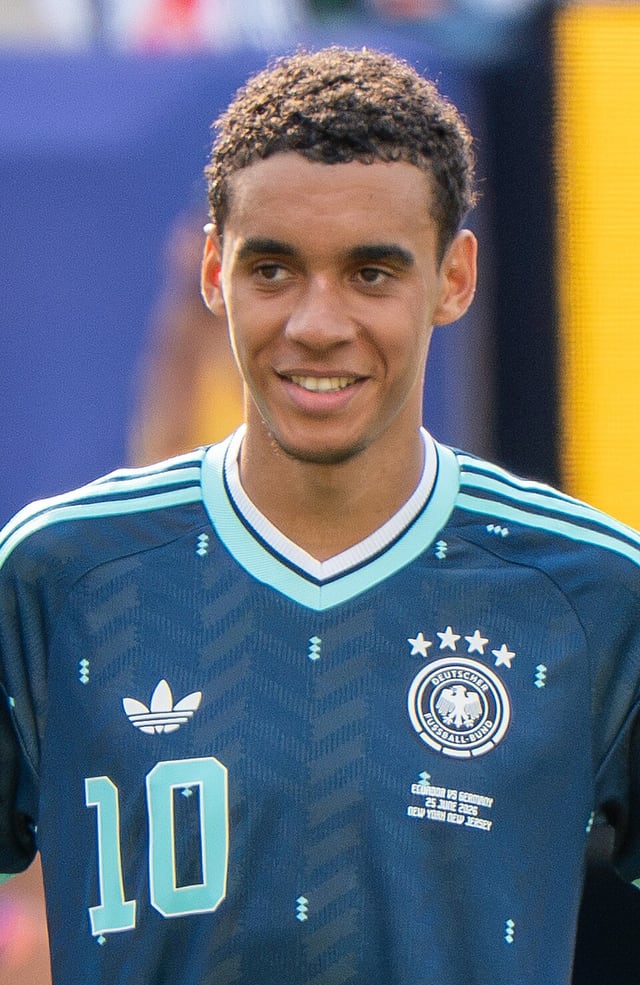
Summary
Musiala's defining skill is not dribbling for decoration. He uses body position, balance and tiny touches to remove the first defender, then attacks the passing or shooting lane that appears behind the challenge.
Quick facts
- Primary role
- Attacking midfielder / left-sided creator
- Current club
- Bayern Munich, number 10 (checked 23 September 2026)
- Contract
- Through 30 June 2030
- Germany record
- 46 senior appearances and 10 goals through June 29, 2026
- Profile
- Tight-space dribbler who changes a defensive shape with close control
The current answer
Jamal Musiala is Bayern Munich’s number 10 and a Germany international. Bayern’s official profile lists him as a midfielder under contract through June 30, 2030. The DFB records 46 senior Germany appearances and 10 goals through June 29, 2026.
The positional label needs explanation. Musiala can begin as a number ten, a left-sided attacker or an advanced midfielder. His most dangerous location is usually the same: between the opposition’s midfield and defence, close enough to goal for one eliminated defender to change the whole attack.
He is often described as a dribbler. That is accurate, but incomplete. The dribble is not the endpoint. Musiala uses close control to create a pass, a shot or a new angle for the next teammate. His value lies in changing the defensive picture before the final action, while Germany teammate Florian Wirtz more often uses one turn to release the next pass quickly.
That makes this profile different from the Bellingham vs Musiala comparison. The comparison asks which player solves a particular team problem. This page asks how Musiala’s own solution works.
Stuttgart, England and the return to Germany
Musiala was born in Stuttgart on February 26, 2003. He spent much of his childhood in England, where his football education included time with Southampton and Chelsea.
That background gave him more than a tidy dual-nationality story. English academy football exposed him to quick physical pressure, while his technical game depended on keeping the ball in precisely those crowded situations. He learned to receive without needing the pitch to become quiet first.
Bayern brought him from Chelsea’s academy in 2019. He was still 16, but the route to senior football moved quickly. Bayern’s profile records that he became the club’s youngest Bundesliga debutant and then its youngest scorer in both the Bundesliga and Champions League at the time of those milestones.
Age records attract attention because they are easy to understand. Their deeper value is opportunity under pressure. A teenage player can enter a senior match; becoming trusted in central attacking spaces requires coaches to believe he will protect the ball and make useful decisions against experienced opponents.
Musiala did not arrive as a physically finished midfielder. His early advantage was the ability to make pressure miss.
How Musiala receives the ball
The first part of the dribble happens before the touch. Musiala checks the space around him, approaches the pass at an angle and tries to receive with more than one exit available.
If he stands square to the ball, a defender can close from behind and lock him into a return pass. If he receives half-turned, he can see the defender and the forward lane. That body position makes the first touch an attacking decision.
Musiala often lets the opponent come close. The choice can look risky because the ball remains within tackling distance. It is also what creates the opportunity. A defender who never commits does not leave a gap; a defender who steps toward the ball has shifted weight and exposed one side.
The next touch is usually small. Musiala does not always knock the ball several metres and race after it. He moves it just beyond the challenging foot, then uses his body to travel through the space that has opened.
That is why clips of his dribbling can look as if opponents have moved the wrong way. He has often waited until their balance made one direction difficult, then chosen the other.
Balance, hips and close touches
Musiala’s balance is central to the skill. He can lean away from the ball, invite contact and still keep his next step close enough to continue the move.
The hips give defenders false information. A body shape that suggests a pass outside can become an inside carry. A touch toward the centre can be followed by a quick escape back to the flank. The ball stays close enough that the change does not require a full reset.
Long-legged dribblers sometimes need open grass to extend their stride. Musiala can shorten his steps and operate in a small square of the pitch. That makes him especially useful against deep blocks, where the important space may be the distance between two defenders rather than the area behind the back line.
The technique is not invulnerable. Carrying into traffic increases the chance of losing possession, and a second defender can arrive after the first challenge. The best Musiala actions include an exit plan: a pass, a shot or a continuation into genuinely open space.
The distinction matters. Beating one player is visually impressive. Beating one player and forcing the entire defence to rotate is tactically valuable.
Number ten, winger or midfielder
Musiala’s role changes with Bayern’s shape. As a number ten, he can move across the space behind a striker and receive between central lines. From the left, he can drift inward while a full-back provides width. As an advanced midfielder, he starts deeper and carries into the attacking line.
None of those labels fully contains him. The useful question is where the possession becomes dangerous.
When Musiala receives too close to the touchline, the boundary limits one escape route. When he receives too deep, beating the first marker may still leave several defensive lines ahead. His highest-value touches usually come in an inside channel where a single dribble can open the box.
Bayern can help create that location by positioning teammates wide and high. A winger pins the full-back. A striker occupies the centre-backs. A deeper midfielder offers the safe return pass. Musiala then receives in the pocket those responsibilities leave between opponents.
His talent makes the pocket useful, but the structure helps make it available. The Bayern Munich profile gives the wider club context: elite attacking players are asked to solve tight domestic matches in which opponents often defend close to their own area.
The decision after the dribble
Close control gets Musiala past the first problem. The next decision determines whether the attack improves.
He can continue toward goal, combine with a striker, release an overlapping runner or shoot before the defence closes again. The correct answer depends on how much the first dribble has changed the shape.
If two defenders collapse, the pass is often the valuable action. If the centre-back holds position, Musiala may have room to carry into the box. If the goalkeeper’s view is blocked, an early shot can be better than another attempt to beat a man.
This is also the main area in which young creators develop. The ability to enter difficult spaces can tempt a player to keep solving problems individually. Elite attacking midfield play requires knowing when the dribble has already done enough.
Musiala’s scoring record shows that he is more than a carrier. The DFB data centre lists 49 goals in 157 Bundesliga appearances through September 18, 2026. That league scope should stay separate from Bayern cup and European matches, but it shows a player regularly converting his movement into goals.
Choosing Germany
Musiala represented both England and Germany in youth football. Bayern’s profile says he chose the Germany senior team in February 2021 and soon became the youngest German player to appear at a major tournament, aged 18 years and 117 days at EURO 2020.
The choice made his development part of two football cultures without requiring a simple label. He learned much of the game in England, returned to a German club as a teenager and built his senior international career with Germany.
For the national team, his club strengths remain useful but the relationships change. International sides have less training time, so a player who can create an advantage without a long rehearsed pattern has special value. Musiala can receive between lines and make the first defender irrelevant even when the surrounding combinations are less familiar.
The trade-off is the same. Germany need the dribble to end in a productive team action, particularly against opponents willing to defend narrow and wait for transitions.
World Cup 2026
The DFB match report records Musiala scoring in Germany’s 7-1 group-stage win over Curaçao. Deniz Undav supplied three goals and two assists across the opening two games, giving Germany a different kind of threat from the bench. Germany won its group but then drew 1-1 with Paraguay in the round of 32 and lost the penalty shootout 4-3.
The early exit limits any claim about a great tournament run. One goal and visible dribbling quality belong in the record; they do not outweigh the completed evidence of players who reached the last weekend.
That is why Musiala sits sixth in our young-player ranking for World Cup 2026. The position recognises the talent and the moments he produced while respecting Germany’s result.
The distinction is useful beyond one tournament. Player quality and tournament achievement are related, not identical. A knockout exit can close an award case without erasing the skills that made the player dangerous.
Musiala and Bellingham are different problems
Musiala and Jude Bellingham share age, status and attacking-midfield territory, which makes the comparison natural. Their methods are different.
Bellingham gives a midfield more power, duels, range and late box arrivals. Musiala gives an attack a specialist at escaping the first challenge in a crowded area. One can strengthen the platform; the other can break the lock.
The full Bellingham vs Musiala page examines team fit, creation and World Cup relevance directly. Musiala’s independent case does not require winning every category. It rests on a rare capacity to make space appear where the defence believed it had disappeared.
How to evaluate Musiala
Dribble counts are a starting point, not a conclusion. A useful evaluation asks where the carry began, how many defenders it moved and what happened next.
A dribble near halfway may help Bayern escape pressure. A dribble between the lines may create a shot. A dribble into three defenders without an exit may only delay the turnover. The same technical action can have very different value.
Musiala is at his best when close control serves the attack’s next step. He receives on an angle, draws pressure, moves across the challenge and releases the ball before the new space closes.
That sequence explains the player more clearly than the word flair. Flair describes how the action feels. Musiala’s craft lies in why the defender could not stop it.
Sources
Sources checked
- DFB - Germany score seven in their World Cup opener
- DFB - Germany eliminated by Paraguay
- FC Bayern - Jamal Musiala player profile
- FC Bayern - current first-team squad
- DFB - Jamal Musiala player record
- DFB - Germany senior player table
- FIFA - Germany 1-1 Paraguay World Cup report
- FIFA - Germany 7-1 Curacao World Cup report
FAQ
What position does Jamal Musiala play?
Musiala is an attacking midfielder who can play as a number ten, from the left or as an advanced central midfielder. His starting position changes, but his best work usually comes between the opposition's midfield and defensive lines.
Which club does Jamal Musiala play for?
Bayern Munich's official profile lists Musiala as the club's number 10 with a contract through June 30, 2030. The profile was checked on September 23, 2026.
How many goals has Jamal Musiala scored for Germany?
The DFB records 10 goals in 46 senior Germany appearances through June 29, 2026. That total is separate from his Bayern record.
Did Jamal Musiala play for England at youth level?
Yes. Musiala represented both England and Germany in youth football after growing up largely in England. In 2021 he chose to represent Germany at senior level.
What makes Jamal Musiala's dribbling different?
He can keep the ball close while changing his hips, stride and direction in a very small area. That lets him draw a challenge, move across it and turn a crowded position into a passing or shooting lane.