
player
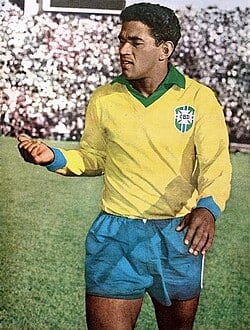
Garrincha: The Right Winger Who Made Brazil Unplayable
Garrincha's Botafogo career, 1958 and 1962 World Cup legacy, right-wing playing style and case as the greatest winger of all time.
Summary
Garrincha made the right wing feel like its own match: receive, isolate the full-back, beat him, then make him face the same problem again.
Quick facts
- Primary role
- Right winger
- Defining club
- Botafogo, 1953–1965
- National team
- Brazil
- World Cup titles
- 1958 and 1962
- Ranking case
- Pure one-v-one threat and decisive tournament impact
Botafogo and the making of a right-wing icon
Garrincha’s defining club chapter belongs to Botafogo. The club’s own historical profile places him there from 1953 to 1965 and describes a right winger built around bewildering dribbles. Botafogo counts 612 appearances and 245 goals across that broad club record, but the numbers are context rather than the centre of his case. His reputation came from what happened before the final pass or shot: the defender knew where he wanted to go and still could not stop him.
The honours give that style a competitive frame. Garrincha won the Campeonato Carioca in 1957, 1961 and 1962, plus the Rio–São Paulo tournament in 1962 and 1964. Those teams also connect him to a wider Botafogo generation that supplied major figures to Brazil. His club legacy is therefore not a detached highlight reel. It sits inside one of the strongest concentrations of Brazilian talent of the era.
The 1962 World Cup became his tournament
Garrincha was already a world champion from 1958, when his arrival in the starting side helped give Brazil a more dangerous right flank. The heavier individual argument comes from Chile four years later. Pelé was injured during the group stage, removing the player expected to carry the attack. Garrincha did not imitate him. He made a different route to the title possible.
The CBF account of the 1962 campaign records two Garrincha goals against England in the quarter-final and two more against host nation Chile in the semi-final. Brazil then beat Czechoslovakia in the final to retain the World Cup. That sequence is why his place in the greatest World Cup players discussion rests on more than winning medals: he became the tournament’s decisive attacking figure when the original plan changed.
Playing style: repetition without predictability
The basic picture was simple. Garrincha started high and wide on the right, encouraged the full-back to step toward him, then attacked the defender’s balance. The magic was that repetition did not make the move easy to read. A pause, body lean or extra touch changed the timing, and a second defender often arrived only after the first had been beaten.
That is a purer winger profile than the modern wide forward who begins outside but measures success mainly through central scoring. Garrincha could finish, as 1962 proved, yet his first tactical value was distortion. He pulled the defensive shape toward one touchline and created room elsewhere. Film still communicates this better than a tidy total can.
Why Garrincha leads our winger ranking
Our best football wingers of all time ranking places Garrincha first because the category fits him without qualification. Cristiano Ronaldo later evolved into a central scorer; Ronaldinho often became a playmaker between the lines. Garrincha’s greatest work remained recognisably winger work.
The ranking case combines role clarity, one-v-one dominance and the highest tournament pressure. He did not merely decorate Brazil’s 1962 title. He supplied the attacking solution that kept the champions moving after losing Pelé. That combination makes him a useful benchmark whenever the argument asks what a winger, specifically, can do to an entire match.
Sources
Sources checked
FAQ
What position did Garrincha play?
He was a right winger whose game centred on receiving wide, isolating the full-back and creating after the dribble.
Why was Garrincha so important at the 1962 World Cup?
After Pelé was injured, Garrincha became Brazil's main attacking reference and scored twice in both the quarter-final and semi-final.
Why is there no exact Brazil cap total on this page?
Official Brazilian sources use different counting conventions, so the profile avoids presenting a disputed total as settled fact.