
player
Pele: Three World Cups and the Complete Attacking Case
Pele's career through Santos, Brazil and three World Cup-winning squads, with the attacking skills, tournament evidence and context behind his legacy.
Summary
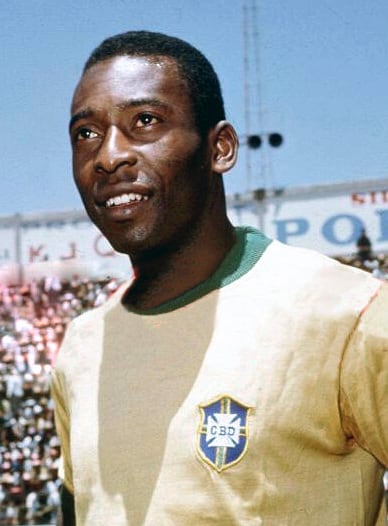
Pelé's case is strongest when the medals, footage and attacking role are read together. He could finish moves, create them and change his function as the team around him changed.
Quick facts
- Primary role
- Forward / attacking playmaker
- Main club
- Santos
- National team
- Brazil
- World Cup titles
- 1958, 1962 and 1970
- World Cup record
- Youngest goalscorer, at 17 years and 239 days
- Career-goal totals
- Vary by competitive, friendly and touring-match scope
The short answer
Pelé was not great because one disputed goal total became famous. His case comes from a much wider body of evidence: a long Santos career, three World Cup-winning squads and an attacking game that could supply both the finish and the pass before it.
He was a forward, but not a narrow penalty-area specialist. Pelé could receive between midfield and defence, combine at speed, attack crosses, shoot with either foot and time runs beyond the last line. That range allowed him to emerge as a teenage scorer in 1958 and return in 1970 as the mature reference point of a more fluid attack.
Our best football players of all time ranking weighs that complete record against other eras. This profile has a different purpose: to explain the player before entering the argument about where he belongs.
Santos built the complete forward
Santos brought Pelé into the senior game in 1956. The club’s historical account says he signed his first contract at 15 years and eight months, initially working as an advanced midfielder, and scored his first senior goal in September of that year. That early description matters because it points to the creative side of his game before the global scoring legend took over.
At Santos, Pelé learned to move between functions rather than wait in one zone. He could come toward the ball to connect midfield, turn as a creator and then arrive in the box to finish the move. A defender following him risked opening space behind; a defender holding position gave him room to receive and face goal.
The club became a major domestic and international force, winning the Copa Libertadores in 1962 and 1963 and travelling widely for high-profile matches. Those tours helped make Pelé a global figure, but they also created the record-keeping problem that follows his career. Santos played many friendlies and exhibitions alongside official competitions, and broad all-match totals count events that a modern league-stat table normally would not.
That does not make the goals imaginary. It means the label has to match the count. A competitive total, a Santos all-match total and a combined senior total answer different questions. This page therefore avoids presenting one number as if every historian uses the same boundary.
How Pelé attacked
The simplest description is a complete central attacker. Pelé could finish early with either foot, generate power without a long backswing and score in the air despite not being built like a traditional target forward. His jump, timing and body control made heading a genuine weapon rather than an occasional surprise.
He was also comfortable before the final action. When he dropped into space, he could play a first-time combination or turn and carry at the defence. Around the box, he disguised passes with the same body shape used for a shot. Teammates could run beyond him because he saw the movement and had the technique to release the ball without resetting his feet.
That mixture makes a strict positional label difficult. Pelé belongs in the historical discussion of the greatest strikers, but his game also contained the work now associated with a number ten or second forward. He was at his most difficult to contain when those roles blended within the same attack.
1958: the teenage breakthrough
Pelé arrived at the 1958 World Cup carrying an injury and did not play Brazil’s first two matches. His first tournament goal came against Wales in the quarter-final. FIFA records him at 17 years and 239 days, still the youngest scorer in men’s World Cup history.
The goal was more than a record. Pelé controlled the ball in a crowded central area, moved around the defender and finished the only goal of a tight knockout match. He then scored a hat-trick against France in the semi-final and twice against Sweden in the final, ending the tournament with six goals.
Brazil had senior creators, Nílton Santos controlling the left side and a devastating right winger in Garrincha, so the teenager did not need to organise every possession. His task was to connect quickly and turn attacks into goals. He did it under knockout pressure before most players his age had established a club career.
1962: a winner with an important qualification
Pelé began the 1962 World Cup by scoring and creating against Mexico. In Brazil’s second group match, against Czechoslovakia, he tore a thigh muscle and took no further part in the tournament. Substitutions were not available, so he stayed on the field but watched the rest of Brazil’s title defence from the side.
He was therefore a member of the winning squad and contributed before the injury, but he did not lead the knockout rounds. Garrincha became the decisive attacking figure as Brazil retained the trophy. Keeping that distinction clear strengthens the historical record: Pelé’s three winner’s medals are real, while the footballing weight of each campaign is not identical.
1970: scorer, connector and creator
By 1970, Pelé’s role had changed. He remained a goal threat and scored Brazil’s opening goal in the 4-1 final win over Italy, rising at the back post to head in Rivelino’s cross. Yet the tournament also showed how fully his game could serve other scorers.
FIFA’s assist record credits Pelé with six assists in Mexico, the highest total recorded for one men’s World Cup. The last one became the clearest image of his patience. In the final move, he received Jairzinho’s pass, waited for captain Carlos Alberto to arrive from the right and rolled the ball into his path for Brazil’s fourth goal.
The pause was the action. Pelé did not force a shot or play the pass too early. He held the defence for the moment required to open the lane. That decision captures the mature version of the player: still able to score, but just as capable of controlling where the decisive space would appear.
This is why his place among the greatest World Cup players cannot be reduced to three medals. The stronger case distinguishes the teenage finisher of 1958, the injury-limited champion of 1962 and the central creator of 1970.
Evidence across eras
Cross-era analysis always has limits. Pelé played on different pitches, under different disciplinary standards and in competitions with record conventions that do not map neatly onto modern databases. Surviving footage is extensive for the World Cups but less complete for an entire Santos season.
The answer is not to ignore the evidence or pretend it is perfectly uniform. Tournament film shows his acceleration, balance, heading, passing and off-ball movement against elite international opponents. Club honours establish sustained team success. Contemporary records establish the unusual scale of Santos’ schedule, provided friendly and competitive matches are not silently mixed.
Those sources are more useful together than one oversized number. They show an attacker whose technique travelled across match types and whose role changed without removing his influence.
Cosmos and global influence
Pelé ended his Santos career in the mid-1970s and joined the New York Cosmos in 1975. The move did not represent his competitive peak. It extended his public influence and gave the North American Soccer League a level of attention it had never previously held.
That late chapter belongs in the career story, but it should not carry the all-time argument. The prime evidence comes from Santos and Brazil. The Cosmos years show what his name meant after the central footballing work had already been done.
The Pelé vs Maradona comparison addresses the separate question of how Pelé’s record stands against another era-defining number ten. Here, the conclusion is narrower: Pelé combined scorer, creator and forward-line organiser at a level that survived changes of age, teammates and tactical responsibility.
Sources
Sources checked
- Santos FC - Pelé's early years and club legacy
- FIFA - Pelé memorial and World Cup career
- FIFA - Pelé's first World Cup goal against Wales
- FIFA - Pelé and the 1958, 1962 and 1970 titles
- FIFA - Pelé led the 1970 World Cup for assists
- FIFA - Carlos Alberto's goal in the 1970 final
- Santos FC - Pelé's Santos farewell and Cosmos chapter
FAQ
How many World Cups did Pele win?
Pelé was part of Brazil's winning squads in 1958, 1962 and 1970, making him the only player to win three men's World Cups. His role differed across the three tournaments because injury ended his 1962 campaign after two matches.
What position did Pele play?
Pelé played across the forward line and as an attacking playmaker. He could operate close to goal, drop between the lines to create or combine with another central forward.
How many goals did Pele score?
There is no single total that every record keeper uses. Some counts include Santos friendlies, international tours and other non-competitive matches, while others count official competitions only. Any Pelé goal figure needs its scope stated beside it.
Why is Pele considered one of the greatest footballers?
The case combines elite scoring and creation, a long Santos peak, decisive World Cup performances and the ability to remain central to Brazil in different attacking roles from 1958 to 1970.