
player
Mikel Oyarzabal: Real Sociedad Captain and Spain Finisher
Mikel Oyarzabal's Real Sociedad and Spain career, from two final-winning goals to his movement, versatility and five-goal World Cup 2026.
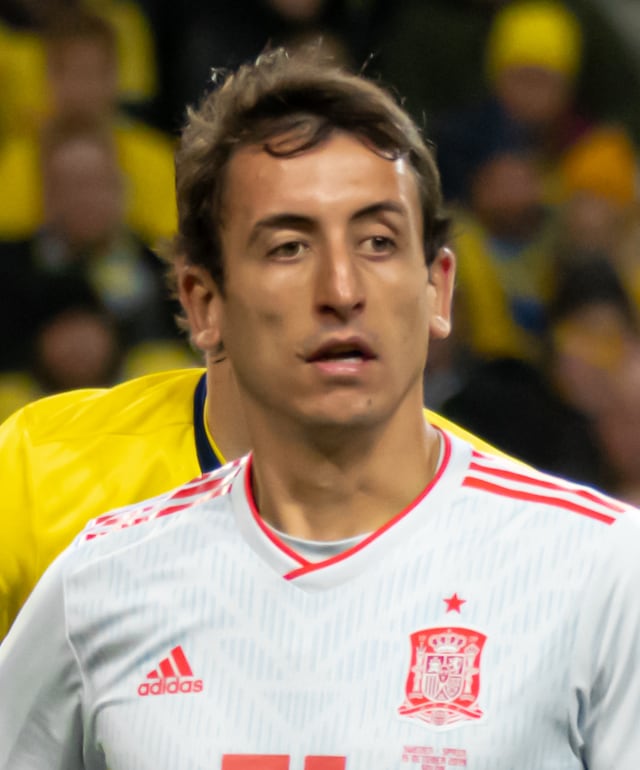
Summary
Oyarzabal makes his best chances by moving after a defender has committed elsewhere. He can start wide or central, but his timing around the box and calm in finals explain his value better than a fixed position.
Quick facts
- Primary role
- Forward / left-sided attacker
- Current club
- Real Sociedad, captain and number 10 (checked September 30, 2026)
- Date of birth
- April 21, 1997
- Birthplace
- Eibar, Spain
- Real Sociedad milestone
- 400 first-team appearances reached in August 2025
- Spain record
- 63 senior appearances and 31 goals (checked September 30, 2026)
- World Cup 2026
- Champion; five goals, including two braces
- Defining finals
- Scored the 2020 Copa del Rey final winner and EURO 2024 final winner
He moves when the defender looks away
Mikel Oyarzabal rarely needs a spectacular route into the penalty area. One step away from a centre-back, a pause near the far post or a late run across the front of a marker can be enough.
The important action often happens before the pass. A defender watches the ball, checks the striker and assumes the space behind him is safe. Oyarzabal enters it during that short gap in attention. By the time the cross arrives, he is no longer where the defensive line last placed him.
That habit connects the different versions of his career. He has played on the left, behind a striker and through the middle. The starting position changes. The aim does not: arrive where the finish is available, without advertising the run too early.
Current profile
Oyarzabal remains Real Sociedad’s captain and number 10 as of September 30, 2026. The club lists him at 1.81 metres and describes a mature left-footer who links play, arrives and finishes. He turned 29 in April.
His international status changed during the summer. Spain won World Cup 2026, and Oyarzabal scored five times. After the September internationals, the RFEF’s record lists 31 goals in 63 senior appearances, checked on September 30, 2026.
Those totals need a date because he is active for club and country. His role also needs context. Calling him a left winger captures many team sheets but misses the central spaces he attacks. Calling him a number nine captures Spain’s recent use but misses the combinations and defensive work that begin outside the box.
He is a forward whose position bends around the other attackers.
Eibar, Zubieta and one senior club
Oyarzabal was born in Eibar on April 21, 1997. He joined Real Sociedad’s academy at Zubieta in 2011, spent a short loan period with Eibar’s youth setup and then returned to continue through the Real system.
The route to the first team was quick once senior football began. He played for Real Sociedad B in the third tier, then made his La Liga debut against Levante in October 2015. A first top-flight goal arrived away to Espanyol the following February.
He was eighteen when the first-team place opened. The initial appeal was obvious: a clean left foot, enough speed to work from the flank and an instinct for reaching the box. The harder part was becoming dependable after opponents learned those qualities.
Oyarzabal stayed. Coaches changed, teammates left and European campaigns came and went, but the club line on his career remained continuous. In August 2025 he reached 400 Real Sociedad appearances. The milestone came before his twenty-ninth birthday, which says as much about availability and trust as it does about early promotion.
One-club careers are often presented as sentimental choices. This one has a football cost and a football reward. He has not built his reputation through annual deep Champions League runs. In return, he has carried the responsibility of making Real Sociedad competitive across several cycles rather than joining a finished attack elsewhere.
The number 10 does several jobs
Real Sociedad’s number 10 is not stationed permanently behind a striker. Oyarzabal may begin from the left, move inside when the full-back advances or become the highest forward when the team presses.
On the ball, he prefers his left foot. He can combine in short spaces, deliver from the flank and finish across goal. He is not a winger who needs repeated isolated dribbles to matter. A simple wall pass followed by a run can put him closer to goal than three touches against a set defender.
Without the ball, his route helps organise the press. He can close a centre-back from outside to in, screen a pass toward midfield and then recover toward the flank. When used centrally, he has to choose between pressing the goalkeeper and staying close enough to block the pivot.
This work makes him useful in matches where he does not dominate possession. A forward can have few touches and still influence which side the opponent uses to escape. Oyarzabal’s discipline keeps that influence connected to the team plan.
The limitation is also visible. He is not a large target striker built to win a long sequence of aerial duels. If a team asks him to receive direct balls with two centre-backs on his back, his best movement is replaced by wrestling. He needs teammates close enough to play through or around the pressure.
Finishing begins with the run
Oyarzabal’s left foot attracts attention, but many of his goals are decided by how he enters the area. He watches the defender’s shoulders and moves across the blind side rather than waiting in an occupied lane.
From the left, he can arrive at the back post while a right-sided attack develops. From the centre, he may drop a few metres, let a centre-back follow the ball and then accelerate into the space that opens. He can also attack the near post, particularly when the cross comes quickly along the ground.
The technique after the run is usually economical. He does not need a wide backswing for a close finish. A short left-foot contact can redirect the ball before the goalkeeper resets. When time is available, he can open his body and guide the shot across goal.
Penalties show a different kind of control. The run is removed, the goalkeeper is waiting and the entire action is reduced to nerve and placement. Oyarzabal has carried that duty for Real Sociedad and accepted it in the biggest club match of his career.
One penalty ended a 34-year wait
Real Sociedad reached the 2020 Copa del Rey final against Athletic Club, but the pandemic delayed the match until April 3, 2021. The Basque rivals met in an empty La Cartuja rather than the full stadium the occasion deserved.
The game stayed goalless until Portu was brought down after running onto Mikel Merino’s pass. Oyarzabal took the penalty against the club from his home city’s regional rival and scored the only goal.
Real Sociedad had not won a major trophy since 1987. Its final match report records the 1-0 victory as the end of a 34-year wait. Oyarzabal did not celebrate wildly after the kick, a detail that became part of the image, but restraint did not make the goal smaller.
The match fixed his status at the club. Academy graduate, captain and leading attacker were already meaningful labels. Scorer of the winning goal in a derby cup final gave them a result that could not be reduced to potential.
The knee injury removed a World Cup
In March 2022, Oyarzabal tore the anterior cruciate ligament in his left knee. The injury ended his season and kept him out of Spain’s squad for the World Cup in Qatar.
Recovery from an ACL tear is not only a race back to the team sheet. A forward has to trust the leg when stopping, turning and striking. The first appearances back can confirm fitness without restoring rhythm.
Oyarzabal returned in December 2022, more than nine months after the injury. Real Sociedad managed the next stage through minutes rather than declarations. The old movements gradually returned, but they did so inside a body that had spent most of a year rebuilding.
That interruption matters when reading the international timeline. He did not simply miss one tournament selection. He lost the normal club sequence that would have prepared him for it. His later Spain goals came after the role, confidence and movement had to be reconstructed.
Spain learned to use him as the spare forward
Oyarzabal made his senior Spain debut in 2016. He was rarely the single permanent answer to the striker position. Instead, different coaches used the same flexibility Real Sociedad had developed.
He could replace a winger, play off a reference forward or lead the line in a more mobile attack. The ambiguity helped squad selection because one place covered several jobs. It could also make him look secondary when the starting eleven was discussed.
Luis de la Fuente knew him from Spain’s youth teams. Oyarzabal started the 2019 Under-21 EURO final as Spain beat Germany, and the relationship continued with the senior side. UEFA lists him among the small group to have won both the Under-21 and senior European Championships.
His national-team game depends on Spain’s control. When the midfield moves the opponent from side to side, Oyarzabal can wait between a full-back and centre-back. When the wide player receives, he attacks the lane created by that defender’s turn.
He does not need the attack built around him. He needs the final line to become occupied by someone else first.
Berlin made the substitute the scorer
Spain and England were level at 1-1 late in the EURO 2024 final. Oyarzabal had replaced Alvaro Morata in the 68th minute, giving Spain a forward who could leave the centre, combine and then return to the box.
In the 86th minute he dropped toward Marc Cucurella, played the ball left and immediately ran between England’s centre-backs. Cucurella continued forward and crossed. Oyarzabal reached the pass first and guided it past Jordan Pickford.
UEFA records the goal as the winner in Spain’s 2-1 victory and fourth European title. The sequence was a compact account of Oyarzabal’s game. He helped begin the move, released the ball before pressure arrived and trusted that the return space would open.
The finish changed how an international career of many supporting roles would be remembered. It did not turn him into a different player. It exposed the value of the movements he had repeated for years.
Five goals at World Cup 2026
Oyarzabal entered World Cup 2026 as de la Fuente’s preferred central option. Spain’s opening draw with Cabo Verde showed the awkward side of the role: a possession-heavy team can leave its striker surrounded when the box stays crowded.
The next match was different. Spain beat Saudi Arabia 4-0, and Oyarzabal scored twice in three first-half minutes. He also supplied the cross for Lamine Yamal’s opening goal. The movements were short, decisive and close to goal.
Alex Baena scored Spain’s only goal against Uruguay. Oyarzabal then scored twice in the 3-0 round-of-32 win over Austria, taking his tournament total to four. FIFA noted that the second brace made him the first Spain forward to score two doubles in one World Cup.
Spain continued through Portugal and Belgium before Oyarzabal scored his fifth goal, a penalty in the 2-0 semi-final win over France. That total equalled the Spanish record for goals at one World Cup, shared with Emilio Butragueno in 1986 and David Villa in 2010. Oyarzabal started the final against Argentina and was replaced by Ferran Torres after 62 minutes. Torres scored the only goal in extra time.
That substitution prevents an easy story in which Oyarzabal decides every final himself. It also gives a fair account of a squad. His five goals helped Spain reach the last match; another forward supplied the last finish.
He ranks seventh in our final Golden Boot table. The placement recognises the five-goal contribution without pretending that it stayed live through the final weekend.
Why the five-goal total suited Spain
Spain’s attack included wingers who wanted the ball, midfielders who controlled territory and full-backs who advanced outside them. A fixed striker occupying the same lane on every possession could have narrowed those routes.
Oyarzabal moved with them. When Yamal or Nico Williams held the width, he stayed near the centre-backs. When a midfielder ran beyond, he could drop and connect. When the cross became likely, he returned to the box.
That work made space for the more visible creators while keeping a finishing target present. Rodri could control the next phase knowing the forward line would continue to change height. Unai Simon and the defence gave the attack time to stay patient.
The goals did not come from one repeatable trick. Some were close finishes after a defensive line had shifted; others followed movement across a marker. Their common feature was arrival rather than occupation.
Captaincy is built on ordinary weeks
International finals supply the famous images. Real Sociedad supplies most of Oyarzabal’s working life.
The captaincy means playing through the less dramatic parts of a season: a difficult away match after a European trip, a young teammate entering the first team, a run of games when the finish will not come. The club’s article marking his 400th appearance focused on how he looks after teammates and represents Gipuzkoa, not only on the number itself.
That description explains why his profile cannot be reduced to two final-winning goals. They are the sharpest evidence of his nerve, but the authority to take those moments grew through hundreds of matches at one club.
Real Sociedad’s number 10 can still drift through a game when opponents deny the area and the team cannot find him between lines. He is not immune to poor finishing spells. Captaincy does not remove those limits. It means the response is judged over the next weeks as well as the next shot.
The defender still has to look twice
Oyarzabal’s career now contains a rare collection: a Copa del Rey final winner, a EURO final winner and five goals in a World Cup-winning campaign. The list sounds like the record of a forward who dominates every match.
His football is quieter than that. He links, presses and waits. He lets another attacker draw the first glance, then enters the space created by it.
That is why the same player can begin on the wing, wear the number 10 and finish a tournament as Spain’s central striker. The label changes with the lineup. The decisive movement happens after the defender thinks the picture is already set.
Sources
Sources checked
- Real Sociedad - Mikel Oyarzabal first-team profile
- Real Sociedad - Oyarzabal reaches 400 club appearances
- Real Sociedad - Club history and the 2020 Copa del Rey final
- Real Sociedad - Copa del Rey 2020 final match report
- Real Sociedad - Oyarzabal's March 2022 knee injury
- Real Sociedad - Oyarzabal returns against Osasuna
- RFEF - Mikel Oyarzabal senior Spain record
- UEFA - Spain 2-1 England, EURO 2024 final
- FIFA - Oyarzabal's World Cup 2026 scoring profile
- FIFA - Spain 3-0 Austria at World Cup 2026
- RFEF - Spain's World Cup 2026 title and scoring sequence
- RFEF - World Cup 2026 match records
- UEFA - Spain's 2019 Under-21 EURO final victory
FAQ
Which club does Mikel Oyarzabal play for?
Mikel Oyarzabal plays for Real Sociedad, where he is captain and wears number 10. The club profile was checked on September 30, 2026.
What position does Mikel Oyarzabal play?
Oyarzabal is a forward who can play from the left, as a second striker or through the middle. His role changes, but he regularly attacks central scoring spaces.
Did Mikel Oyarzabal score in the EURO 2024 final?
Yes. He replaced Alvaro Morata and scored in the 86th minute as Spain beat England 2-1 in Berlin.
How many goals did Mikel Oyarzabal score at World Cup 2026?
Oyarzabal scored five goals as Spain won World Cup 2026: two against Saudi Arabia, two against Austria and a penalty against France in the semi-final.
How many goals has Mikel Oyarzabal scored for Spain?
The RFEF listed Oyarzabal at 31 goals in 63 senior appearances when checked on September 30, 2026. The total is dated because he remains an active international.
Has Mikel Oyarzabal won a trophy with Real Sociedad?
Yes. Oyarzabal scored the only goal from the penalty spot when Real Sociedad beat Athletic Club in the delayed 2020 Copa del Rey final, played in April 2021.