
player
Ferran Torres: Versatile Forward and Spain's World Cup Final Hero
Ferran Torres at PSG after Barcelona, with his movement across the front line, Spain's 2026 World Cup-winning goal and his Ballon d'Or nomination.
Summary
Torres has spent his senior career moving between the wing and centre-forward. That adaptability explains his value more fully than one fixed position, while his extra-time winner in the 2026 World Cup final gave the role a career-defining moment.
Quick facts
- Primary role
- Forward / winger
- Current club
- Paris Saint-Germain, number 9 (checked 23 September 2026)
- Barcelona record
- 206 official matches and 65 goals across 2021/22–2025/26; friendlies excluded
- Spain record
- 64 senior appearances and 25 goals through the July 19, 2026 final; RFEF checked September 23
- World Cup 2026
- Champion; scored the 106th-minute winner in the final
- Profile
- Mobile attacker who finds space from wide and central starting positions
Current profile
Ferran Torres plays for Paris Saint-Germain and Spain as of September 23, 2026. PSG confirmed his arrival on a contract through 2031 and assigned him the number 9 shirt. His Barcelona record below is a dated account of the previous chapter, rather than his current club listing.
The move gives his versatile role a new setting. Torres has played on either wing, through the middle and from the bench, when his brief was to run at a defence that had already worked for an hour.
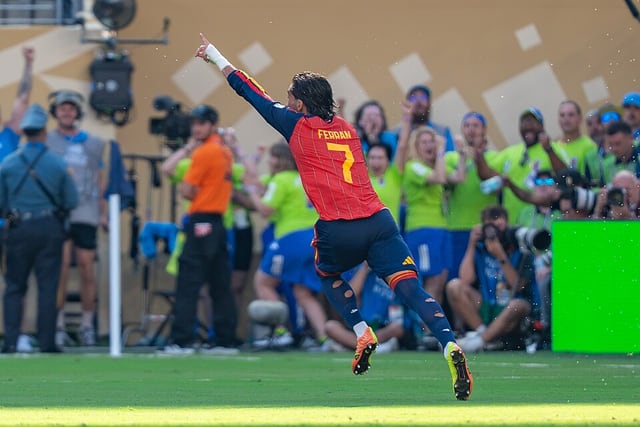
His biggest moment came from the bench. In the 2026 World Cup final, Torres replaced Mikel Oyarzabal after 62 minutes. Forty-four minutes later he scored the only goal against Argentina. Spain were world champions, and a movement Torres had practised for years had delivered the finish people would remember.
Torres is often most dangerous before he touches the ball. He leaves the touchline, runs across a centre-back and reaches the area from a position that did not look threatening when the move began.
2026 Ballon d’Or case
Torres is an official 2026 Ballon d’Or nominee after a season capped by Spain’s World Cup-winning goal. Few candidates can point to a single finish with more direct consequences. The counterargument is also clear: one goal, however important, cannot replace an assessment of his whole Barcelona and Spain season.
His PSG move took place after the July 19 award cutoff. We separate that current club context from his nomination in our Ballon d’Or contenders guide, which also compares the claims of Spain teammates Rodri and Lamine Yamal.
Valencia and the wide-forward foundation
Torres was seven when he entered Valencia’s academy, where he first learned the wide roles before being used nearer to goal. November 2017 brought his competitive senior debut in the Copa del Rey. His first La Liga appearance followed a month later and, Barcelona’s profile notes, made him the league’s first player born in the 2000s.
At Valencia, an experienced full-back might suddenly find a teenager receiving in front of him and driving forward at speed. Torres was not yet scoring in volume. His calling cards were acceleration, width and direct running, qualities that stayed useful when coaches later moved him into the middle.
That mix creates an awkward decision for defenders. Follow Torres inside and the flank opens behind you; hold the line and he can arrive between two opponents. His best runs take advantage of that moment of doubt. He is less suited to standing still and trying to dribble through two defenders who are already set.
What Manchester City changed
Torres moved to Manchester City in 2020, and Pep Guardiola did not keep him on the wing. Minutes through the centre showed how his pace could hurt a back line even when he had not begun the attack by the touchline. The stay was brief; the positional lesson lasted.
Playing as a number nine altered what he had to see. A winger usually has most of the pitch in front of him. In the middle, centre-backs are close and the goal sits behind their shoulders. Torres had to check the space early, choose the instant to move and finish without spending several touches on setup.
The 2020/21 season brought Premier League and League Cup winner’s medals. City’s departure announcement records 13 goals in 36 appearances that season, then three in seven in 2021/22: 16 goals in 43 competitive games across his full spell. A foot injury interrupted the second campaign before his move back to Spain.
England did leave him comfortable in several positions. It also gave him a centre-forward’s destination for some of the runs he started out wide.
Barcelona and the search for the right role
Barcelona reached an agreement in December 2021, and Torres made his debut in January 2022. His arrival did not end the debate over his best position. A change of coach, formation or teammate could alter where he started, what line he pressed and whether his competition for minutes came from a winger or a striker.
Versatility is not always an uncomplicated compliment. Sometimes it means a player can fill three jobs without owning one. With Torres, though, the jobs connect. From the left he can cut onto his right foot or run beyond the striker; from the right he attacks the far post. Starting centrally allows him to pull toward a channel and leave room for a teammate to come through the middle.
As those runs became sharper, the scoring return rose. Barcelona’s archive lists 18 competitive goals in 2024/25, then 21 from 49 official appearances in 2025/26. At the time of checking, that second campaign was his best in club football.
Not every part of his game improved at the same rate. Torres is not the forward to ask to organise each possession. Against a low block, he can fade when he has to receive from a standstill and invent space on his own. He is better once the defence starts moving, whether a teammate’s pass, a press or his own run causes it.
The broader setting is covered in the Barcelona profile. A forward there must combine in small spaces, react to a lost ball and judge whether the attack needs width or another runner in the area. Even without a permanent place in the starting eleven, Torres kept finding minutes because he could handle each version of the job.
The move to Paris
PSG signed Torres after his World Cup-winning summer. He brings the off-ball runs developed at Barcelona to an attack that also includes Ousmane Dembele and Khvicha Kvaratskhelia. Those players can create the movement around a centre-back that his runs exploit.
The transfer does not turn his Barcelona numbers into PSG statistics. Nor does it add to his 2026 Ballon d’Or evidence: the award period ended on July 19, before the move.
Playing style: arriving before the gap closes
The moments just before a defender resets are Torres’ best ones. He waits on the blind side, watches the passer raise his head and changes speed. The run may last only a few steps; crossing the defender’s line of sight can still be enough to open a first-time finish.
He is comfortable shooting in the area without taking several controlling touches. That speed is important because the advantage disappears quickly. An extra touch gives the goalkeeper time to close the angle and brings the covering defender back into the move.
Some runs help even when the pass goes elsewhere. Going to the near post can pull a centre-back away from the far side. A diagonal move from the wing may clear the outside lane for the overlapping full-back. Torres does not receive a statistical reward for either action, but the attack has more room because of it.
He can also press from any position across the front. The exact run depends on the plan: close a centre-back, block the pass into midfield or guide play toward the touchline. Pace makes the effort obvious, yet the timing matters more. A sprint that leaves the easy pass open is only noise.
There are clear limits to the profile. Torres is neither a target striker built to dominate long aerial balls nor a pure one-against-one winger who wants to live outside. He sits between the two. That is why changing his starting lane does not automatically remove his best qualities.
Spain before the final
By the time the 2026 World Cup began, Torres had been a senior Spain international for six years. His earlier tournament record included two goals at EURO 2020, another two at the 2022 World Cup and one during the successful EURO 2024 campaign. UEFA’s records include him among those European champions.
Spain often had long spells of control in midfield and needed its forwards to run beyond the last line. Torres could begin outside, swap positions and reach the area while defenders were still watching the ball. That became his recurring international job.
RFEF’s match record, rechecked on September 23, lists 64 appearances and 25 goals through the July 19 World Cup final. That is the national-team snapshot used here, rather than an undated career total. Long before the final, Torres had already scored at several tournaments and for different tactical versions of Spain.
The 106th minute
Ninety minutes of the 2026 World Cup final failed to produce a goal between Spain and Argentina. Emiliano Martínez had repeatedly kept Spain out, while Torres had been on the field since replacing Oyarzabal in the 62nd minute. Then, in the 106th, Nico Williams supplied the ball and the substitute finished.
The RFEF called him the decisive figure in the final. That is fair: his goal was the only one of the match and delivered Spain’s second men’s World Cup. It does not mean he was the tournament’s leading player. Our final World Cup 2026 ranking places him tenth, giving the winner its proper weight without ignoring the rest of the competition.
The Golden Ball ranking makes the same distinction. Rodri, Pau Cubarsí and Unai Simón had larger roles across Spain’s full tournament. Torres produced the moment that will be shown most often.
Finals allow that kind of imbalance. A substitute can play far fewer minutes than the starters and still decide who lifts the trophy. Both facts belong in the description.
What the final changed
Before July 2026, a short account of Torres’ career would have led with his positional range, uneven status and improving goal return. Now it begins in the 106th minute. Defining goals reorder a player’s story even though they do not rebuild the player overnight.
The winner secured his place in Spain’s history. It did not guarantee his next club start, settle his best position or erase every earlier criticism. Those questions still have to be answered over the matches that follow.
Torres is both the scorer of a World Cup-winning goal and an active forward whose best use depends on the team around him. One part of that sentence is permanent. The other needs checking whenever this profile is updated.
Ranking context
Torres appears in three structured 2026 lists: the best players, Golden Ball contenders and players to watch. They judge tournament impact and do not need to retell his development at Valencia, Manchester City and Barcelona.
His goal also appears in the greatest final ranking and among the moments people replay. The 2026 final may move up or down those lists with time. The decisive sequence will stay the same: Torres reached the gap and finished before it closed.
Sources
Sources checked
- Manchester City - Ferran Torres departure and complete City record
- RFEF - Spain win the 2026 World Cup final
- PSG - Ferran Torres signs through 2031
- UEFA - Official 2026 Ballon d'Or shortlist
- FC Barcelona - Ferran Torres first-team profile
- RFEF - Ferran Torres senior Spain record
- RFEF - Ferran Torres and the 2026 World Cup final winner
- UEFA - EURO-winning squad records
FAQ
What position does Ferran Torres play?
Torres plays across the front line. He can start from either wing or operate as a centre-forward, with his strongest work often coming from runs into the penalty area rather than from staying on the touchline.
Which club does Ferran Torres play for?
As of September 23, 2026, Ferran Torres plays for Paris Saint-Germain. PSG confirmed a contract through 2031 and the number 9 shirt.
Did Ferran Torres score in the 2026 World Cup final?
Yes. Torres came on in the 62nd minute and scored in the 106th minute as Spain beat Argentina 1-0 after extra time.
Which clubs has Ferran Torres played for?
His senior route runs from Valencia to Manchester City, Barcelona and Paris Saint-Germain. He joined PSG in 2026 after his Barcelona spell.
What are Ferran Torres' main strengths?
His main strengths are off-ball movement, timing inside the box, direct running and the flexibility to attack from several positions. He is more dangerous arriving into space than acting as a stationary touchline creator.