
player
Raul: The Forward Who Arrived Before the Rebound
Raul Gonzalez's Real Madrid, Schalke and Spain career, with his Champions League goals, movement, captaincy and finishing style explained.
Summary
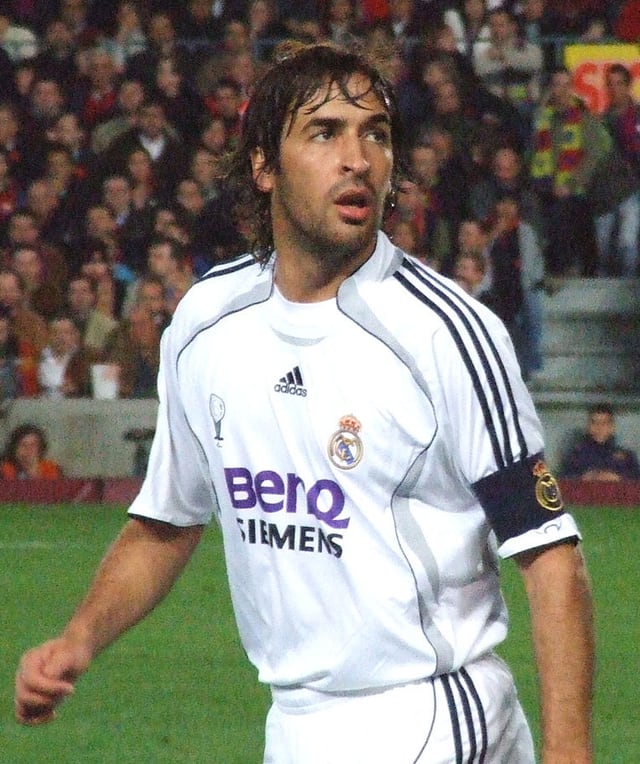
Raul rarely waited for a chance to become obvious; he read the loose ball or open shoulder first and reached the finish before the defence reset.
Quick facts
- Primary role
- Second striker / centre-forward
- Real Madrid
- 323 goals in 741 competitive appearances
- Champions League
- 71 goals in 142 appearances; three titles
- Spain
- 44 goals in 102 senior internationals
- Major club honours
- Six La Liga titles and three Champions Leagues with Real Madrid
- Profile
- Blind-side movement, rebounds and early left-footed finishing
The run began before anyone called it a chance
Raul Gonzalez scored plenty of clean goals, but his most recognisable work often began with a mess. A goalkeeper pushed the ball sideways. A centre-back looked toward the passer and lost sight of the forward. A low cross escaped the first defender. Raul had already moved.
He was not physically imposing and did not dribble through entire teams. His advantage was the fraction of a second between an opponent noticing danger and reacting to it. He watched shoulders, rebounds and the goalkeeper’s balance. When the ball arrived, the finish tended to be short and early.
That instinct lasted through sixteen Real Madrid seasons. The club records 741 competitive appearances and 323 goals, both totals that place him near the top of its history. The numbers are large because the decisions worked in ordinary league matches as well as European finals.
Atletico released him, Madrid gave him a route
Raul grew up in Madrid and spent part of his youth career with Atletico. When Atletico closed its academy, he moved to Real Madrid’s youth structure in 1992. The route to the first team then became remarkably short.
Jorge Valdano gave him a senior debut against Zaragoza on 29 October 1994. Raul was seventeen. He missed chances in a 3-2 defeat, but the selection was not withdrawn as a failed experiment. One week later, against Atletico at the Bernabeu, he scored with his left foot from the edge of the area.
That second match established two parts of the story at once: the local tension around his academy past and the willingness to keep attacking after a wasteful debut. Real Madrid won the league in his first senior season. Raul had entered the team before his game was polished, then learned in public.
He played between striker labels
Calling Raul a centre-forward is reasonable, but it suggests a fixed reference point he did not always provide. He could begin behind another striker, move into the left inside channel or lead the line. The common job was finding the next scoring space.
With Fernando Morientes, Raul often had a stronger aerial striker occupying the centre-backs. Raul could pull away, combine and then enter the box later. With Ronaldo Nazario, he adjusted around a forward who wanted to face goal and accelerate. With wide players such as Luis Figo, he timed runs toward the delivery rather than demanding the ball early.
The left foot shaped the final action. Raul could lift the ball over a goalkeeper, pass it inside the far post or shoot while the defender expected another touch. He did not need a violent swing. Releasing the shot before the block arrived was more useful.
The 1998 European Cup ended a thirty-two-year wait
Real Madrid had won six European Cups by 1966, then none for the next thirty-two years. The 1998 final against Juventus therefore carried a different pressure from a routine addition to the trophy cabinet.
Raul did not score in Amsterdam. Predrag Mijatovic supplied the only goal. Raul’s place in that team still matters because he had become the attacking symbol of the long-awaited seventh title while still only twenty.
Iker Casillas later became the goalkeeper associated with the next two wins. Together, the academy pair provided continuity as Madrid moved from the late 1990s side into the first Galacticos team. The club could buy famous players without making its own pathway irrelevant.
Paris in 2000 gave Raul his final goal
The 2000 final against Valencia was the first Champions League final between clubs from the same country. Madrid won 3-0. Raul scored the third after receiving the ball inside his own half, running clear, rounding Santiago Canizares and finishing into the empty net.
The distance of the run makes the goal look like a pure counterattack. The important part came at the end. Raul did not rush the shot when the goalkeeper came out. He touched the ball around him, kept his balance and waited until the angle was certain.
That was his tenth Champions League goal of the season. The forward who thrived on rebounds could also finish a long one-on-one in a final without changing expression or tempo.
The 2002 final put him beside Zidane’s volley
Two years later, Raul scored the opening goal against Bayer Leverkusen at Hampden Park. A quick Roberto Carlos throw sent him behind the defence, and he passed a low left-footed finish across Hans-Jorg Butt. Lucio equalised before Zinedine Zidane produced the volley that defines the match.
Zidane’s goal owns the replay. Raul’s should not disappear. It came from recognising that Leverkusen were not set for the throw and finishing before the goalkeeper could close the far-post lane. In another match, it would have been the main image.
UEFA’s final records give Raul two Champions League final goals, one in 2000 and one in 2002. Real Madrid won both matches. That is a compact summary of his European value: alert movement, an early finish and a contribution attached to the result rather than only the highlight reel.
Seventy-one goals once meant the competition record
Raul scored 71 times in 142 Champions League appearances for Real Madrid and Schalke. When he reached that total, it was the tournament record. Lionel Messi matched it in November 2014, and Messi and Cristiano Ronaldo later moved the benchmark much higher.
The old record can look smaller after the scoring explosion that followed. Context helps. Raul played in an era with fewer high-possession mismatches and left Madrid before the club’s four-title run of 2014 to 2018. He also carried the number across fifteen Champions League seasons rather than one brief peak.
UEFA still lists him fifth on the all-time scoring table checked in August 2026. He is sixth in our ranking of the greatest Champions League players because the three titles, two final goals and long period as the tournament’s record scorer belong to the competition itself, not merely to a wider career reputation.
Captaincy meant repetition, not speeches
Raul became Real Madrid captain after Fernando Hierro left in 2003. The armband arrived during the Galacticos era, when the dressing room held Ballon d’Or winners and global stars. His authority was based less on public drama than on routine.
He pressed, chased a poor pass and remained available when his scoring form dipped. That work did not make every Madrid team balanced. The club went through six consecutive Champions League round-of-16 exits from 2005 to 2010, a sharp contrast with Raul’s earlier finals.
Those defeats belong in the record. Longevity includes the seasons when the same habits could not solve a team problem. Raul remained productive, but the European structure around him was no longer strong enough to turn every close tie.
Spain received goals but not the coming trophy cycle
The Spanish federation records 102 senior appearances and 44 goals. Raul played at the 1998, 2002 and 2006 World Cups, plus Euro 2000 and Euro 2004. He captained the national team and was its leading scorer when his international career ended.
Spain did not win a major tournament during those years. The great possession side emerged immediately afterward, winning Euro 2008, the 2010 World Cup and Euro 2012. Raul was not recalled for that cycle.
This creates a difficult historical position. He helped carry Spain through a less successful period, but the team found its winning midfield without him. Forty-four goals remain substantial; they cannot be retroactively turned into medals.
Schalke showed the movement travelled
Raul left Real Madrid in 2010 and joined Schalke at thirty-three. The move could have been a ceremonial final contract. Instead, he helped Schalke reach the 2011 Champions League semifinals and win the German Cup.
The Bundesliga asked for more running over open ground, and Raul adapted without pretending to be faster than he was. He combined with younger forwards, dropped into spaces behind the first line and kept reading the box. Schalke’s own record table gives him 28 Bundesliga goals; his interview with the club identifies the 2011 cup as the high point of his two seasons.
Those years matter because they separate Raul’s method from one institution. The Bernabeu understood his timing, but the timing also worked in Gelsenkirchen.
Qatar and New York completed the playing career
After Schalke, Raul joined Al Sadd and won the Qatari league. He later played for the New York Cosmos, adding a North American Soccer League title before retiring in November 2015.
The final stops did not add to his Champions League case. They did extend the same professional habits into leagues with different rhythms and expectations. Raul finished as a player rather than remaining in Europe for a role built around his name.
He later returned to Real Madrid as a coach in the academy structure that had accelerated his own path. That post-playing work is outside this profile’s ranking calculation, but it fits the longer institutional connection.
Why defenders lost him without seeing a sprint
Raul’s movement was economical. He often stood near a defender’s far shoulder, where the marker could see the ball or the forward but not both. One step as the pass travelled was enough to change who reached it first.
He also anticipated the second action. When a teammate shot, Raul did not admire the attempt. He adjusted toward the likely parry. When a defender stretched to intercept a cross, he moved toward the loose-ball zone. Many goals looked simple because the hard part had happened before the camera found him.
The chipped finish became another signature. A goalkeeper expecting a low left-footed shot would set early, and Raul could lift the ball with little backlift. It was not decoration. It used the keeper’s first commitment against him.
Why he sits sixth in the Champions League list
Raul’s case is tied to the early modern Champions League. He helped end Madrid’s long wait in 1998, scored in the next two winning finals and held the competition scoring record at 71. Few players have a European identity that complete.
The five names above him on this site’s list have either a larger knockout peak, greater final-stage longevity across eras or broader control of the match. Raul’s claim is narrower: he made the decisive space his own for fifteen seasons and did it before the competition’s scoring totals accelerated.
Sixth does not reduce him to an old record. It recognises what the record measured. Long before the rebound became a chance, Raul was already moving toward it.
Sources
Sources checked
FAQ
How many goals did Raul score for Real Madrid?
Real Madrid records 323 goals in 741 competitive appearances across sixteen first-team seasons from 1994 to 2010.
How many Champions League goals did Raul score?
UEFA lists Raul on 71 Champions League goals in 142 appearances for Real Madrid and Schalke.
How many Champions League titles did Raul win?
He won three with Real Madrid, in 1998, 2000 and 2002. Raul scored in the 2000 and 2002 finals.
How many goals did Raul score for Spain?
The Spanish federation records 44 goals in 102 senior internationals between 1996 and 2006.
Which clubs did Raul play for?
His senior career covered Real Madrid, Schalke 04, Al Sadd and the New York Cosmos. He retired in November 2015.