
player
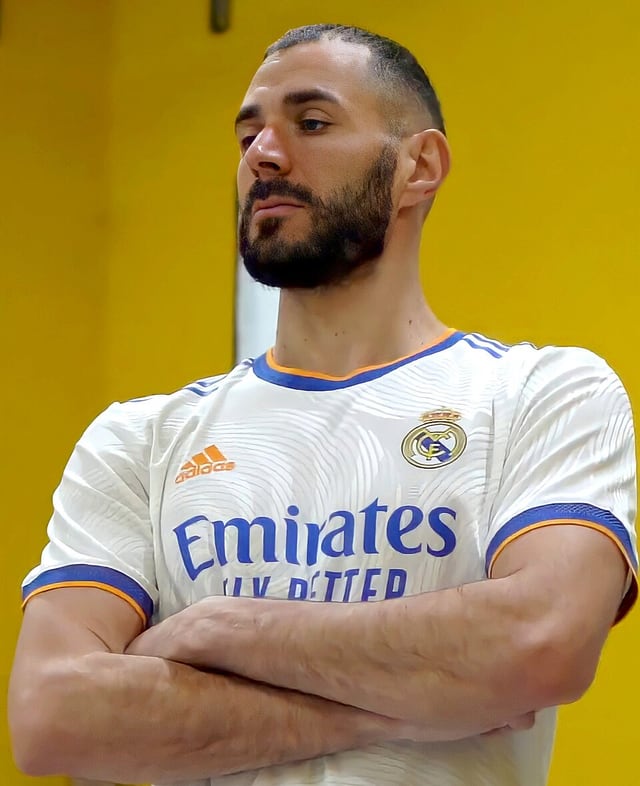
Karim Benzema: From Supporting Forward to Madrid's Main Scorer
Karim Benzema's career from Lyon to Real Madrid and Al Hilal, with his link play, 2022 Champions League run, goals and major honours explained.
Summary
Benzema spent years opening attacks for other scorers, then proved he could carry the finishing load himself when Real Madrid needed it most.
Quick facts
- Primary role
- Centre-forward / linking forward
- Latest club update
- Al Hilal contract ended by mutual agreement on August 31, 2026
- Real Madrid
- 354 goals in 648 competitive appearances
- Champions League
- 90 goals, 152 appearances and five titles
- Individual peak
- 2022 Ballon d'Or after a 44-goal club season
- Profile
- Combination play, penalty-box timing and two-footed finishing
The years when the assist mattered as much as the finish
Karim Benzema did not arrive at Real Madrid as a supporting player. Lyon had raised a quick, technical centre-forward who could score from either foot, and Madrid paid for a future focal point in 2009. What followed was less direct. Cristiano Ronaldo became the dominant scorer, so Benzema learned how to make a number nine useful before the shot.
He came away from centre-backs, took passes with his back to goal and returned the ball before the defence could close around him. On the left, Ronaldo could begin outside and attack the space Benzema had just left. The move rarely looked like a formal rotation. One player read the other’s run, and the gap appeared.
That work made Benzema easy to underrate if goals were the only column in view. It also kept him in the team through several managers and several versions of Madrid. When Ronaldo left in 2018, the same forward had to keep the links and take far more of the shots. He did both.
Lyon taught him to play quickly in crowded areas
Benzema joined Lyon’s academy as a child and reached the first team in January 2005. The club was already the dominant force in France, so the young striker entered a side expected to control domestic matches rather than wait for open counterattacks.
That setting rewarded clean decisions near the box. Benzema could receive between lines, turn onto either foot and shoot without a long setup. By 2007/08 he was Ligue 1’s leading scorer and its player of the year. He left France with four league titles and enough Champions League experience to interest Madrid.
The early version already contained the later one. He was not a penalty-box statue, and he did not need every possession aimed straight at him. His best attacks involved a short pass, a change of lane and a second appearance closer to goal.
Madrid asked for patience before it offered control
The first seasons in Spain were uneven. Benzema had to compete for minutes, adjust to a louder level of scrutiny and fit around forwards whose preferred spaces overlapped with his. Gonzalo Higuain could provide a more obvious run behind the defence. Ronaldo’s scoring volume made every other attacker look secondary.
Benzema’s answer was not to imitate either man. He became the forward who could keep a move alive with one touch. If a midfielder passed into his feet, he might set the ball back and turn. If Ronaldo drove inside, Benzema could move across the line and occupy the defender who wanted to help.
Those actions were small, but they accumulated. Madrid could attack at speed without asking the centre-forward to disappear from the combination. The relationship with Cristiano Ronaldo eventually became one of the defining partnerships of the club’s modern European period.
The BBC front line did not divide the work equally
The label was neat: Bale, Benzema and Cristiano, the BBC. Their responsibilities were not symmetrical. Gareth Bale supplied direct running and another elite finishing threat. Ronaldo attacked the highest-value shooting positions. Benzema often stood between those jobs.
He could drift left to exchange passes with Ronaldo, then cross the box while Bale arrived from the right. He pressed centre-backs, contested awkward clearances and accepted stretches in which his best contribution was the pass before the assist. None of that made him selfless by nature. It made him adaptable enough to remain important beside two expensive scorers.
The 2014 Champions League title gave that front line its first European Cup. Three more followed in 2016, 2017 and 2018. Benzema scored in the 2018 final after reading Loris Karius’s attempted throw and sticking out a foot. It was not a glamorous chance. It was the reward for watching the goalkeeper when most forwards would have turned away.
After Ronaldo left, the shot count belonged to Benzema
Ronaldo’s 2018 departure removed more than goals. It removed the player around whom Madrid’s final pass had been organised. Benzema responded with 30 club goals in 2018/19, then kept scoring while the team rebuilt around an older midfield and younger wide players.
His movement changed by degrees. He still dropped to connect, but he became stricter about returning to the box. Crosses that once sought Ronaldo now needed Benzema between the posts. He attacked the near side, waited behind a defender or delayed his run until a cutback lane opened.
The finishing did not come from one pattern. He could guide a first-time shot with his right foot, shift the ball onto his left or beat a goalkeeper in the air. The common point was preparation. His body was usually set before the pass arrived.
The 2021/22 Champions League run changed the public memory
Real Madrid’s 2021/22 knockout campaign was untidy, dramatic and repeatedly close to ending. Benzema kept finding the goal that changed the argument.
Paris Saint-Germain led the round-of-16 tie until Benzema pressed Gianluigi Donnarumma, helped force the mistake and scored. Two more goals followed in the next seventeen minutes. Against Chelsea, he scored a hat trick at Stamford Bridge: two headers followed by a finish into an open goal after Edouard Mendy’s mistake. He later headed the extra-time winner in Madrid. Manchester City conceded another three Benzema goals across the semifinal, including the Panenka penalty at the Etihad and the extra-time penalty at the Bernabeu.
These were not padded totals from comfortable group matches. They arrived while Madrid were losing control of ties. Benzema finished the tournament with 15 goals and lifted his fifth Champions League trophy after the final against Liverpool.
That run is why he sits fifth in our ranking of the greatest Champions League players. UEFA’s current table lists 90 Champions League goals and 152 appearances across Lyon and Madrid. The longevity was already secure; 2022 supplied the concentrated knockout peak.
Forty-four goals made the Ballon d’Or vote simple
Benzema scored 44 goals for Real Madrid in 2021/22. He led La Liga with 27 and the Champions League with 15, then received the 2022 Ballon d’Or and UEFA men’s player award.
The numbers mattered, but the shape of the season mattered more. Madrid did not merely have the leading scorer. They had a forward who could solve a press, combine with Vinicius Junior and still take the decisive penalty. Luka Modric and Toni Kroos could find him between lines; Vinicius could sprint beyond him; Benzema could choose which action the moment required.
His partnership with Vinicius was different from the old Ronaldo relationship. The younger winger carried the ball over longer distances and looked for Benzema’s return pass, while Benzema now owned the central finishing position. The forward had gone from supporting a historic scorer to helping a young winger grow without surrendering the shots himself.
The Real Madrid totals need a clear scope
Real Madrid records 354 goals in 648 competitive appearances from 2009 to 2023. That places Benzema second on the club’s scoring list behind Ronaldo. The club also credits him with 25 trophies: five Champions Leagues, four La Liga titles, three Spanish Cups and a collection of world and European super cups.
The 648/354 line is useful because both numbers use the same competitive-match scope. Career databases sometimes mix friendlies or count predecessor competitions differently. This profile keeps the official club total and uses UEFA’s own tables for European figures.
Fourteen seasons also explain part of the standing. Benzema survived the transfer-market churn that regularly replaces Madrid forwards. He played beside Kaka, Mesut Ozil, Angel Di Maria, Bale, Ronaldo and Vinicius, and adjusted without losing the central job.
France brought success, separation and a late return
Benzema’s international career did not follow the clean rise of his club story. The FFF records 97 appearances and 37 goals, beginning with his debut against Austria on March 28, 2007. He played at Euro 2008, Euro 2012 and the 2014 World Cup, then was absent from the national team for more than five years amid the legal case involving Mathieu Valbuena.
France won the 2018 World Cup without him. Didier Deschamps recalled him for Euro 2020, played in 2021, and Benzema later helped France win the 2021 Nations League. He was selected for the 2022 World Cup but withdrew injured before the opening match. His international retirement followed in December 2022.
The national-team record cannot be written as a simple trophy list. The late return showed that he could still combine with another dominant scorer in Kylian Mbappe, but the missing years remain part of the career.
Saudi Arabia extended the playing career
Benzema left Madrid in 2023 and joined Al Ittihad. In 2024/25 he helped the club win the Saudi league and King’s Cup double, scoring 21 league goals according to the Saudi Pro League.
In February 2026 he moved to Al Hilal on a one-and-a-half-year agreement. That spell ended early: the club announced a mutual contract termination on August 31. As of the September 30 source check, a subsequent club or retirement was not confirmed by the official sources reviewed here.
The Saudi seasons do not alter the central Madrid case. They do show that the older Benzema still preferred a role with regular possession and combinations around the box rather than living only as a penalty-area substitute.
What his best football actually looked like
Benzema’s first touch was often a decision. A firm pass into his feet could become a layoff, a turn or a short dribble across the defender. Because he was comfortable with either foot, the marker could not simply show him away from his right.
He also watched defenders rather than following a fixed route. If the centre-back stepped out, Benzema released the ball and ran behind him. If the defender stayed deep, he turned and faced goal. Near the six-yard box he waited for rebounds and goalkeeper errors, a habit visible in the 2018 final and the pressure on Donnarumma four years later.
The late-career scoring explosion did not replace the link play. It completed it. Benzema could create the shape of an attack and finish once the ball returned.
Why the Champions League ranking stops at fifth
Fifth is a high position and still leaves room for debate. Benzema has five titles, 90 goals and one of the competition’s great individual knockout runs. Cristiano Ronaldo and Lionel Messi produced larger European scoring peaks over longer stretches. Paolo Maldini and Modric carry different forms of final-stage longevity and control.
The case for moving Benzema higher begins with 2022. The case for keeping him fifth notes that several earlier title teams were built around Ronaldo’s scoring and Madrid’s midfield. Both can be true. Benzema was an essential connector in the first phase and the decisive scorer in the last one.
That change is the career. He did not become a different footballer after thirty. Madrid simply needed every part of the forward at once.
Sources
Sources checked
- Real Madrid - Karim Benzema legend profile
- UEFA - Champions League all-time scorers
- UEFA - Champions League final records
- UEFA - Champions League all-time appearances
- Real Madrid - Benzema passes 350 goals
- Al Hilal - Benzema contract ends by mutual agreement, August 31, 2026
- Saudi Pro League - Benzema joins Al Hilal
- FFF - Benzema's France career, appearances and honours
- FFF - Benzema's withdrawal from World Cup 2022
- UEFA - Benzema's two headers and third goal at Chelsea in 2022
FAQ
What club does Karim Benzema play for?
Al Hilal announced on August 31, 2026 that Benzema's contract had ended by mutual agreement. The official sources checked on September 30 do not establish a subsequent club or confirm his retirement.
How many goals did Karim Benzema score for Real Madrid?
Real Madrid credits Benzema with 354 goals in 648 competitive appearances across fourteen seasons from 2009 to 2023.
How many Champions League goals did Karim Benzema score?
UEFA's all-time table lists Benzema on 90 Champions League goals, fourth in the competition ranking checked on September 30, 2026.
How many Champions League titles did Karim Benzema win?
He won five Champions League titles with Real Madrid: 2014, 2016, 2017, 2018 and 2022.
Why did Karim Benzema win the 2022 Ballon d'Or?
He scored 44 club goals in 2021/22, led both La Liga and the Champions League scoring charts and supplied decisive knockout goals during Real Madrid's European title run.