
player
Ronaldinho: The Playmaker Who Reawakened Barcelona
Ronaldinho's Barcelona peak, 2002 World Cup role, major honours, creative playing style and place among the greatest wingers ever.
Summary
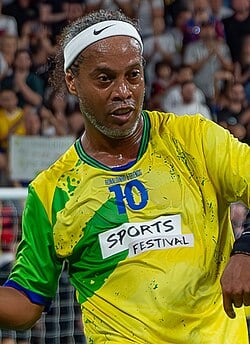
Ronaldinho began from the left but treated the whole attacking half as a creative space, using disguise and touch to make difficult actions feel improvised.
Quick facts
- Primary role
- Left-sided forward and playmaker
- Peak club
- Barcelona, 2003–2008
- National team
- Brazil
- World Cup title
- 2002
- Peak individual award
- Ballon d'Or 2005
Barcelona and the return of possibility
Ronaldinho joined Barcelona from Paris Saint-Germain in 2003 and spent five seasons at the club. The timing is part of the legacy. Barcelona had gone several years without winning La Liga, and his arrival gave Frank Rijkaard’s developing side a player who could change both the mood and geometry of an attack.
The first league title arrived in 2004/05. Barcelona retained it the following season and added the Champions League, beating Arsenal in the 2006 final. UEFA named Ronaldinho its Club Footballer of the Year after that European campaign, in which it described him as an inspirational forward and playmaker. His individual peak also included the 2005 Ballon d’Or and consecutive FIFA World Player awards in 2004 and 2005.
The Barcelona club profile places that revival inside the longer institutional story. Ronaldinho was not the only reason the team improved, but he became its clearest symbol: elite results had begun to look joyful again.
Brazil and the 2002 World Cup
Ronaldinho was still emerging internationally when Brazil travelled to Korea and Japan in 2002. The attack was led by Ronaldo Nazario, with Rivaldo supplying goals and connective play, but the younger Ronaldinho had his defining turn in the quarter-final against England.
With Brazil trailing, he carried forward through the centre and released Rivaldo for the equaliser. He then scored the winning goal from a long free-kick before being sent off later in the match. Brazil survived and went on to win all seven games, beating Germany in the final. The sequence captures the two sides of the early player: creative responsibility and audacious execution, with risk never far away.
That title gives Ronaldinho a bridge into the greatest World Cup players conversation, although his strongest sustained peak came at club level rather than across several World Cups.
Playing style: a winger who refused the boundary
Calling Ronaldinho a left winger is useful as a starting location, not a complete tactical description. He could receive near the touchline and beat the full-back, but he was just as comfortable drifting into the inside-left channel or arriving centrally as a No. 10. UEFA’s description of him as a playmaker fits that broader map.
His technique worked through concealment. A look in one direction moved the defender; the pass went somewhere else. First touches became turns, set pieces became shots, and combinations could accelerate without warning. Unlike a pure touchline winger, he did not always need to win a foot race. He could change the defence with the weight and timing of one pass.
That freedom also explains why his peak is remembered more vividly than its length. The best version reorganised matches around imagination, but the final Barcelona seasons were disrupted and did not sustain the same standard.
Why Ronaldinho is part of the winger argument
Ronaldinho ranks fourth in our best football wingers of all time list. He sits below players with a longer or purer flank case, yet leaving him out would make the category too narrow. Wide play evolved, and Ronaldinho showed how a left-sided attacker could become the main creator without abandoning one-v-one threat.
His case is peak-led: the Barcelona revival, the 2006 European campaign and a World Cup-winning contribution in 2002. He does not need a disputed aggregate goal total to support it. The stronger evidence is role and consequence—how often his touch changed the next decision for every defender around him.
Sources
Sources checked
FAQ
Was Ronaldinho a winger or a playmaker?
He was both: a left-sided forward who moved into central pockets to create, combine and shoot rather than staying fixed to the touchline.
What were Ronaldinho's biggest Barcelona honours?
He won two La Liga titles and the 2005/06 Champions League during five seasons with Barcelona.
What did Ronaldinho do at the 2002 World Cup?
He was part of Brazil's title-winning attack and produced an assist and the winning free-kick against England in the quarter-final.