
player
Xavi: The Midfielder Who Controlled the Clock
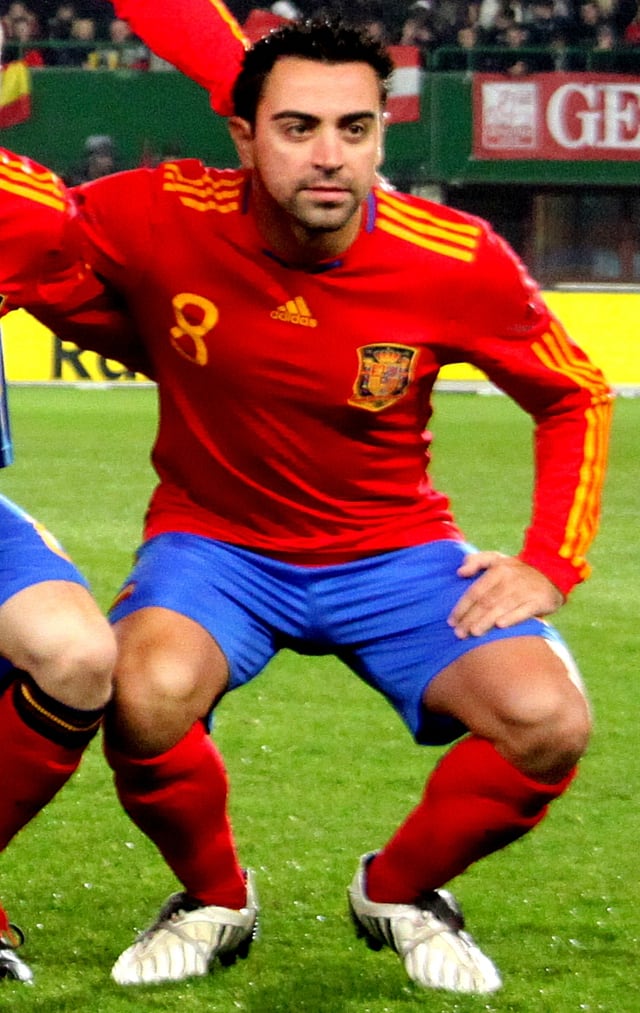
Xavi profile covering his Barcelona career, Spain's 2008–2012 run, passing style, major honours and all-time midfield ranking case.
Summary
Xavi turned possession from a broad idea into a sequence of precise decisions, controlling where Barcelona and Spain played and how quickly the next opening appeared.
Quick facts
- Primary role
- Central midfielder and tempo controller
- Defining club
- Barcelona, 1998–2015
- Barcelona record
- 767 matches in the club's current legend-page count
- Major club honours
- 8 La Liga titles and 4 Champions Leagues
- Spain honours
- EURO 2008, World Cup 2010 and EURO 2012
- Individual landmark
- EURO 2008 Player of the Tournament
From La Masia to Barcelona’s reference point
Xavi joined Barcelona’s youth system before making his senior debut in 1998. His first-team career lasted 17 seasons, a span that matters as much as the famous peak under Pep Guardiola. He adapted through changes of coach, shape and supporting cast before becoming the player around whom Barcelona organised possession.
The club’s current legend profile records 767 matches, eight La Liga titles and four Champions Leagues. Barcelona archive pages sometimes show broader totals when friendlies and regional competitions are added; this profile follows the narrower figure on the current legend page rather than combining incompatible scopes. The final season supplied a fitting endpoint: Xavi captained the team during the 2014/15 treble and left after another Champions League win.
The Barcelona club profile gives that career its wider institutional setting. Xavi did not invent the club’s positional ideas, but few players expressed them with such consistency.
Spain’s midfield compass from 2008 to 2012
Spain’s first senior international title in 44 years arrived at EURO 2008, where UEFA named Xavi Player of the Tournament. The award recognised more than pass completion. He controlled the rhythm of a side learning how to turn long spells of possession into territorial pressure, and he supplied the pass for Fernando Torres’s winner in the final.
The national team’s cycle continued through the 2010 World Cup and EURO 2012. FIFA’s account of Spain’s development connects that success to a midfield culture built around movement, support angles and patience. In South Africa, Xavi also delivered the corner from which Carles Puyol scored the semi-final winner against Germany.
Those titles support his place in the greatest World Cup players discussion, but the stronger argument is cumulative: three consecutive major tournaments in which Spain’s preferred kind of match depended on his decisions.
Playing style: control before the final pass
Xavi’s technique was economical rather than decorative. He scanned before receiving, opened his body to preserve several passing lanes and used short movements to escape the first presser. A sideways or backward pass was not automatically passive; it could reset the angle and force the opponent to chase again before the vertical ball appeared.
That made him difficult to judge with goals and assists alone. His value often came one or two actions earlier: attracting pressure, moving the block and delivering the pass that allowed a teammate to face forward. He could play decisive balls, but his larger responsibility was making the team’s next decision easier. Pedri works with a similar scanning habit in the current Barcelona midfield, though the comparison describes a role rather than declaring an equivalent career.
This is why Xavi remains central to the greatest Champions League players conversation. Four titles matter, yet the tactical legacy is broader: he provided an elite model for controlling risk without removing ambition.
Why Xavi ranks second among all-time midfielders
Our best football midfielders of all time ranking places Xavi second, behind Zinedine Zidane and narrowly ahead of Andrés Iniesta. The distinction is about role dominance rather than claiming that the three had identical jobs.
Zidane leads for decisive big-game authority across a more individual creative role. Iniesta could carry the ball through pressure and owns some of the era’s sharpest final-stage moments. Xavi’s case is the architecture of entire matches: he repeatedly determined where possession circulated, when the pace changed and how quickly control returned after the ball was lost.
That influence travelled across club and international football and survived for long enough to avoid being reduced to one great team or one short peak. Xavi is the reference point when a midfield ranking asks how much power can reside in tempo itself.
Sources
Sources checked
FAQ
What position did Xavi play?
Xavi was a central midfielder who often operated as the main tempo controller, receiving under pressure and connecting defence, midfield and attack.
How many games did Xavi play for Barcelona?
Barcelona's current legend profile records 767 games. Some club archive totals are higher because they include a broader set of friendlies and regional fixtures.
Why is Xavi ranked above Andrés Iniesta here?
The ranking gives Xavi a narrow edge for sustaining match-wide tempo control, while recognising that Iniesta offered more direct carrying and several defining final-stage moments.