
player
Bruno Fernandes: Manchester United, Portugal and Creative Risk
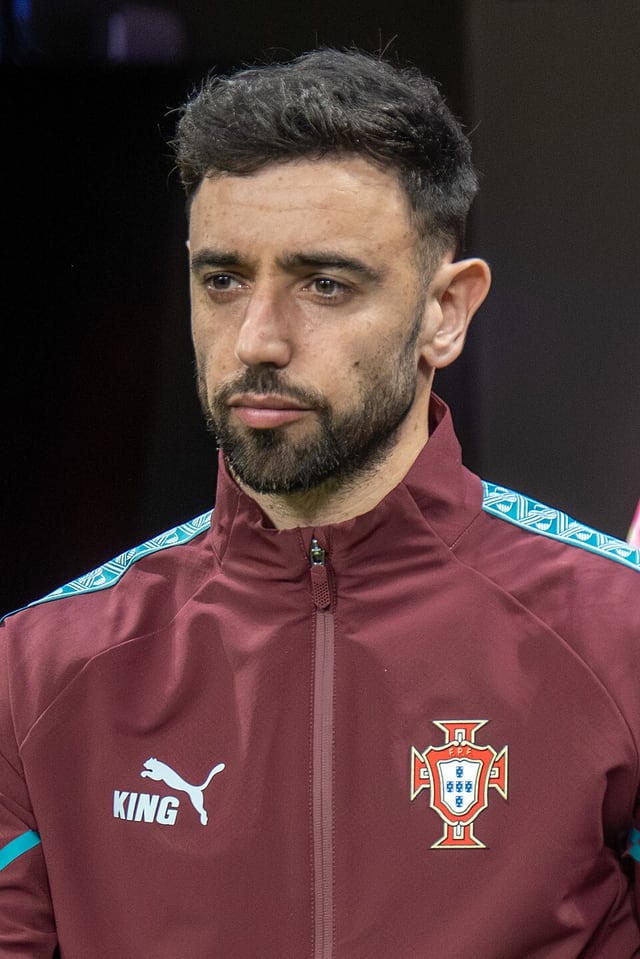
Bruno Fernandes through Sporting, Manchester United and Portugal, with his chance creation, forward passing, scoring and high-risk midfield role.
Summary
Fernandes creates through volume and ambition. He accepts more failed forward actions than a safe midfielder because his job is to find chances before the defence can reset.
Quick facts
- Primary role
- Attacking midfielder / advanced number eight
- Current club
- Manchester United captain (checked 22 September 2026)
- National team
- Portugal
- Manchester United
- Joined 30 January 2020 and passed 100 club goals
- 2025/26 Premier League
- Nine goals, a record 21 assists and Player of the Season
- 2026 World Cup
- Portugal reached the round of 16
Current profile
Bruno Fernandes remains Manchester United’s captain and a Portugal midfielder as of September 22, 2026. His game is easy to misread. A safe-pass percentage or a turnover total can make him look careless; an assist total can make him look like a specialist in the final ball. Neither view captures the full job.
Fernandes tries to move attacks forward before the defence is organised. He plays early passes, crosses from imperfect positions, arrives for shots and then presses after the ball is lost. The result is a midfielder whose mistakes are visible because his decisions are aggressive, but whose best actions can remove several defenders at once.
That balance supports his place in our ranking of the best football players in the world right now. His 2025/26 season supplied exceptional evidence. The career profile explains why that production followed the same risk-reward logic visible much earlier.
An unusual route through Italy
Fernandes did not follow the most familiar route from a Portuguese academy into the Primeira Liga. He left for Novara before turning 18, then played for Udinese and Sampdoria. In a UEFA interview after joining United, he described that period as an early test of independence and credited Italian football with making him more mature.
The tactical education mattered too. Playing in different midfield structures forced him to learn when to receive deeper, when to move beyond a striker and how to find space against organised opponents. He was not yet the high-volume Premier League creator, but the willingness to take responsibility for the next action was already there.
Sporting brought him back to Portugal in 2017. His role expanded, his scoring increased and the team gave him greater influence over attacks. The move established the version of Fernandes that Manchester United wanted: a midfielder comfortable making the difficult pass and then entering the box to finish the same phase.
Sporting ideas carried into Manchester
Manchester United signed Fernandes on January 30, 2020. The official club profile records double figures for both goals and assists in every full season after his arrival and notes that he became the fourth overseas player to reach 100 goals for United.
Those totals reflect more than set pieces. Fernandes can create from several layers of the pitch. From deeper positions, he can switch play or pass over a line. Between midfield and defence, he can turn and find a runner immediately. Near the box, he can combine, cross early or shoot.
The common feature is speed of recognition. He often releases the ball before the receiving player looks completely free. That timing is the point: waiting for an obvious lane also gives the defence time to close it.
His connection to the Manchester United club profile is therefore larger than one productive season. United have changed coaches, structures and forward combinations since 2020. Fernandes has remained one of the players asked to supply direction when the attack loses shape.
What creative risk actually means
Calling Fernandes a risk-taker should not excuse every decision. A hopeful pass with no runner is still a poor pass. The tactical question is whether the attempted action matches the movement ahead of him and the protection behind the ball.
When a winger starts a run before the full-back can turn, an early diagonal may be worth a turnover. When the striker pins both centre-backs, a clipped pass into the channel can create a chance that a safe sideways ball never will. Fernandes repeatedly looks for those moments.
That approach also creates messy sequences. A through ball is intercepted, United recover the second ball and Fernandes attempts another forward action. Evaluating only the first loss misses the pressure created across the whole passage.
The same logic applies to early crosses. They may reduce passing accuracy, but they can reach the box before defenders establish marking positions. Creative value sometimes depends on acting while the picture is incomplete.
More than the final pass
Fernandes contributes as a scorer because he does not remain behind the attack after releasing the ball. He follows play toward the box, looks for cutbacks and takes responsibility from the penalty spot. His shooting from distance forces midfielders to step out, which can open the pass he wanted in the first place.
Without the ball, his work is energetic rather than perfectly tidy. He presses, tracks runners and tries to direct teammates, but an aggressive jump can leave space if the players behind him do not move at the same time. As with his passing, the action makes most sense as part of the team structure.
Durability has increased his influence. Manchester United’s profile says he has missed only a handful of matches since joining, and the captaincy makes his tactical responsibility visible. Leadership is not a substitute for football analysis, but availability allows a player to carry the same demands through changing teams.
The 2025/26 Premier League peak
The Premier League named Fernandes its 2025/26 Player of the Season. Final competition figures list nine goals and 21 assists, with the assist total setting a new single-season league record. He also created 136 chances, according to the league’s final-season report.
The scope matters. Those are Premier League numbers, not all-competition figures. They describe one domestic campaign in which Manchester United finished third and returned to the Champions League.
The assist record is valuable evidence because it matches the underlying role. Fernandes was not simply collecting the final touch after a teammate’s individual work. He repeatedly supplied early passes, crosses and set-piece deliveries across a full season.
It also shows why one metric should not become the whole profile. Assists depend on finishing and official classification. The repeatable skill is creating enough dangerous situations for a record total to become possible.
Portugal role and World Cup 2026
Portugal use Fernandes as an advanced midfielder, but his exact position changes with the players around him. Alongside a quicker ball-winner such as João Neves, he can stay closer to the forwards and attack the box. When the team needs help progressing the ball, he can drop and play the first forward pass.
An FPF interview during qualifying captured that flexibility: Fernandes explained that one version of his role focused more on helping the striker and less on early construction. That distinction matters. International football gives coaches less training time, so a player’s club habits must fit a more compact set of patterns.
Portugal reached the round of 16 at the 2026 World Cup before losing 1-0 to Spain. Diogo Costa made 20 saves across the tournament behind a side that did not convert its depth into a long run. FIFA’s coverage placed Fernandes in the midfield for the Spain match and described him as part of an unusually talented Portugal squad. The exit limits any attempt to turn the tournament into a triumph, but it does not erase the broader international role.
This draft deliberately avoids a current senior cap total. The federation page separates senior, Olympic and youth appearances, but its accessible snapshot was not reliably updated through the end of the World Cup. That figure should be refreshed directly before publication rather than presented with false precision.
Ranking context
Fernandes’ current-form case rests on a Player of the Season award, a record 21-assist league campaign and a central leadership role for a top-three side. Those facts justify the recent ranking position without defining his entire career.
The durable question is how a midfielder manages creative risk. Fernandes chooses forward actions at a rate that guarantees some visible failures. At his best, the volume is not chaos. It is a deliberate attempt to reach the defence before the defence is ready.
Our best midfielders of all time ranking covers a different historical question. This profile does not place Fernandes into that order. It explains the modern attacking-midfield role he has built through Italy, Sporting, Manchester United and Portugal.
Sources
Sources checked
- Manchester United - Bruno Fernandes player profile
- UEFA - Manchester United 2026/27 squad and captain
- Portugal Football Federation - Bruno Fernandes record
- Premier League - Bruno Fernandes wins 2025/26 Player of the Season
- Premier League - Bruno Fernandes sets the 21-assist record
- Premier League - Bruno Fernandes creates 136 chances in 2025/26
- UEFA - Bruno Fernandes on Italy, Sporting and creative risk
- FIFA - Bruno Fernandes career and World Cup profile
- FIFA - Portugal exit the 2026 World Cup against Spain
FAQ
What position does Bruno Fernandes play?
Fernandes is an attacking midfielder who can play as a number ten or an advanced number eight. He moves between midfield and the forward line to create, shoot and press.
When did Bruno Fernandes join Manchester United?
Manchester United signed Fernandes from Sporting CP on 30 January 2020. He made his debut against Wolverhampton Wanderers two days later.
Why does Bruno Fernandes lose possession so often?
Many of his turnovers come from forward passes, early crosses and through balls attempted before the defence is set. The useful question is whether that risk creates enough high-value attacks, not whether every pass is safe.
What is Bruno Fernandes' role for Portugal?
Portugal use Fernandes as an advanced midfielder and chance creator, although his exact height and freedom change with the midfield and forward selection around him.