
player
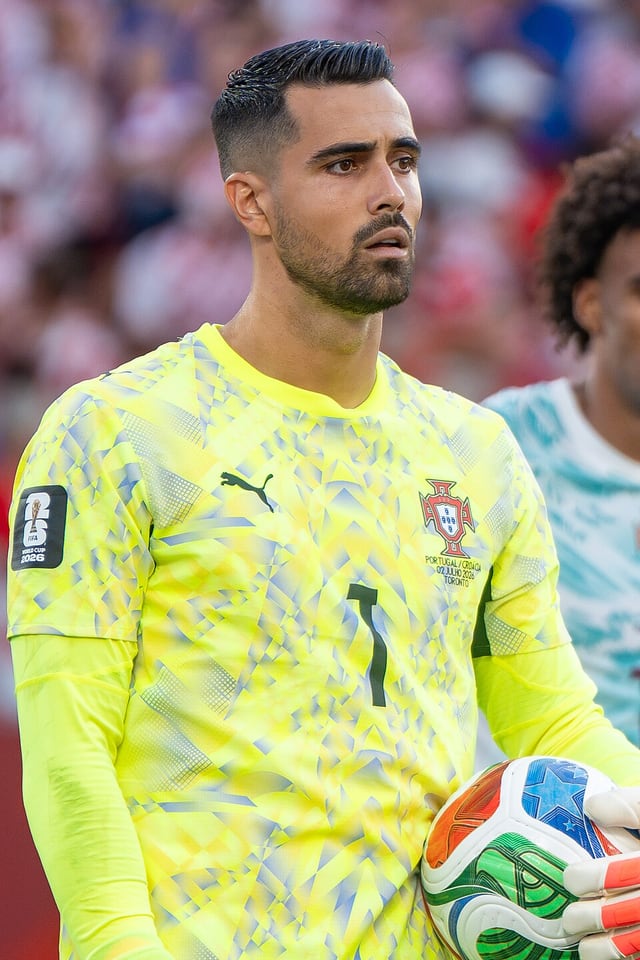
Diogo Costa: The Goalkeeper Built at Porto
Diogo Costa's Porto and Portugal career, with his distribution, penalty saves, EURO 2024 record and World Cup 2026 performance explained.
Summary
Diogo Costa grew from Porto's academy into its captain by combining sharp goalkeeping with the passing range and penalty preparation required of a modern number one.
Quick facts
- Position
- Goalkeeper
- Current club
- FC Porto captain (checked September 30, 2026)
- Contract
- Through 2030
- FC Porto milestone
- 200 first-team appearances on August 24, 2025
- Senior club honours
- Two league titles, three Portuguese Cups and two Super Cups by December 2025
- International peak
- EURO 2024 record shootout and 2025 Nations League winner
- World Cup 2026
- 20 saves; Portugal reached the round of 16
One match made the penalty reputation impossible to miss
Benjamin Šeško ran clear in the 115th minute of Portugal’s EURO 2024 match against Slovenia. Pepe could not recover, and the striker had enough space to choose his finish. Diogo Costa waited, stayed upright and blocked the shot.
The save kept the score at 0-0 after Cristiano Ronaldo had missed a penalty at the other end. Then came the shootout. Costa stopped Slovenia’s first kick, then the second, then the third. Portugal scored three times and the contest was over before a fourth taker was needed.
UEFA recorded two firsts: no goalkeeper had saved three penalties in a European Championship shootout, and none had completed a EURO shootout without conceding. The sequence turned an existing strength into the first line of Costa’s international profile.
It did not come from nowhere. Porto already knew him as a goalkeeper who could stop penalties, play through pressure and handle responsibility. He had joined the club before his teens and worked through every level until the number 99 shirt and captain’s armband belonged to him.
Born in Switzerland, developed in northern Portugal
Costa was born in Rothrist, Switzerland, on 19 September 1999. His family returned to Portugal when he was young, and he grew up around Santo Tirso. FC Porto brought him into its academy in 2011 for the under-13 team.
The route matters because his senior career is not a transfer story. Porto taught him the position, gave him youth competition, moved him into its B team and eventually trusted him with the first-team goal. By the time other clubs saw a Champions League goalkeeper, Porto had already watched the development for a decade.
His early honours arrived with club and country. In 2016, he won Portugal’s junior championship with Porto and the European Under-17 Championship with the national team. Two years later came a Premier League International Cup with Porto B and another European title with Portugal’s under-19s.
The 2018/19 season linked the academy work to the senior squad. Costa trained with the first team while Porto’s under-19s won the UEFA Youth League. He was no longer being prepared only for age-group football; the next question was whether he could carry the same calm into an adult goal.
Porto B supplied the repetitions
Goalkeepers develop through decisions that cannot be fully recreated in training. A cross arriving through bodies, a back-pass played too firmly or a striker appearing after a teammate’s mistake forces an immediate answer.
Porto B gave Costa those repetitions in Portugal’s second tier. The level mixed experienced professionals with young players, and the matches exposed any hesitation. He had to organise defenders who were also learning, make the simple save and recover quickly when an action went wrong.
The first-team dressing room offered another education. Iker Casillas was Porto’s established goalkeeper during part of Costa’s rise. Their games were different, but the younger player could observe how an elite veteran prepared, communicated and handled a club where domestic victory was treated as the minimum.
Costa joined the senior squad permanently before becoming its regular starter. The delay was useful. He reached the job with match experience rather than only academy promise.
The starting role arrived in 2021
Porto promoted Costa to first choice during the 2021/22 season. Marchesín had been an established senior goalkeeper, so the change was a judgment about what Costa could add rather than a vacancy waiting to be filled.
His passing suited a side that wanted options against pressure. Centre-backs could split, a midfielder could drop and Costa could decide whether to keep the ball short or send it beyond the first line. The goalkeeper did not need every possession to look ambitious. He needed the opponent to respect both distances.
Porto won the league and Portuguese Cup that season. Costa’s first full campaign therefore ended with a domestic double rather than a development-only excuse. The club’s December 2025 record credits him with two league titles, three Portuguese Cups and two Super Cups as a senior player.
Those honours came before he turned twenty-seven. They also explain why captaincy at Porto carries more weight than a ceremonial armband: the goalkeeper had been part of the institution since 2011 and had won at nearly every level.
Distribution gives Porto two ways out
Costa can invite pressure with a short pass, receive the return ball and move the attack to the free side. His first touch usually places the ball where the next pass remains available rather than trapping him beside a post.
The longer option is just as important. He can drive the ball toward a winger or striker without the high, hanging flight that gives the defence time to reset. If an opponent commits too many players to Porto’s buildup, one accurate pass can move the match beyond them.
That range creates mistakes as well as advantages. A goalkeeper involved in possession will eventually misjudge a weight or choose a marked teammate. The sensible comparison is not with a goalkeeper who never risks the same pass. It is between the chances Costa’s distribution creates and the danger it occasionally invites.
His technique is especially useful for Portugal, whose midfield contains players comfortable receiving between lines. Bruno Fernandes can stay higher when the first pass reaches him quickly, while deeper midfielders do not always need to return beside the penalty area to begin every attack.
The Champions League showed the full range in one night
Porto beat Bayer Leverkusen 3-0 in October 2022. Costa saved a penalty and supplied an assist in the same match, which Porto records as a first for a goalkeeper in Champions League history.
The pairing is a neat summary of his role. A penalty save protects the smallest defensive margin. An assist turns the goalkeeper into the first attacker. Most of his matches will not produce either event, yet the skills behind them appear every week: reading a taker, striking a long pass and staying ready for the next phase.
Porto also records that he passed Helton and Acúrcio to become the goalkeeper with the most penalties saved in club history. A record across normal penalties is different from a shootout because the match continues after the save, often with a rebound. Costa’s preparation applies to both settings, but the second action cannot be ignored.
How the penalty technique works
Costa does not need exaggerated movement to dominate the wait before a kick. He studies the run-up, keeps his weight available and makes the taker decide whether to hold the original plan.
His first push is quick, and his hands reach low without his torso falling backward. Against Slovenia, each save followed a slightly different flight. The common detail was commitment after the taker revealed enough information.
Preparation narrows probabilities; it does not guarantee the correct side. UEFA’s account of the Slovenia match includes Costa saying that Portugal had analysed the takers but that players can change their method. He combined that work with body-language reading and instinct.
The one-on-one save from Šeško deserves equal weight. Without it, there is no shootout to remember. Costa closed the angle without collapsing early and reacted after the striker chose. The later penalties repeated the same patience from a fixed starting line.
Qatar supplied difficult lessons before the EURO record
Costa became Portugal’s first-choice goalkeeper in time for the 2022 World Cup. FIFA identified the twenty-three-year-old as the youngest first-choice goalkeeper entering Qatar 2022.
The campaign mixed clean work with moments that remained attached to him. Against Ghana, he nearly released the ball without noticing Iñaki Williams behind him. In the quarter-final against Morocco, Youssef En-Nesyri rose above Costa and the defence to score the only goal.
The cross was a public lesson in timing and traffic. A goalkeeper leaving the line has to reach the ball or remove the attacker’s clean contact. Costa arrived without doing either. Portugal were eliminated, and the error sat beside his strong club form.
That context makes EURO 2024 more meaningful. The Slovenia performance was not the first time he had faced tournament pressure. It was a response from a goalkeeper who already knew how quickly one decision could define the discussion.
EURO 2024 showed the whole game
Portugal reached the quarter-finals in Germany and lost to France on penalties. Costa’s tournament will always be identified with Slovenia, but the preceding 120 minutes demanded concentration while Portugal controlled much of the ball.
Šeško’s late chance came after a defensive mistake and almost no warning. Costa had spent long stretches watching attacks develop away from him, then had to solve the clearest chance of the night. UEFA’s technical observers highlighted the one-on-one alongside the three shootout saves when naming him Player of the Match.
Portugal’s shootout against Mike Maignan’s France ended differently. João Félix hit the post, every French taker scored and Costa could not produce another save. Penalty reputation does not make a goalkeeper automatic. It gives the team a better chance in an event still shaped by the takers.
The 2025 Nations League final added another decisive save
Portugal returned to a shootout against Spain in the 2025 Nations League final. The match ended 2-2 after extra time. Seven penalties were scored before Álvaro Morata stepped forward.
Costa saved Morata’s attempt. Rúben Neves converted next, and Portugal became the first country to win the Nations League twice. UEFA’s report gives the goalkeeper the decisive shootout action without pretending he was the only reason for the title: Nuno Mendes scored and assisted across the finals, while Cristiano Ronaldo equalised in the final.
The trophy broadened Costa’s international case. Slovenia had been a spectacular rescue in a tournament Portugal did not win. Munich connected his penalty work to a senior national-team title.
Unai Simón was in Spain’s goal that night. Their later World Cup meeting would reverse the result.
Two hundred Porto matches and a contract through 2030
Costa made his 200th first-team appearance for Porto against Casa Pia on 24 August 2025. The milestone arrived with a 4-0 win and another clean sheet.
Four months later, Porto renewed his contract through 2030 and set a €60 million release clause. The announcement described a player in his fifteenth season at the club, counting the academy years, and confirmed his place as captain.
The dates matter because transfer discussion has followed Costa for several summers. A long contract does not make a future move impossible. It establishes the current reality: Porto kept its captain, protected its negotiating position and gave him a deal that can carry the relationship into his thirties.
Porto recorded his 50th senior Portugal appearance against Norway on 27 September 2026. He played the full match, made five saves and helped Portugal win 2-1 in the Nations League.
His status also changes the academy story for younger goalkeepers. The pathway does not end at first-team promotion. Costa became the person wearing the armband and advising the next group about the work required to stay there.
World Cup 2026 ended early despite twenty saves
Portugal entered the 2026 World Cup with a deep squad and expectations of a long run. It finished second in its group, beat Croatia in the round of 32 and met Spain in the last sixteen.
Costa’s tournament contained 20 saves. FIFA’s Power Rankings gave him the highest “defending the goal” score among goalkeepers, 8.44. Those numbers describe how often he kept Portugal in matches; they do not change the elimination.
Against Spain, he saved from Lamine Yamal, Álex Baena and Pedri in the first half, then pushed away another Yamal free kick after the break. Mikel Merino finally scored in the 90th minute. Portugal lost 1-0 and were eliminated in the round of 16.
It was a strong losing performance, the kind that complicates a goalkeeper ranking. Costa could not claim a deep tournament run, but the shot-stopping evidence was among the best at the competition.
Ninth right now, with time to build the larger case
Costa is ninth in The Top Football’s best goalkeepers in the world right now ranking. The 20 World Cup saves, Porto captaincy and proven penalty record keep him in the ten, one place above Gregor Kobel, who matched that tournament save total during Switzerland’s quarter-final run. Costa sits below goalkeepers whose 2025/26 club seasons or World Cup finishes supplied stronger complete outcomes.
He is not in the all-time top ten. The great historical cases combine peak performance with a long record in the largest club and international matches. Costa has individual nights and a Nations League title; the next stage is accumulation.
The career is already unusually coherent. Porto trained him, promoted him, won with him and made him captain. Portugal trusted him early and saw him recover from a difficult first World Cup. The penalty saves are the headline. The path that made them possible is the story.
Sources
Sources checked
- FC Porto - Diogo Costa first-team profile
- FC Porto - Diogo Costa renews through 2030
- FC Porto - Diogo Costa reaches 200 matches
- UEFA - Portugal 0-0 Slovenia at EURO 2024
- UEFA - Portugal win the 2025 Nations League
- FIFA - World Cup 2026 Power Rankings
- FIFA - Portugal 0-1 Spain at World Cup 2026
- FC Porto - Diogo Costa makes his 50th Portugal appearance
- FIFA - Diogo Costa before Qatar 2022
- FIFA - World Cup 2026 leading statistics
- FIFA - World Cup 2026 on-pitch statistics
FAQ
Which club does Diogo Costa play for?
Costa plays for FC Porto and captains the first team. He renewed his contract through 2030 in December 2025.
How many games has Diogo Costa played for Porto?
He reached 200 first-team appearances on August 24, 2025. The total has since increased, so 200 should be read as a dated milestone rather than his current career total.
How many penalties did Diogo Costa save against Slovenia?
He saved all three Slovenia attempts in the EURO 2024 shootout, becoming the first goalkeeper to save three penalties in a European Championship shootout.
Did Diogo Costa win the Nations League?
Yes. Portugal won the 2025 Nations League, and Costa saved Álvaro Morata's penalty in the final shootout against Spain.
What are Diogo Costa's main strengths?
His strongest traits are quick reactions, patient one-on-one positioning, penalty preparation and distribution that can begin short buildup or reach a forward directly.
How did Diogo Costa perform at World Cup 2026?
FIFA recorded 20 saves and ranked him first for its defending-the-goal score. Portugal were eliminated 1-0 by Spain in the round of 16.