
player
Dani Alves: The Right-Back Who Became an Extra Midfielder
Dani Alves's Sevilla, Barcelona and Brazil career, with his right-sided partnership with Messi, 46-trophy claim and legal record carefully separated.
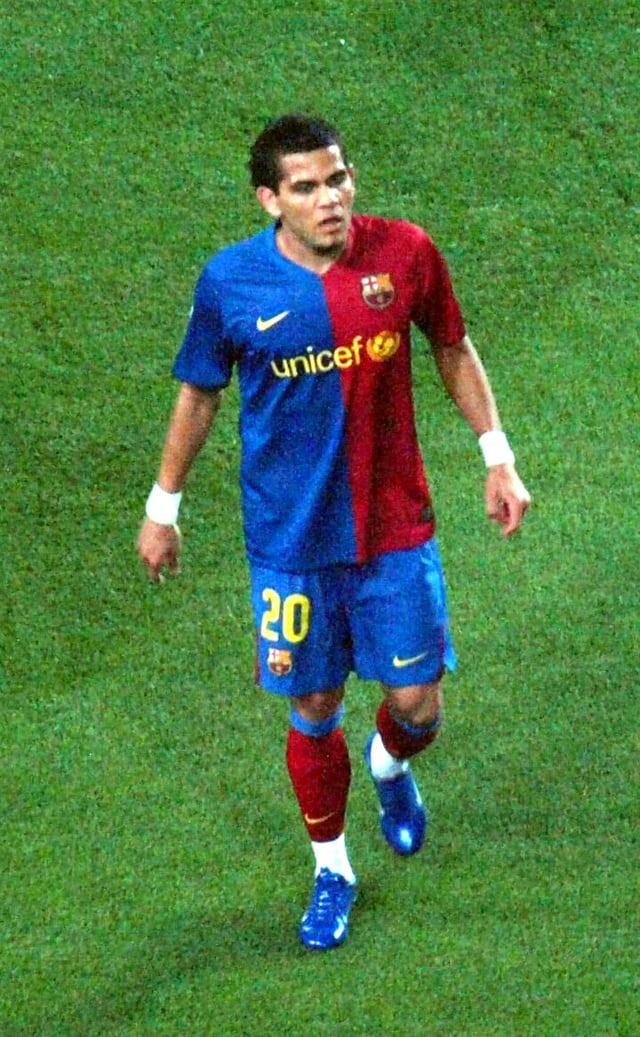
Summary
Dani Alves did not wait outside Lionel Messi's space. He ran beyond it, stepped inside it and kept offering the next pass until Barcelona's right side had one player too many for the defence.
Quick facts
- Primary role
- Right back
- Born
- 6 May 1983 in Juazeiro, Bahia
- Barcelona record
- 408 official matches across two spells
- Champions League
- Three titles with Barcelona
- Brazil record
- 127 senior appearances in CBF's historical register
- Major international honours
- Two Copa Américas, two Confederations Cups and Olympic gold
- Profile
- Overlap, combination play, crossing, counter-pressing and midfield support
The spare man was wearing number two
Lionel Messi receives near the right touchline and turns inward. The opposing left-back follows him. Dani Alves does not stand still and admire the problem. He runs outside, takes the return pass, or steps into the gap Messi has just opened.
Sometimes the move ends with a cross. Sometimes Alves gives the ball straight back and runs again. The important part is the extra decision. A defence that had prepared for Messi now has to track a full-back arriving at winger speed, and the two Barcelona players rarely offer the same solution twice.
Alves was not the safest right-back ever, nor the most physically imposing defender. His case rests on how much football he added without changing his starting position on the team sheet. He could be an overlap, a midfielder, a counter-presser and a set-piece taker during the same passage of play.
He sits fifth in our all-time full-backs ranking. The players above him carry stronger defensive or World Cup arguments. Few made the attacking geometry of one flank feel so unfair.
Juazeiro taught the work before the stage arrived
Daniel Alves da Silva was born in Juazeiro, Bahia, on 6 May 1983. His father, Domingos, farmed melons and organised a local team. Alves worked on the land and played wherever the side needed him.
Bahia gave him the professional route. He began as a midfielder before settling on the right, a detail that helps explain why his later full-back play never looked limited to crossing from the outside. He wanted touches in combinations and understood the passing lane inside the winger.
Sevilla first took him to Spain on loan in 2002. He was nineteen, slight and not yet the relentless presence Barcelona supporters would recognise. The club made the move permanent after Brazil won the 2003 Under-20 World Cup.
The transfer was a leap in geography and football. Alves had to defend La Liga wingers, learn the timing of a more structured European game and prove that his appetite to attack would not leave every transition to a centre-back.
Sevilla turned the runner into a European player
The first season brought only ten league appearances. By the middle of the decade, Alves had become essential to the best Sevilla side in generations.
Juande Ramos used Jesús Navas high on the right and Alves behind him. The pair could stretch one defender with width, then exchange positions before the next challenge arrived. Alves still overlapped, but he also came inside to pass or shoot. The full-back label described where he began, not every place he visited.
Sevilla won the 2006 UEFA Cup by beating Middlesbrough 4-0. Alves started the final. Three months later he was Player of the Match when Sevilla beat Barcelona 3-0 in the UEFA Super Cup, a performance that advertised his range against the club he would later join.
The team retained the UEFA Cup in 2007 and added the Copa del Rey. Two European wins matter because they prevent his story from beginning beside Messi. Alves had already driven a rising team through major knockout matches.
UEFA’s later Champions League profile records the origin plainly: winger at Bahia, right-sided partnership with Navas at Sevilla, then Barcelona. Each step kept a piece of the previous role.
Guardiola’s first signing solved the right side
Barcelona signed Alves in the summer of 2008. He became the first new player of Pep Guardiola’s first-team era.
The fit was immediate but not simple. Messi was moving from a conventional right-wing starting point toward central spaces. A cautious full-back would have left the touchline empty. A reckless one would have run beyond the ball and stranded the defence. Alves had to judge when Messi needed width, when he wanted a wall pass and when the safest contribution was an early counter-press.
Barcelona won La Liga, the Copa del Rey and Champions League in 2008/09. Alves was suspended for the European final against Manchester United, so his medal should not be written as a final appearance. He had played throughout the run and helped build the team that reached Rome.
The distinction is useful. Trophy lists compress a season into one line. A proper profile asks what the player did on the way there and what happened in the decisive match.
The Messi partnership worked because neither man stayed put
The familiar picture has Alves sprinting outside while Messi cuts in. That happened often, but repetition alone would have made it defendable.
Alves might begin the overlap and stop, holding the opposing full-back wide while Messi carried toward the box. He could receive inside, play a first-time pass and continue through the middle. When Messi dropped toward midfield, Alves sometimes became the highest player on the right.
Their short passing mattered as much as the long run. Alves trusted Messi to return the ball in tight space; Messi trusted Alves to arrive again after releasing it. One-two combinations turned the sideline from a boundary into a third player because the ball could bounce through the space before the defender reset.
This was system football, not a private trick. Xavi and Andrés Iniesta controlled the central angles, Sergio Busquets guarded the structure and the nearest forward shaped the last line. Alves could take risks because the team understood the next action.
He still deserves individual credit. Many full-backs have played beside great wingers without reading them so fluently.
His attacking game contained several jobs
Alves could cross early, but he was rarely reduced to it. His low cut-backs found runners arriving behind the defensive line. His clipped passes attacked the far post. From a narrower position, he could reverse the ball into Messi or a midfielder.
He also shot from distance and took free kicks. Those actions forced defenders to step toward him rather than treating every touch as preparation for another player.
The engine supported the technique. After losing possession high, Alves pressed immediately. A clean recovery let Barcelona keep the attack alive; even a delayed counter gave teammates time to restore the shape.
There was a cost. Space appeared behind him, especially when the first press failed. Centre-backs and the holding midfielder often had to slide across. His defending was aggressive and competitive, but it was not the calm one-against-one insurance offered by Maldini or Cafu.
That trade belongs in the ranking. Alves’s attack was valuable enough to justify structural protection. It did not make the protection imaginary.
Three Champions Leagues describe three versions of the team
Alves won the Champions League with Barcelona in 2009, 2011 and 2015. The 2011 side was the purest Guardiola version: possession, pressing and a 3-1 final win over Manchester United. Alves started at Wembley and spent much of the night pushing United’s left side backward.
By 2015, Barcelona’s front line had changed. Neymar and Luis Suárez joined Messi, creating a more direct attack. Alves adjusted. He still combined on the right, but the team could now travel forward faster and finish moves before a long positional sequence developed.
Barcelona’s historical database records 408 official appearances across two spells. Other club pages mix official and unofficial games or display older totals, which explains why a single search can produce 408, 409 or 431. This profile uses the club’s stated official count and labels it.
The honours are less ambiguous at the top: three Champions Leagues and six La Liga titles. Barcelona also credits four Copas del Rey, four Spanish Super Cups, three Club World Cups and three UEFA Super Cups.
One season at Juventus proved the role could travel
Alves left Barcelona in 2016 and joined Juventus. The move lasted one season, yet it removed an easy objection to his career: that the attacking work existed only inside Barcelona’s possession system.
Juventus used him as a right-back and wing-back. He helped the club win Serie A and the Coppa Italia, then reach the Champions League final. His crossing, combinations and late arrivals were prominent in the knockout rounds.
Real Madrid won the final 4-1. Alves did not add a fourth European Cup, but the run showed he could interpret a different structure, league and set of forwards at thirty-four.
Paris Saint-Germain followed. He won domestic trophies in France and occasionally played in midfield, making explicit what his Barcelona movement had long suggested. The feet and decisions belonged centrally even when the team sheet placed him on the flank.
Brazil gave him longevity without a World Cup title
The Brazilian federation’s historical register lists Alves with 127 senior appearances. When checked on 21 August 2026, that placed him fourth among the men’s national team’s appearance leaders, behind Cafu, Roberto Carlos and Neymar.
He won the Copa América in 2007 and 2019, plus the Confederations Cup in 2009 and 2013. The 2019 title carried special weight. At thirty-six, he captained Brazil and CONMEBOL named him the tournament’s best player.
The World Cup record is thinner. He appeared at the 2010 and 2014 tournaments, missed 2018 after a knee injury and returned in 2022. FIFA records that his appearance against Cameroon at 39 years and 210 days made him Brazil’s oldest men’s World Cup player at the time.
He never won the competition. That gap matters when comparing him with Cafu, captain of the 2002 champions, or Carlos Alberto Torres, captain in 1970.
Alves did add Olympic gold in Tokyo. Brazil selected him as an over-age player, and he captained a younger squad through the 2021 tournament. It was not a senior World Cup substitute. It was a distinct achievement built on durability and leadership.
The 46-trophy claim needs its label
Barcelona has described Alves as the most decorated footballer and credits him with 46 trophies. The number includes competitions from Bahia, Sevilla, Barcelona, Juventus, Paris Saint-Germain, São Paulo and Brazil.
Trophy totals are not governed by one universal ledger. Some counts include state championships, youth titles or one-match super cups; others narrow the field. A player can move up or down an all-time list without winning anything new simply because the compiler changes the rules.
The sensible wording is therefore specific: Barcelona credits Alves with 46. The claim demonstrates extraordinary winning across clubs and countries. It should not be presented as an uncontested record independent of counting method.
The return to Barcelona was brief
Alves returned in late 2021, aged thirty-eight, to work under Xavi. Registration rules delayed his first competitive appearance until January 2022.
He played 17 official matches in the second spell. The pace had changed, but the habits had not. He still moved inside to help the buildup and looked for the quick pass around the right corner.
Barcelona announced his departure in June 2022. Pumas UNAM became his final club. The Mexican side terminated his contract in January 2023 after his arrest in Spain.
That ending cannot be folded casually into a paragraph about ageing legs. It belongs to a separate legal record with precise language.
The legal record must be stated without rewriting the rulings
A Barcelona trial court convicted Alves of sexual assault in February 2024 and sentenced him to four years and six months in prison. He denied the accusation and appealed.
In March 2025, the Catalan High Court unanimously overturned the conviction and acquitted him, finding the evidence insufficient to overcome the presumption of innocence. Associated Press reported both the original ruling and the appellate result.
Spanish prosecutors filed an appeal to the Supreme Court in May 2025. This page, checked on 21 August 2026, does not infer a later result from the absence of one in the sources reviewed. It will change only when a directly verified court notice or reliable report establishes the next disposition.
The football ranking and the legal history answer different questions. His work on the pitch can be evaluated without erasing the case, and the case must be reported without pretending an editorial football site can retry it.
Fifth is a judgment on the whole full-back job
Alves has a reasonable argument for the best attacking right-back of the modern era. His Sevilla work, Barcelona partnership with Messi, Juventus adaptation and Brazil longevity make the case much broader than assists.
Fifth is where this ranking balances the record. Cafu offers stronger World Cup evidence and a more secure defensive floor. Maldini and Philipp Lahm gave elite teams greater control without needing the same cover. Roberto Carlos matched attacking force from the opposite side and added a World Cup-winning peak.
Alves remains ahead of many great defenders because he changed the number of usable players in possession. He did not merely support the attack. On his best nights, he became one of its organisers while still starting from right-back.
The run outside Messi is the image people remember. The reason it kept working was the thought before the run: where the defender looked, which teammate had moved and whether Barcelona needed width, a pass inside or one more sprint to make the side crowded again.
Sources
Sources checked
- FC Barcelona - Dani Alves leaves after 408 competitive appearances
- FC Barcelona - Dani Alves club legend profile
- UEFA - Dani Alves in the Champions League 100 club
- Sevilla - the club's first UEFA Cup era
- CBF - Brazil all-time appearance leaders
- CONMEBOL - Copa América 2019 technical report
- FIFA - Dani Alves becomes Brazil's oldest World Cup player
- AP - appeals court overturns Dani Alves conviction
- El País - prosecutors appeal the acquittal
FAQ
How many games did Dani Alves play for Barcelona?
FC Barcelona records 408 official appearances across his 2008-2016 and 2021/22 spells. The club's broader historical database also lists unofficial matches, which is why some totals differ.
How many Champions Leagues did Dani Alves win?
He won three with Barcelona, in 2009, 2011 and 2015. He was suspended for the 2009 final but had been a regular during the campaign.
Why did Dani Alves work so well with Lionel Messi?
Messi moved inside from the right, while Alves supplied width, overlaps and quick return passes. Their movement forced the opposing full-back and midfielder to choose between two connected threats.
How many times did Dani Alves play for Brazil?
CBF's historical register lists 127 senior appearances, fourth among Brazil's men when checked on August 21, 2026. He played at the 2010, 2014 and 2022 World Cups.
Was Dani Alves the most decorated footballer ever?
Barcelona credits him with 46 trophies and has called him the most decorated player. Trophy counts vary when minor, regional and short-format competitions are included, so the scope should stay attached to the number.
What is the latest court outcome included on this page?
A Catalan appeals court overturned his sexual-assault conviction and acquitted him in March 2025. Spanish prosecutors filed a Supreme Court appeal in May 2025; this profile does not claim a later result without a directly verified court or major-news source.