
player
Jurrien Timber: The Defender Who Connects Arsenal's Lines
Jurrien Timber's career from Ajax to Arsenal, with his hybrid full-back role, one-on-one defending and 2025/26 Premier League title explained.
Summary
Timber gives Arsenal several shapes without requiring a substitution. He can defend the touchline as a full-back, step into midfield during build-up or close the back line as an extra centre-back.
Quick facts
- Primary roles
- Right-back and centre-back
- Current club
- Arsenal, number 12 (checked August 30, 2026)
- Born
- June 17, 2001, Utrecht, Netherlands
- Development route
- Feyenoord and Ajax academies before Ajax's first team
- 2025/26 league season
- Premier League champion and Fan Team of the Season selection
A position can change before the move is finished
Jurriën Timber may appear on the team sheet at right-back, but that label describes only where the possession begins. When Arsenal build, he can move inside beside a midfielder. When the ball is lost, he can close the channel as a conventional full-back or narrow into a line of three centre-backs.
The value is not novelty for its own sake. Each movement changes an opponent’s decision. A winger who follows Timber inside leaves the touchline available; one who stays wide allows Arsenal an extra passing option in the centre. Mikel Arteta can therefore adjust the structure without changing personnel.
Our ranking of the best defenders in the world right now places Timber tenth after Arsenal’s 2025/26 Premier League title. Supporters also voted him into the competition’s Fan Team of the Season alongside three other Arsenal defenders.
Ajax taught him to defend with the ball nearby
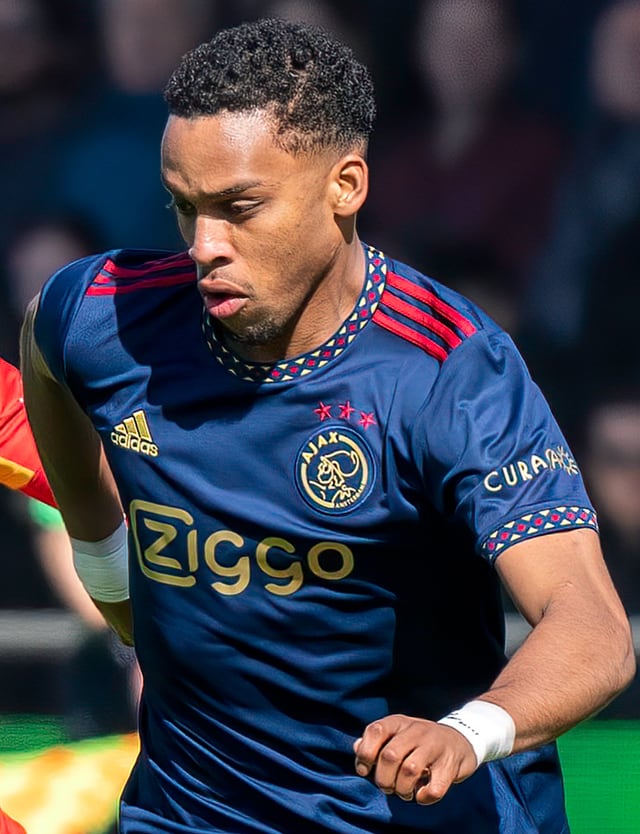
Timber was born in Utrecht and spent part of his youth development at Feyenoord before joining Ajax. He reached the senior team in a club where a defender is judged not only by tackles, but by the quality of the team’s first pass.
Ajax centre-backs regularly receive with forwards trying to close them. They must recognise whether to play through pressure, carry beyond it or move the ball quickly enough to create a free player elsewhere. Timber learned those decisions in central defence, even though his height was often discussed more than his reading of the game.
Arsenal signed him in 2023 because the same habits could translate across positions. Timber himself has noted similarities between the clubs: both expect defenders to participate in attacking football and both place young players inside demanding tactical systems.
The first Arsenal season became rehabilitation
Timber’s competitive Arsenal debut brought a Community Shield win, but his first league appearance ended with an anterior cruciate ligament injury. He missed nearly all of 2023/24. The setback matters to his profile because the role he returned to required trust in turns, contact and rapid changes of direction.
Recovery was not simply a matter of being medically available. A full-back defending an isolated winger has to plant, rotate and accelerate without protecting the injured leg. Arsenal gradually restored those demands rather than treating the first appearance back as the end of the process.
By the title-winning 2025/26 season, Timber was no longer framed mainly through the injury. He was part of the champion’s normal defensive structure.
Why he is difficult to isolate
Timber is compact in one-on-one situations. He lowers his centre of gravity, stays close enough to contest the next touch and tries not to reveal the direction of his challenge too soon. An attacker may have more room outside than he appears to, but reaching that room requires carrying the ball across Timber’s body.
His centre-back experience helps when the winger moves inside. Timber is comfortable following the run into traffic and passing responsibility to a team-mate when the movement becomes central. He does not have to defend every action as a pure race down the line.
There are physical limits. Taller forwards can target the far post, and an aggressive starting position can leave space behind him. Arsenal reduce that risk through the recovery speed of William Saliba and the way the midfield protects a turnover.
Moving inside is a practical solution
The phrase “inverted full-back” can make the role sound more mysterious than it is. Timber moves inside to give the ball carrier another short option and to place an extra defender near the centre if possession breaks down.
He does not need to become the main playmaker. His job is often to receive, turn the pressure and find the next player. If an opponent closes him, someone else should be free. If the opponent waits, Timber can carry forward until that decision changes.
That movement also lets Arsenal hold attacking players higher. A winger can stay near the touchline instead of dropping to help the build-up, while the full-back occupies the supporting lane underneath.
One piece of a flexible back line
Gabriel Magalhães supplies left-footed balance and box authority. Saliba manages open space on the right. Timber connects those centre-backs to midfield and can become the outside defender when Arsenal need a wider last line.
The partnership is therefore bigger than a fixed back four. Arsenal can attack in one shape and defend in another, with Timber acting as the hinge between them. David Raya adds another passer behind the line, making the first phase harder to press with only two forwards.
Timber’s current standing depends on that versatility remaining precise. Playing several roles is valuable only when the decisions in each role are reliable. The 2025/26 title supplied the clearest evidence yet that Arsenal can trust those changes over a full season.
Sources
Sources checked
FAQ
What position does Jurrien Timber play?
Timber can play at right-back or centre-back. Arsenal often use him as a full-back who moves into narrower midfield or defensive positions during the same match.
Which club does Jurrien Timber play for?
Timber plays for Arsenal. His current squad status was checked on August 30, 2026.
Did Jurrien Timber suffer a major injury at Arsenal?
Yes. He suffered an anterior cruciate ligament injury in his first Premier League appearance in August 2023 and missed most of that season before returning.
Why can Jurrien Timber play in midfield areas?
His Ajax education made him comfortable receiving under pressure and passing through short central angles. Arsenal use those skills to add a player beside the midfield during possession.