
player
Marco van Basten: The Striker Who Finished the Impossible Ball
Marco van Basten's career with Ajax, AC Milan and the Netherlands, the technique behind his finishing, EURO 1988 and the injuries that shortened his peak.
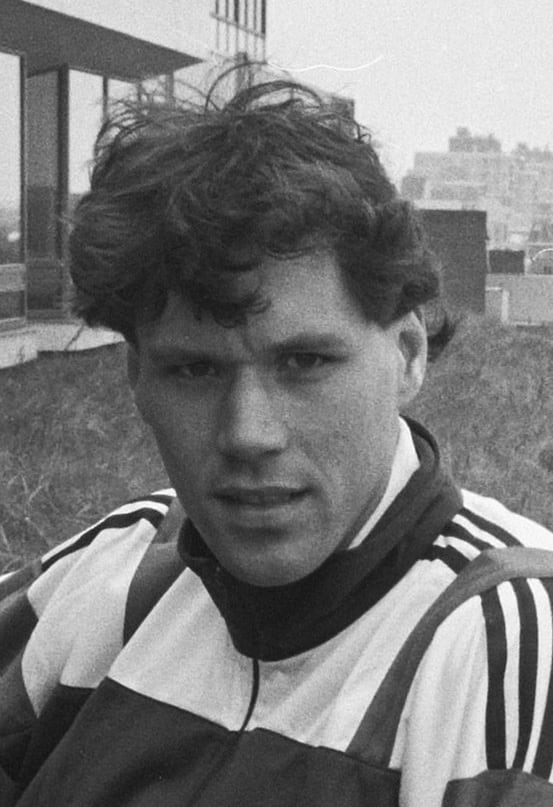
Summary
Van Basten adjusted his feet, hips and balance to deliveries that looked misplaced, then struck before the defender could benefit from the bad angle.
Quick facts
- Primary role
- Centre-forward
- Defining clubs
- Ajax and AC Milan
- AC Milan
- 125 competitive goals in the club's official all-time table
- Netherlands
- 24 goals in 58 senior matches
- EURO 1988
- Champion and five-goal leading scorer
- Individual record
- Ballon d'Or winner in 1988, 1989 and 1992
The striker who made a bad ball usable
Marco van Basten scored plenty of ordinary striker goals. He got across a defender, met a cross and finished from close range. The unusual part was how many difficult deliveries he could rescue before the shot.
A pass could arrive behind him or at an awkward height. Van Basten adjusted his feet, let the ball travel across his body and found a clean contact anyway. His first touch did more than control possession. It changed the angle of the chance.
That skill made a tall centre-forward hard to reduce to one type. He could play with his back to goal, run beyond the line, finish with either foot and attack crosses in the air. When the penalty area became crowded, balance bought him the half-second that pace could not.
The career ended long before the technique failed. His last professional match came in 1993, with repeated ankle injuries preventing a return. The short ending is part of the all-time argument, but it should not erase what happened before it.
Ajax gave him the first-team shirt early
Van Basten was born in Utrecht on 31 October 1964 and joined Ajax as a teenager. He made his first-team debut in 1982, entering a club whose attacking players were expected to understand space as well as score.
The line through Johan Cruyff is easy to overstate, but there was a literal handover in Van Basten’s debut: he replaced Cruyff and scored. The older player represented an Ajax idea already built into the team. A forward could leave the centre if the movement created a better angle for someone else.
Van Basten soon became the main scorer. AC Milan’s official legend profile credits him with 152 goals in 172 Ajax appearances before the 1987 transfer. UEFA’s honours record lists three Dutch league titles, three Dutch Cups and the 1987 European Cup Winners’ Cup.
Those totals came before his 23rd birthday. They also came in a league that allowed Ajax to attack often, so the move to Italy would test whether the finishes survived tighter distances and more physical marking.
His first touch prepared the finish
Van Basten often received side-on rather than square to goal. That position kept two options alive. He could protect the ball with the far leg and bring a teammate into play, or let the pass run across him and shoot with the next contact.
The height of a delivery did not settle the method. A low cross might be guided with the inside of the foot. A bouncing ball invited a half-volley. If the pass arrived behind his stride, he could open his hips or change the contact instead of taking an extra touch that gave the defender time.
His length helped in the air, though the leap alone explains little. Van Basten moved away from a defender before attacking the ball. That small separation let him choose direction instead of merely winning the header.
None of this required every goal to look perfect. The technique mattered because it created a usable shot from service that had not landed perfectly.
Milan began with an ankle problem
AC Milan signed Van Basten in 1987 alongside Ruud Gullit. His first season brought a Serie A title but very little uninterrupted football. An ankle operation limited his appearances and made the early Italian months a rehabilitation story as much as a transfer story.
The 1988 summer looked like a sudden arrival only to viewers who had missed his Ajax years. Van Basten had already scored heavily. At the European Championship, his body finally allowed a wider audience to see the range again.
Milan then got the forward it had bought. The club’s official all-time scoring table credits him with 125 competitive goals. Its separate legend page currently displays conflicting match and goal totals, so this profile does not use either appearance figure.
The 125 belongs beside three Serie A titles and two European Cups. It should not be padded with a second total from a different club scope.
Sacchi asked the striker to defend forward
Arrigo Sacchi’s Milan compressed the pitch. The back line stepped up, the midfield moved as a unit and the forwards had to direct pressure instead of waiting for possession to return.
Van Basten’s job began with the opposing defenders. His run could close one passing lane and point the ball toward the side where Milan wanted to trap it. If the team recovered possession, he was already close enough to become the first attacking reference.
The Dutch trio did not share one vague role. Gullit carried power and invention across the front. Frank Rijkaard connected midfield control to the next pass. Van Basten occupied centre-backs, combined under pressure and finished the moves their work produced.
At San Siro, that compact football could feel relentless. Opponents had less room to play out and then had to defend a striker capable of using an imperfect first pass into the box.
Two European Cups showed different versions of Milan
Milan beat Steaua Bucharest 4-0 in the 1989 European Cup final. Van Basten scored twice and Gullit scored twice. The goals came after Milan’s pressure and passing had pulled the Romanian side apart, not from a forward standing outside the team structure.
The second title arrived a year later against Benfica. Rijkaard scored the only goal. Van Basten did not need to own the final touch for his movement to matter; occupying the centre and combining around the box remained part of Milan’s route through the match.
Back-to-back European Cups put the club at the top of a demanding era. They also placed Van Basten’s Ajax scoring habits inside a different tactical test. He was no longer receiving chances from a dominant Dutch attack every week. He had learned to create the shot against deeper experience and tighter marking.
The European run is one reason his shorter career can still sit near longer striker records. His first touch and finishing survived opponents who removed comfortable service, which says more about the peak than a goal rate on its own.
EURO 1988 took five goals, not one
The Netherlands lost its opening match of EURO 1988 to the Soviet Union. Van Basten began on the bench. He started against England next and scored a hat trick.
The three goals did not repeat one finish. He attacked space behind the line, adjusted in the box and used the ball arriving at different heights. The performance won him the place for the rest of the tournament.
Against hosts West Germany in the semi-final, Van Basten scored the 88th-minute winner by reaching a low ball before Jurgen Kohler could close him. The contact was not a full swing. It only had to redirect the pass beyond the goalkeeper.
That made four goals. The volley against the Soviet Union in the final was the fifth. UEFA lists him as the tournament’s leading scorer, and the Netherlands won its first major men’s title.
Reducing the tournament to the last goal misses the recovery after the opening defeat and the three different problems he solved before the final.
The final volley began with body position
Arnold Muhren’s cross travelled toward Van Basten on the right side of the penalty area. The angle looked too narrow for a direct shot. Letting the ball drop might have invited the defender and goalkeeper to reset.
Van Basten stayed side-on, watched the flight and met it before that reset. His right foot travelled through the ball while his body leaned away from goal. The contact sent the volley across Rinat Dasayev and inside the far side.
Luck belongs in any strike from that position, and Van Basten later acknowledged as much to UEFA. The preparation was still his. Balance gave the foot a clean path to the ball, and striking early removed the normal defensive response.
The goal is remembered because it looked unreasonable. It also fits the rest of his game: take a delivery that appears wrong and make the first contact decisive.
The 1992 peak had more than awards
Van Basten won the Ballon d’Or in 1988 and 1989, then won it a third time in 1992. UEFA’s archive lists the three years, but the football beneath the last award deserves attention.
He finished as Serie A’s leading scorer while Milan won the 1991/92 title without losing a league match. The team had moved from Sacchi to Fabio Capello, asking Van Basten to solve matches in a slightly less frantic structure.
On 25 November 1992, he scored all four goals against IFK Goteborg. UEFA records it as the first four-goal performance in a Champions League match. One of them was an overhead kick, another answer to a ball that did not arrive as a standard centre-forward chance.
The season shows why the peak cannot be filed under one coach or one summer with the Netherlands. Van Basten remained decisive as Milan’s structure changed around him.
The Netherlands record includes 1992
The Dutch federation records 24 goals in 58 senior appearances. Five came at EURO 1988, but the international story continued through the 1990 World Cup and EURO 1992.
The Netherlands reached the 1992 semi-final against Denmark. The match finished 2-2 and went to penalties. Peter Schmeichel saved Van Basten’s kick, the only miss of the shoot-out, and Denmark advanced.
One failed penalty is a poor summary of 58 matches. It does belong in the record because tournament careers include the action that goes wrong as well as the famous finish. Van Basten had been part of the attack that brought the defending champion back into the game before the shoot-out.
The national total is strong without being unusually long. It is another place where his case rests on concentration of quality rather than accumulated seasons.
The last match came two years before retirement
Van Basten played in Milan’s 1-0 loss to Marseille in the 1993 Champions League final. UEFA identifies it as his last professional match.
He did not announce retirement that night. More ankle treatment and attempts to return followed, but he never played another competitive game. The formal retirement came in 1995.
Keeping those dates separate avoids a neat but false ending. The playing career effectively stopped in 1993; the decision became official two years later.
AC Milan’s current legend page contains an incorrect age in its retirement sentence. This profile uses the documented dates instead. They say enough: a three-time Ballon d’Or winner did not play again after the 1993 final.
Why Van Basten ranks among the great strikers
Van Basten is fourth in our ranking of the best football strikers of all time. Longevity is the obvious weakness. The final competitive appearance arrived before his 29th birthday, and the attempted comeback never produced another match.
The peak carries unusual weight. There were 152 goals for Ajax in the scope used by Milan’s official profile, 125 competitive goals for Milan, three Ballon d’Or awards, two European Cups and the five-goal EURO 1988 title run.
Gerd Muller offers the stronger accumulated scoring record and a different penalty-box economy. Van Basten’s case rests more heavily on the range of service he could solve. The shot did not have to be presented cleanly.
That is what survives beyond the final volley. A cross arrives too high, too far behind or at an angle that should end the move. Van Basten adjusts once, and the bad ball becomes a finish.
Sources
Sources checked
- AC Milan - Marco van Basten legend profile
- AC Milan - official all-time scoring table
- UEFA - EURO 1988 tournament review
- UEFA - EURO 1988 final report
- UEFA - Ballon d'Or winners archive
- OnsOranje - Marco van Basten international record
- UEFA - Van Basten's last professional match
- Ajax - Marco van Basten's first-team debut
FAQ
How many goals did Marco van Basten score for the Netherlands?
The Dutch federation records 24 goals in 58 senior international appearances.
How many Ballon d'Or awards did Marco van Basten win?
Van Basten won the Ballon d'Or three times, in 1988, 1989 and 1992.
What did Marco van Basten win at EURO 1988?
He won the European Championship with the Netherlands and finished as the tournament's leading scorer with five goals, including the final volley against the Soviet Union.
Why did Marco van Basten retire early?
Repeated ankle injuries stopped him from playing after the 1993 Champions League final. His retirement was formally announced in 1995 after attempted rehabilitation.
What was Marco van Basten's playing style?
Van Basten was a tall, mobile centre-forward with an unusually clean first touch, two-footed finishing and the balance to adjust to crosses, volleys and awkward passes.