
player
Gerd Muller: 365 Bundesliga Goals and the Art of the Box Striker
Gerd Muller's career with Bayern and West Germany, the movement and finishing behind 365 Bundesliga goals, and his decisive World Cup record.
Summary
Müller's records came from a repeatable penalty-box skill: reading the next touch early, staying balanced in traffic and finishing before defenders could turn a half-chance into a safe situation.
Quick facts
- Primary role
- Centre-forward / penalty-box striker
- Main club
- Bayern Munich
- Bundesliga record
- 365 goals in 427 appearances
- West Germany record
- 68 goals in 62 senior matches
- World Cup record
- 14 goals across 1970 and 1974; champion in 1974
- Profile
- Compact, instinctive finisher who created shots with tiny movements
The short answer
The penalty area could be packed and untidy, which suited Gerd Müller perfectly. A loose ball, an unbalanced defender and half a yard were usually enough. By the time the danger looked obvious, he had already shot.
For Bayern Munich, that gift produced 365 Bundesliga goals in 427 games. West Germany got 68 goals from his 62 appearances, and 14 of those international goals came across two World Cups. The last one settled the 1974 final.
Those are separate competition totals, not parts of one invented grand total. Read together, they show how often the same penalty-box craft survived a change of opponent or setting. Müller was not living off one spectacular summer.
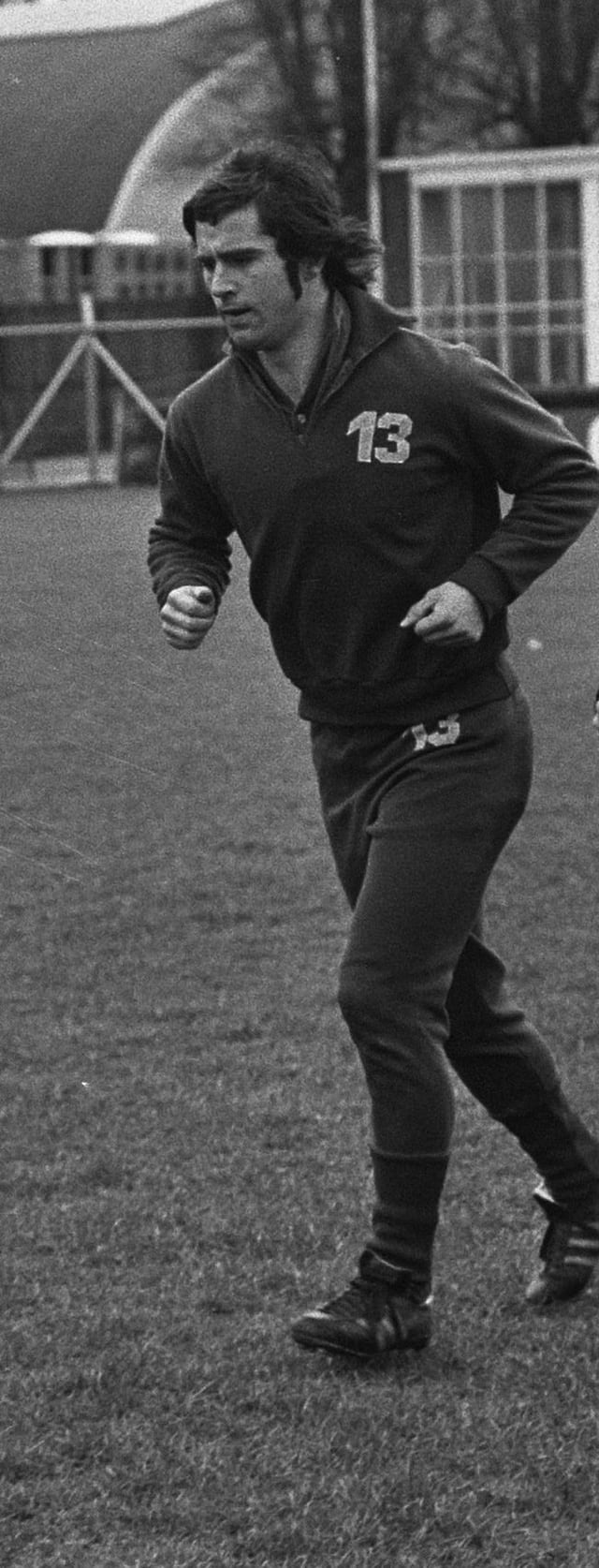
Freeze the film and Müller can look awkward, neither tall like a traditional target man nor standing in the clean space expected of a great scorer. Let the picture run and the impression changes. The crowded position was exactly where his balance and quick release hurt defenders most.
From Nördlingen to Bayern
Born in Nördlingen on November 3, 1945, Müller first played senior football for his hometown club. Bayern arrived in 1964. Their timing placed a prolific young striker inside a side that was about to outgrow its previous limits.
The club entered the Bundesliga in 1965 with Franz Beckenbauer influencing play from deep and Sepp Maier in goal. Müller supplied the part at the other end. Bayern’s climb and his own cannot really be separated, as the Bayern Munich profile makes clear.
Bayern’s Hall of Fame gives Müller 566 goals in 607 competitive appearances for the club. That figure covers all competitions. His famous total of 365 applies only to the Bundesliga.
Historical scoring numbers become messy when league, cup and European matches are mixed with friendlies or exhibitions. There is no reason to do that here. Müller’s official competition records already tell the story.
How Müller found space that barely existed
People often call great penalty-box movement instinctive. That describes its speed but hides the work involved. Müller’s movements were small and specific.
He watched the defender while reading the next touch. A cross that looked likely to deflect sent him toward the second ball before the clearance was made. When a teammate prepared to shoot, he was already moving for the rebound. If the centre-back turned toward the ball, Müller slipped into the space behind the turn.
Most of this happened over a yard or two. Half a step across a defender could decide who reached the ball first. One quick turn moved the shot out from behind a blocking leg without taking Müller away from goal.
His build helped him stay upright through contact. He could rotate with his feet still close to the ball, so there was no need for an extra settling touch. Some finishes looked poked or improvised. The goalkeeper did not get extra credit for their appearance; the ball had already gone past him.
That early release was the signature. Müller often won the chance before the strike, simply by making sure a shot existed at all.
What the World Cup goals reveal
FIFA’s review of West Germany’s 1974 champions puts useful detail behind the reputation. Every one of Müller’s 14 World Cup goals came from inside the penalty area, and seven came from inside the six-yard box. Five were headers and two were volleys.
Miroslav Klose later became the German who passed that total, reaching 16 across four World Cups. The comparison needs both halves: Müller scored 14 in two editions, while Klose’s case rests on repeating the work over a much longer tournament span.
So he was not merely a collector of scruffy finishes along the ground. Nor did his lack of traditional centre-forward height stop him in the air. Timing got him to headers in dangerous positions; balance let him meet awkward balls on the volley.
Müller did not need to dominate an attack from beginning to end. He needed the ball to enter the area once. By then, his movement had improved the chance that he, rather than the nearest defender, would touch it first.
That is the case behind his high place in our all-time striker ranking. The goal totals matter because they record the same specialised skill being repeated on a huge scale.
The Bundesliga record
The Bundesliga’s career scoring list still starts with Müller: 365 goals, every one for Bayern, from 427 appearances. Robert Lewandowski did take one famous record from him, scoring 41 in 2020/21 to pass Müller’s single-season mark of 40. The longer chase ended short of 365.
It is possible to admire both achievements without treating them as the same test. One belongs to a peak season; the other required elite scoring to survive years of new teammates, new opponents and an ageing body.
Müller repeatedly finished as the Bundesliga’s leading scorer in the late 1960s and 1970s. Bayern could approach the box in different ways, yet he kept being ready for the final ball. That tactical consistency matters more than a list of scoring awards.
Scoring 365 times in fewer than 430 league matches remains startling. It also belongs to its era. Pitches, substitutions, defensive methods, match tempo and competition formats have changed. A cross-era comparison is useful only when those differences are acknowledged, not when they are used to make the record disappear.
Bayern’s European breakthrough
Müller’s years in Munich took Bayern from an emerging domestic side to a European power. The Cup Winners’ Cup came in 1967. Between 1974 and 1976, they won the European Cup three years running; his main era also brought four Bundesliga titles and four German Cups.
Calling them Müller’s trophies alone would flatten a great team. Franz Beckenbauer advanced the ball and imposed order, Maier protected the goal, and Uli Hoeneß and Franz Roth supplied different kinds of movement and direct running.
Müller completed their attacks. It sounds like a narrow task, but his presence changed the room available to everybody else. Centre-backs stayed close to goal because they feared his first step. Midfielders found more space at the edge of the area. A low pass or an untidy cross remained dangerous after the original move had broken down.
Bayern’s Hall of Fame treats his scoring as central to that golden period. The team created the conditions; Müller made them exceptionally productive.
Mexico 1970
Müller scored ten goals at his first World Cup. There were hat tricks against Bulgaria and Peru, then knockout goals against England and Italy. The semifinal against Italy finished 4-3 after extra time and became one of the matches most closely associated with Mexico 1970.
Ten goals won him the tournament’s scoring title. Jairzinho scored in all six of Brazil’s matches and finished with seven, but he attacked from the right rather than living as close to goal as Müller did. The comparison is a reminder that equal-looking columns can contain very different jobs.
Only Just Fontaine and Sándor Kocsis have scored more in one men’s World Cup. Eusebio reached nine in 1966, the tournament immediately before Müller’s ten-goal run, and did it through a more direct carrying and long-range threat.
Later German scorers took a longer route. Jurgen Klinsmann reached eleven across three tournaments, while Miroslav Klose needed four editions to move beyond Muller’s career total.
West Germany took third place, not the trophy. Even so, the tournament showed that Müller’s Bundesliga game held up against international defenders and in knockout matches.
It also keeps the 1974 final from becoming his entire World Cup story. By the time he became a champion, Müller had already produced one of the competition’s great scoring campaigns.
The 1974 winner
Four goals at the home World Cup in 1974 carried Müller’s tournament total to 14. Number 14 was the one West Germany needed most, against the Netherlands in the final.
After Johan Neeskens scored an early penalty for the Dutch, Paul Breitner made it 1-1. Müller struck before half-time. He received with part of his back to goal, found his balance in the traffic and shot past Jan Jongbloed quickly enough to win a final that finished 2-1.
It was a very Müller goal. The body position looked wrong, the space was poor and the defence seemed close enough. He still got the shot away before the chance vanished.
He never scored another senior international goal. His DFB line therefore ends with that final winner: 68 goals from 62 matches, plus team honours at the 1972 European Championship and 1974 World Cup.
Our greatest World Cup players list considers the ten-goal run in 1970 alongside the final winner four years later. The all-time scorers table places his 14 in historical order while leaving room for the different ways players reached their totals.
The final playing years
In 1979, Müller exchanged Bayern for the Fort Lauderdale Strikers in the United States. It was the closing chapter of his playing career, not the period on which his historical case rests; that had been built in Munich and with West Germany.
Later, he returned to Bayern and helped younger players. What looked instinctive in his own game had trainable parts: the glance before a pass, balance under contact and the timing of that first small step.
Müller was 75 when he died in 2021. Record books preserve the scale of what he achieved, but an old clip explains the football better. There is the loose ball, almost no room and two defenders close by. Then there is the shot, already too late to block.
What modern strikers can copy
The 1960s and 1970s cannot be recreated for a modern striker, but parts of Müller’s game travel well. Prepare before the pass. Expect rebounds rather than treating them as accidents. Stay balanced after contact. When the opening comes, do not spend an extra touch making the finish pretty.
Ronaldo Nazario could carry the ball into the area at explosive speed. Pele mixed scoring with a much broader creative role. Müller’s model was narrower and deeper: he made the last few yards feel roomy for Bayern and cramped for every defence.
The 365 Bundesliga goals, 68 internationals and 14 World Cup goals remain separate records. Each one points back to the same habit of reaching a small opening first.
Ranking context
Müller appears in three historical lists on The Top Football: strikers, World Cup players and World Cup scorers. Those rankings answer narrower questions than a career profile can.
His case does not depend on pretending that every football era is directly comparable. The evidence is strong without that shortcut: no one has matched his Bundesliga career total, his West Germany scoring rate was above a goal a game, and his two World Cups included both a ten-goal tournament and a final winner.
Defenders knew Müller wanted the ball close to goal. They were rarely confused about his destination. The problem was the second between seeing where he had gone and stopping the shot.
Sources
Sources checked
FAQ
How many Bundesliga goals did Gerd Muller score?
Müller scored 365 goals in 427 Bundesliga appearances, all for Bayern Munich. He remains the competition's all-time leading scorer.
How many goals did Gerd Muller score for West Germany?
The DFB records 68 goals in 62 senior internationals between 1966 and 1974. That is a national-team total and should not be combined with his club figures.
How many World Cup goals did Gerd Muller score?
He scored 14 World Cup goals: ten in 1970 and four in 1974. He reached that total across two tournaments.
What was Gerd Muller's playing style?
Müller was a compact penalty-box striker with exceptional anticipation, balance and finishing speed. He used short changes of direction and quick turns to shoot before defenders could reorganise.
Did Gerd Muller score in the 1974 World Cup final?
Yes. Müller scored West Germany's second goal in the 2-1 final victory over the Netherlands. It was the winning goal and his last senior international goal.