
player
Nat Lofthouse: Bolton's Centre-Forward and the Lion of Vienna
Nat Lofthouse's Bolton career began in wartime, with football around mining shifts. The England goals, Vienna nickname and two Wembley finals followed.
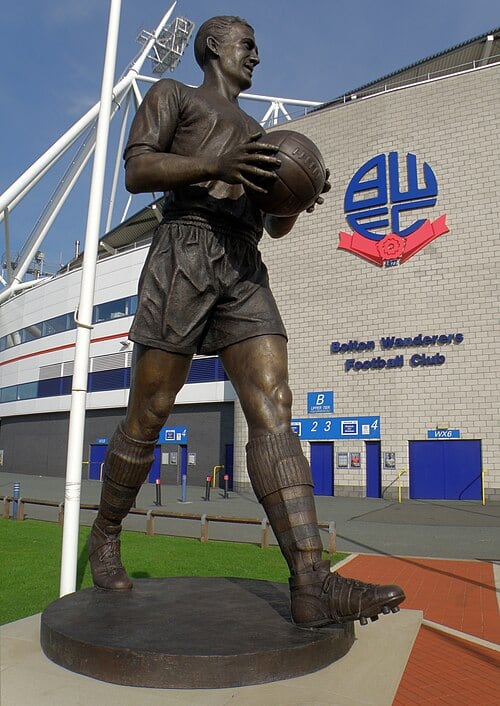
Summary
Strong in the air and able to shoot with either foot, Lofthouse was a defining post-war centre-forward. He gave Bolton his whole playing career, scored freely for England and won the 1958 FA Cup with two goals in the final.
Quick facts
- Primary role
- Centre-forward
- Defining club
- Bolton Wanderers
- England senior record
- 33 caps / 30 goals
- Bolton league goals
- 255, as recorded by the club
- 1958 FA Cup final
- Scored both Bolton goals against Manchester United
- Nickname
- The Lion of Vienna
A Bolton career shaped by wartime football
Nat Lofthouse signed for Bolton Wanderers as a 14-year-old apprentice on 4 September 1939. His first football for the club came during the war, years before the league debut that begins his official record. He scored twice against Bury in a 5-1 wartime win in 1941; in 1946, he scored twice again on his league debut, a 4-3 defeat by Chelsea.
We keep those records separate, following Bolton’s own account. Football carried on through the war, but its matches don’t all belong in the league totals used to compare careers.
He was also working underground. Lofthouse became a Bevin Boy in 1943 and worked at Mosley Common. The museum’s account of a typical Saturday has him getting up at 3.30am, taking a 4.30am tram and spending eight hours in the mine before joining the team bus for a match. That was part of his wartime life, rather than the routine for his entire career. It gives some substance to a phrase like “wartime football”: a young player’s match could follow a working shift.
What he offered at centre-forward
Strength, heading and shooting with either foot are the qualities picked out by the National Football Museum. A defender had to deal with him when the ball was in the air, without being able to relax when a chance came along the ground.
The physical presence mattered because he could turn it into goals. Being awkward to mark wouldn’t, by itself, explain his standing. Bolton records 255 league goals, a return built over seasons. Add the 30 domestic cup goals recorded by UEFA and the total becomes 285. Both figures can appear in accounts of his career; the difference is which competitions they count.
He won the Football Writers’ Association Footballer of the Year award in 1953, five years before the 1958 cup final. His reputation was already established by then. The museum included him among its inaugural Hall of Fame inductees in 2002.
Thirty England goals in thirty-three caps
Lofthouse began his England career with two goals in a draw against Yugoslavia at Highbury in 1950. The performance behind his Lion of Vienna nickname followed two years later. With England and Austria level at 2-2, he was put through on a counterattack, slipped the ball past the goalkeeper and was knocked unconscious in the challenge. England won 3-2.
As the museum recounts, Lofthouse said, “I never saw the ball enter the Austrian net for the goal of my life.” The Lion of Vienna nickname came from that performance.
His final record was 30 goals in 33 appearances: 0.91 per cap, rounded to two decimal places. Our England all-time top scorers table puts him level with Tom Finney and Alan Shearer. We give them the same rank because they scored the same number of goals. The caps column is there too, so you can see how differently they reached 30.
Wembley, defeat and then victory
Bolton lost the 1953 FA Cup final to Blackpool. Lofthouse was back at Wembley in 1958, and both goals in Bolton’s 2-0 win over Manchester United were his. The museum describes the second as a charge that carried the goalkeeper and ball over the line.
Wembley was a high point, with substantial league and England scoring elsewhere in his career. His commitment to Bolton went on past retirement in 1960: he worked in coaching, management, scouting and executive roles. President from 1986, Lofthouse also received an OBE in 1994. When he died in 2011, UEFA’s obituary recorded that he had spent his whole playing career with his hometown club.
Comparisons with modern centre-forwards need room for those circumstances. His 33 England appearances are a much shorter sample than the hundred-cap careers of later scorers, while wartime football shaped the start of his career. His scoring rate is impressive. It doesn’t require us to treat the opportunities available in each era as identical.
Sources
Sources checked
FAQ
How many goals did Nat Lofthouse score for England?
He scored 30 goals in 33 senior appearances for England, a rate of 0.91 goals per cap when rounded to two decimal places.
Why was Nat Lofthouse called the Lion of Vienna?
He earned the nickname in England's 3-2 win over Austria in 1952. Lofthouse scored the winner despite a heavy challenge that knocked him unconscious.
Did Nat Lofthouse win the FA Cup?
Yes. After losing the 1953 final with Bolton, he scored both goals in their 2-0 victory over Manchester United in the 1958 final.