
player
Rivaldo: The Left Foot Behind Barcelona and Brazil
Rivaldo's Barcelona peak, left-wing and playmaker roles, 1999 Ballon d'Or, Valencia hat-trick and contribution to Brazil's 2002 World Cup win.
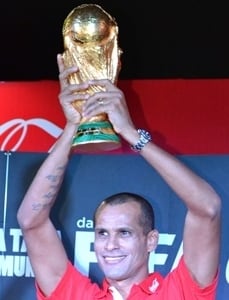
Summary
Rivaldo could begin on the left and take responsibility for the whole attack, combining a playmaker's touch with the shooting range and instinct of a leading scorer.
Quick facts
- Primary roles
- Left winger / attacking midfielder / second striker
- Barcelona years
- 1997–2002
- Barcelona league titles
- 1998 and 1999
- 1999 individual honours
- Ballon d'Or / FIFA World Player of the Year
- World Cup title
- 2002 with Brazil
- Left-wingers ranking
- #10 in The Top Football's all-time list
Barcelona’s new Brazilian match-winner
When Rivaldo arrived from Deportivo La Coruña in 1997, Barcelona had lost Ronaldo Nazario to Inter. There was a considerable responsibility to take on, though the new man changed the shape of the attack. Barcelona’s history describes him as suited to either the left wing or attacking midfield, with the technique and scoring ability to affect matches from both.
Against Real Sociedad on his league debut, he scored twice. He helped the team win La Liga and the Copa del Rey in his first season; in 1999 he helped them win the league again. That was also the year he received the Ballon d’Or and the FIFA World Player of the Year award.
His role explains the peak marked by those awards. Rivaldo could take the ball away from the crowded central lane, draw an opponent after him and bring the attack inside again through a pass or a shot. For Barcelona, he was a creator willing to finish the moves he helped put together.
A left foot with several ways to hurt a defence
Rivaldo had the height and strength to hold on to possession, an unusual physical presence in a playmaker. He could also work in small spaces, using his first touch and dribbling. Close control with the left foot gave him chances to use it in other ways: a powerful shot or a free-kick.
A full-back facing Rivaldo had more to consider than the cross. He might carry the ball into a position to shoot; he might pass to a teammate and move toward the box. The attacker a central defender now had to deal with had come from outside the usual marking relationship.
Calling him a left winger describes a clear part of his Barcelona career. It cannot account for every achievement: to do that would hide how often he played centrally. His range makes any single position label imperfect, so this profile and the ranking keep the playmaking role alongside the work on the flank.
The Valencia hat-trick that rescued a season
On 17 June 2001, Barcelona’s Champions League qualifying place depended on beating Valencia. Rivaldo put them in front with a free-kick, and later restored the lead by shooting from outside the area. Twice Valencia equalised through Rubén Baraja. Barcelona needed one more goal.
Frank de Boer’s delivery arrived in the 87th minute. Rivaldo controlled it on his chest and scored with an overhead kick from the edge of the box. That made it 3–2, enough for Barcelona to finish fourth above Valencia even though the two teams ended with the same number of points.
Three very different finishes in one match show how many ways he could score. Each answered the same need: the team’s collective performance had left little margin, and its best attacker had to find the result. The last goal’s beauty made it memorable. What it meant for Barcelona gives that image its weight.
Brazil’s 2002 title and the attacking partnership
At the 2002 World Cup, Rivaldo reached his international peak alongside Ronaldo and Ronaldinho. According to FIFA, he scored five goals in five consecutive appearances at the start of the competition. Brazil went on to win every one of its seven matches.
Against England in the quarter-final, the overlap between the trio’s roles was clear. Ronaldinho carried the ball through midfield, then released Rivaldo to equalise; later, he scored the winner himself. Rivaldo could finish one attack and be the link to Ronaldo on the next.
His part in that title win deserves a place in any assessment of his career. The partnership gave three prominent attackers different ways to contribute. Rivaldo’s goals came through the group stage and early knockout rounds, helping Brazil keep going toward the final.
His place in the left-wingers ranking
Rivaldo is tenth in our best left wingers of all time ranking. We have weighed an extraordinary individual peak against the fact that his role often took him beyond the flank. His years at Barcelona qualify him for the list, and the 1999 awards and 2002 World Cup show how high his influence reached.
The Champions League winner’s medal he received with AC Milan in 2003 was a later addition. His strongest case in this ranking comes from his work as a principal attacker. You can see that responsibility in Barcelona’s league-winning seasons, the Valencia hat-trick and Brazil’s World Cup run more clearly than in a collection of medals alone.
Sources
Sources checked
FAQ
Was Rivaldo a winger or an attacking midfielder?
He played both roles. Barcelona explicitly describes him as a left winger or attacking midfielder, and he also operated closer to a central striker.
What was Rivaldo's most famous Barcelona goal?
His late overhead kick completed a hat-trick in a 3–2 win against Valencia on 17 June 2001, taking Barcelona into the next season's Champions League qualifying rounds.
How many goals did Rivaldo score at the 2002 World Cup?
He scored five, finding the net in each of Brazil's first five matches as the team went on to win the title.