
player
Gregor Kobel: Dortmund's Last Line and First Voice
Gregor Kobel's Dortmund and Switzerland career, from his Bundesliga development to the 2024 Champions League final and 2026 World Cup run.
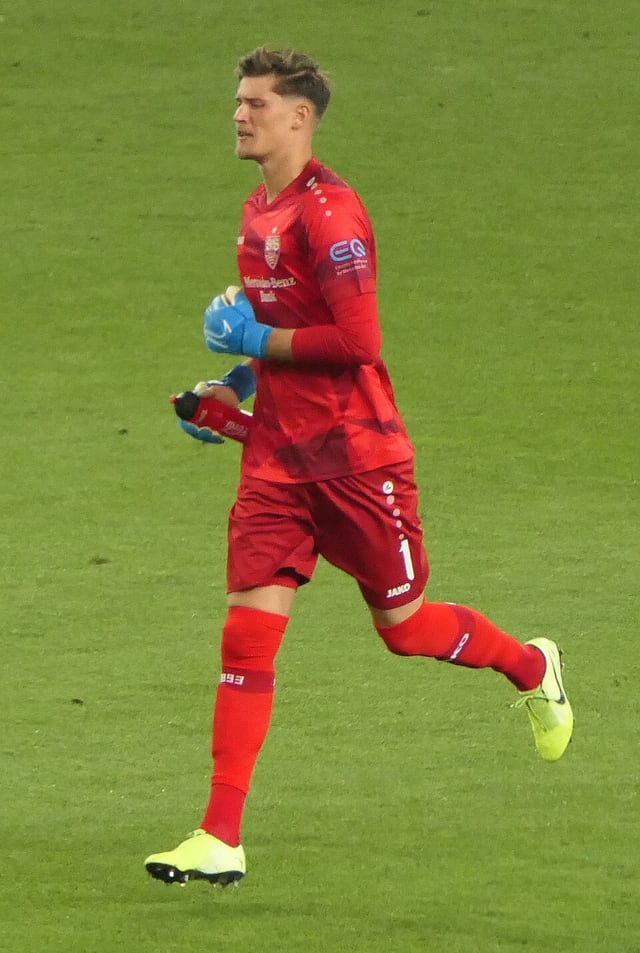
Summary
Gregor Kobel gives Dortmund size, reflexes and a loud organising presence, while Switzerland's 2026 World Cup run showed that his club-level rescue work travels.
Quick facts
- Position
- Goalkeeper
- Current club
- Borussia Dortmund vice-captain (checked September 30, 2026)
- Contract
- Through June 30, 2028
- Dortmund milestone
- 200 competitive appearances on February 1, 2026
- 2025/26 Bundesliga
- 15 clean sheets; Dortmund finished second with the league's best defence
- Champions League
- Runner-up with Dortmund in 2024
- World Cup 2026
- 20 saves in six matches; Switzerland reached the quarter-finals
A save can change the temperature of the stadium
Borussia Dortmund were hanging on in Leverkusen in May 2025. Bayer kept finding shots, and Gregor Kobel kept getting something in the way. He made nine saves, equalling his personal best, while Dortmund scored four times from nine attempts and won 4-2.
That is the blunt version of Kobel’s value. Some goalkeepers are most comfortable in a controlled match with clear reference points. He can survive the opposite: bodies moving across his sightline, rebounds arriving at awkward heights and a defence retreating toward him.
The noise around the save matters too. Kobel does not play the position quietly. He directs, complains, celebrates and demands a response. Dortmund made him vice-captain because the voice is part of the job rather than decoration attached to it.
His 2025/26 season added control to the rescue work. Dortmund conceded 34 Bundesliga goals, the best defensive record in the division, and Kobel became the first BVB goalkeeper to record 15 clean sheets in one league campaign. Then Switzerland took him to the World Cup and asked him to solve a different set of problems.
Zurich, Grasshopper and an early move to Germany
Kobel was born in Zurich on 6 December 1997. His father, Peter, played professional ice hockey, so elite sport was familiar at home without football being the only available path.
The goalkeeper spent most of his early academy years at Grasshopper Club Zurich. He was tall, but the attraction was not simply reach. He moved well enough to deal with low shots and was willing to take responsibility for the area in front of him.
Hoffenheim brought him to Germany in 2014, when he was sixteen. The move placed him in a development system led at senior level by coaches who were comfortable asking young players to learn complex roles. Julian Nagelsmann later gave him first-team opportunities, mainly in the German Cup.
One youth match offered a curious preview. Hoffenheim faced Borussia Dortmund in the 2016 German under-19 final. Dortmund won 5-3, yet its own club profile now recalls how often the eighteen-year-old Kobel frustrated the attack. Five years later he would arrive as BVB’s first-choice signing.
Augsburg made the Bundesliga real
Training beside an established goalkeeper can sharpen habits. It cannot reproduce a Bundesliga forward running at you with points at stake. Kobel needed matches.
A loan to Augsburg in January 2019 supplied them immediately. He played 16 of the remaining 17 league games. The side was fighting for safety, so the young goalkeeper saw pressure in practical form: second balls, crowded set pieces and the knowledge that one lost point could matter in May.
There were mistakes, as there are for almost every goalkeeper entering a top league. There were also saves that showed why Hoffenheim had trusted him. The spell removed the protected label of prospect. Kobel had been exposed to a relegation race and stayed in the team.
Stuttgart offered the next step that summer. The club was in the second tier, which meant accepting a temporary drop in level for a clearer starting job. Stuttgart won promotion in 2019/20. Kobel then started 33 of 34 Bundesliga games in 2020/21 as the promoted side finished ninth.
That season changed the market around him. Dortmund did not need to project how his reactions might look against elite Bundesliga attacks; it had a full campaign of evidence.
Dortmund bought a goalkeeper and gained a leader
BVB signed Kobel in 2021. The club described a vocal goalkeeper who was strong on the line, comfortable controlling his area and useful in possession. All three qualities mattered behind a team that expected to attack.
The starting role was immediate. Dortmund’s defensive shapes and coaches changed, but Kobel remained the fixed point. He could make the spectacular stop after a breakdown, then confront the defenders about the breakdown before play restarted.
That manner can look confrontational from outside. Inside a defence, clarity is often kinder than silence. A centre-back needs to know whether the goalkeeper is coming for the cross. A full-back must hear when a runner has moved behind him. Kobel’s communication tries to settle those questions early.
The club extended his contract through 2028 on 5 October 2023. He had already been named vice-captain that summer, barely two years after joining Dortmund. Those decisions showed how quickly reliability and personality had become linked.
His goal-line technique begins with patience
At 1.96 metres, Kobel can cover a large part of the goal. Height does not make the save by itself. A goalkeeper who drops too early still gives a striker the upper corners; one who attacks without balance can be rounded.
Kobel usually tries to stay available for as long as the distance permits. In one-on-ones, his stance remains tall while he closes the angle. The arms and legs spread only after the attacker has shown enough of the finish.
At close range, his first movement is compact. He does not always need a full dive. A foot, lower leg or strong hand can redirect the ball before the body follows. Some of his best saves look improvised even when the starting position was carefully chosen.
The trade-off appears when he has to reset. A big first action can leave a large body on the ground, and the rebound may arrive before he regains his feet. Dortmund’s defenders have to react around the save rather than admire it.
Crosses demand size, timing and traffic management
Kobel’s reach lets him claim balls that shorter goalkeepers may punch. He starts with an advantage, then has to decide whether the flight and crowd allow him to use it.
The safest catch is not always the bravest-looking action. If the box is crowded, a firm punch into a wide area may remove more danger than reaching through players for the ball. Kobel is at his best when the decision is early and the route is clean.
He also gives Dortmund a strong back-post presence. Deep crosses can expose the space behind a full-back, especially when the defensive line has shifted toward the ball. Kobel’s final step and high hands let him attack that delivery before a forward heads down across goal.
There are evenings when the area becomes untidy and he chooses to stay. That is not automatically hesitation. The goalkeeper has to read bodies he cannot move through legally, as well as the ball. Command is judgment, not a count of how many crosses are claimed.
With the ball, he favours a clear solution
Kobel can participate in short buildup, though he is not trying to turn every possession into a technical exhibition. His best distribution is direct and purposeful.
When Dortmund split the centre-backs, he can pass into either side and force the press to choose. If the opponent blocks the short lane, he has the power to reach a forward or wide player without a slow, hanging clearance.
The long ball is useful because Dortmund often have fast runners around a central striker. It can bypass pressure and turn a defensive restart into a contest near halfway. The pass does not need to become an assist to change the location of the next duel.
Manuel Neuer remains the sharper historical reference for a goalkeeper shaping an entire possession system. Kobel’s version is less radical. He supplies the extra pass, recognises danger behind the line and usually chooses speed over flourish.
The 2024 Champions League final left two truths
Dortmund reached the 2024 Champions League final by surviving difficult knockout matches against PSV, Atlético Madrid and Paris Saint-Germain. Kobel was the goalkeeper throughout the run.
At Wembley, Dortmund created the better first-half chances against Real Madrid. Karim Adeyemi went around Thibaut Courtois but could not finish, and Niclas Füllkrug hit the post. The match stayed 0-0 until Dani Carvajal headed in from a corner in the 74th minute. Vinícius Júnior added a second.
The result left two honest conclusions. Kobel had played in the biggest club match available and helped his team reach it. He did not leave with the trophy.
That distinction matters in a career profile. A final appearance is evidence of level and durability through the competition. It is not a title. Thibaut Courtois and Madrid completed the last step that Dortmund could not.
Two hundred games arrived during his best defensive season
Kobel made his 200th competitive Dortmund appearance against Heidenheim on 1 February 2026. The match ended 3-2, which suited his public reaction: pleased with the milestone and points, irritated by how wild the game had become.
By then, the season was building toward a cleaner record. BVB finished second with 73 points and conceded 34 league goals, fewer than any other Bundesliga side. Its 15 clean sheets equalled the club’s team record, while Kobel became the first single Dortmund goalkeeper to play in all 15.
Clean sheets belong to a unit. Nico Schlotterbeck, Waldemar Anton, Ramy Bensebaini and the midfield protection reduced shots before Kobel touched the ball. The goalkeeper’s organisation helped hold that unit together, and his saves protected it on the days when the structure opened.
The club listed 216 Kobel appearances through the end of the season. That is a dated total, not a number to freeze while he remains active. The 200-game mark is the more useful milestone because Dortmund documented when it happened.
Switzerland’s starting job came after waiting
Kobel progressed through Switzerland’s youth teams and made his senior debut in September 2021. He went to the 2022 World Cup as Yann Sommer’s understudy and played the final group match, a 3-2 win over Serbia.
Sommer also remained first choice at EURO 2024. Switzerland reached the quarter-finals and lost to England on penalties. Kobel’s patience at national-team level therefore lasted longer than it had at Dortmund.
When the starting role opened, he took it into World Cup qualifying. BVB noted that he matched Sommer’s Swiss record of five consecutive internationals without conceding while helping secure qualification for 2026.
The comparison between the two should not be reduced to height. Sommer built his reputation through quick feet, sharp positioning and consistency across many tournaments. Kobel brought a different physical presence and had to show that the transition would not weaken the team.
Colombia made him Switzerland’s World Cup hero
Switzerland topped its 2026 group, beat Algeria 2-0 in the round of 32 and met Colombia in the last sixteen. The match remained goalless for 120 minutes.
Kobel made an acrobatic save from Gustavo Puerta and saw a Jhon Lucumí header hit the crossbar. FIFA named him Player of the Match. The shootout still required one decisive action.
Davinson Sánchez hit the bar before Cucho Hernández took Colombia’s fourth penalty. Kobel chose correctly and saved. Ruben Vargas then converted Switzerland’s fifth kick for a 4-3 win.
The result sent the country to its first World Cup quarter-final since 1954. It also gave Kobel an international moment that belonged to him rather than to the discussion about who had come before.
Argentina ended the run in extra time
The quarter-final was harder. Alexis Mac Allister headed Argentina ahead from a Lionel Messi corner after ten minutes. Dan Ndoye equalised in the 67th, but Breel Embolo’s second yellow card left Switzerland with ten men.
Kobel and the defence carried the match into extra time. Thiago Almada hit the outside of the post. Julián Álvarez finally found the top corner in the 112th minute, and Lautaro Martínez made it 3-1 in added time.
Switzerland lost, yet the tournament represented progress: six Kobel starts, two clean sheets, 20 saves and a quarter-final after two knockout wins. The numbers do not turn elimination into a medal. They explain why the run changed his international standing.
Emiliano Martínez was at the other end in the quarter-final and later helped Argentina reach the final. Kobel’s World Cup ended earlier, but his workload and Colombia shootout supplied a strong current-form case.
Why he is tenth right now
Kobel is tenth in our ranking of the best goalkeepers in the world right now. The place combines a record 15-clean-sheet Dortmund season with 20 World Cup saves and Switzerland’s best run since 1954.
The nine names above him have stronger evidence in at least one part of the same window. Diogo Costa matched the World Cup save total and added Portugal’s established penalty record. Mike Maignan reached the World Cup final weekend with France. The leaders paired domestic awards or a world title with their goalkeeping.
Kobel’s case does not need exaggeration. He is Dortmund’s established number one, a vice-captain under contract through 2028 and the goalkeeper who carried Switzerland through a World Cup shootout. The next question is whether those high points become a title-winning season rather than another impressive rescue.
Sources
Sources checked
- Borussia Dortmund - Gregor Kobel player profile
- Borussia Dortmund - Kobel contract through 2028
- Borussia Dortmund - Kobel's vice-captain appointment
- Borussia Dortmund - 200-match milestone
- Borussia Dortmund - 2025/26 clean-sheet record
- Swiss FA - Gregor Kobel national-team record
- FIFA - Switzerland beat Colombia at World Cup 2026
- FIFA - Argentina beat Switzerland in the quarter-final
- UEFA - Dortmund beat Paris to reach the 2024 Champions League final
- Borussia Dortmund - Kobel interview in August 2026
- Borussia Dortmund - Kobel makes nine saves in Leverkusen
- FIFA - World Cup 2026 leading statistics
FAQ
Which club does Gregor Kobel play for?
Kobel plays for Borussia Dortmund, where he is the first-choice goalkeeper and vice-captain. His contract runs through June 30, 2028.
How many games has Gregor Kobel played for Dortmund?
He made his 200th competitive Dortmund appearance on February 1, 2026. The club listed 216 appearances through the end of the 2025/26 season.
Did Gregor Kobel play in a Champions League final?
Yes. He started the 2024 final for Borussia Dortmund, who lost 2-0 to Real Madrid at Wembley after creating the better first-half chances.
What are Gregor Kobel's main strengths?
His strongest traits are close-range reactions, reach, one-on-one patience, command of the penalty area and clear, forceful communication with the defence.
How did Gregor Kobel perform at World Cup 2026?
Kobel made 20 saves across six starts. He kept two clean sheets, saved Cucho Hernández's shootout penalty against Colombia and helped Switzerland reach the quarter-finals.
Where does Gregor Kobel rank among current goalkeepers?
He is tenth in The Top Football's July 2026 ranking. His World Cup run and Dortmund's record-setting defensive season put him in the Top 10.