
player
Nuno Mendes: Recovery Speed and Left-Side Force
Nuno Mendes' career from Sporting CP to Paris Saint-Germain, with his recovery defending, ball carrying and back-to-back Champions League titles explained.
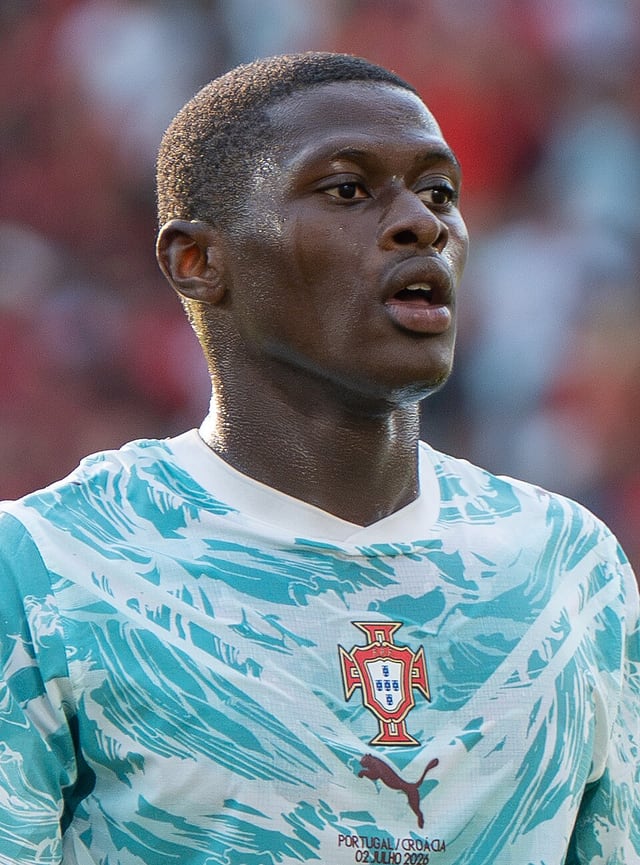
Summary
Mendes can lose the first yard and still recover the duel. That speed supports a more complete role: carrying attacks down the left, defending elite wingers and giving Paris width when the forwards move inside.
Quick facts
- Primary role
- Left-back / left wing-back
- Current club
- Paris Saint-Germain, number 25 (checked August 30, 2026)
- Born
- June 19, 2002, Sintra, Portugal
- Senior development
- Sporting CP academy and first team
- European peak
- Back-to-back Champions League winner and 2025/26 UEFA Team of the Season
Speed gives him a second defensive chance
Nuno Mendes can appear beaten and still finish the action in control. A winger may push the ball past him, but the gap closes before the attacker reaches the next useful touch. That recovery speed is the most visible part of his game. It is not the whole explanation for his rise.
Paris Saint-Germain ask Mendes to defend elite wide players and then carry the left side of an attack. He has to recognise when to overlap, when to hold the touchline and when to stay behind the ball because the opposite full-back has already gone forward.
Our current defenders ranking places him third after Paris retained the Champions League in 2025/26 and UEFA selected him in its Team of the Season.
Sporting made the role normal early
Mendes joined Sporting CP’s academy as a child and reached the senior side before turning eighteen. The promotion did not protect him with a narrow role. Sporting’s wing-back structure required him to cover the entire left side, receive high up the pitch and recover quickly when possession changed.
He was part of the team that won Portugal’s league in 2020/21. Paris first brought him in on loan and then made the move permanent. The transfer increased the level of the opponent without changing the central demand: Mendes still had to provide attacking width and enough speed to repair the space that ambition created.
In Paris he developed from a promising runner into a defender trusted in the most exposed Champions League matchups.
Recovery is technique as well as pace
A fast defender can waste speed by taking the wrong line. Mendes tries to recover toward the goal rather than simply chasing the attacker. That angle protects the central route and can force the ball carrier toward a narrower shooting position.
His challenge often arrives from the side after he has matched the run. The timing matters because a desperate tackle inside the box turns a useful recovery into a penalty risk. Mendes can also use shoulder contact and body position to slow the action until a centre-back arrives.
Paris still have to protect him. When both full-backs advance, Marquinhos and Willian Pacho can face a wide field. The midfield’s rest defence decides whether Mendes is recovering one lane or trying to solve the entire transition.
Carrying the ball changes the left side
Mendes is most dangerous when the space is ahead of him. He can accelerate with the ball, push beyond the first defender and force a centre-back to decide whether to leave the box. That carry can become a low cross, a cutback or a simple pass inside after the defence has shifted.
The relationship with Khvicha Kvaratskhelia gives Paris two different ways to enter the same area. The winger can receive to feet and slow the defender; Mendes can overlap at speed or arrive inside after Kvaratskhelia has drawn attention toward the touchline.
This is not constant sprinting. If the winger already holds the outside lane, Mendes may stay deeper or move into the half-space. Good full-back play includes knowing when another run would only crowd the attack.
Paris need asymmetry, not identical full-backs
Achraf Hakimi attacks aggressively from the right and often arrives near the forward line. Mendes can do the same on the left, but Paris do not need both players on the last line in every possession.
One can advance while the other gives the centre-backs a safer outlet. The next attack may reverse that balance. Because both full-backs can carry the ball, opponents cannot prepare for only one side becoming the extra attacking lane.
That flexibility helped Paris move away from a side organised around isolated stars. The full-backs became active parts of a coordinated structure in which forwards rotate and midfielders cover the space behind them.
The honours now support the performance
Mendes’ official Paris profile listed fourteen trophies and two Champions League titles when checked on August 30, 2026. He also won the 2025 UEFA Nations League with Portugal. Trophy counts require context, but consecutive European wins show that his role survived repeated knockout tests.
UEFA’s technical observers selected Mendes at left-back in the 2025/26 Champions League Team of the Season, alongside a back line of Marcos Llorente, Marquinhos and Gabriel. The selection supports the match evidence: Mendes was not merely an attacking passenger in a dominant team. He defended difficult opponents and helped Paris progress the ball out of pressure.
His next challenge is availability and repetition. An explosive role places unusual stress on the body. If Mendes can keep supplying both recovery defence and forward force, the argument will move from “best current left-back” toward the much harder historical comparison.
Sources
Sources checked
FAQ
What position does Nuno Mendes play?
Mendes is primarily a left-back. He can also operate as a wing-back when the structure gives him more freedom to attack.
Which club does Nuno Mendes play for?
Mendes plays for Paris Saint-Germain and wears number 25. His current club profile was checked on August 30, 2026.
Where did Nuno Mendes begin his career?
He developed at Sporting CP, reached the senior team as a teenager and won the Portuguese league before moving to Paris.
Has Nuno Mendes won the Champions League?
Yes. Paris Saint-Germain won the competition in 2025 and retained it in 2026, giving Mendes consecutive Champions League titles.