
player
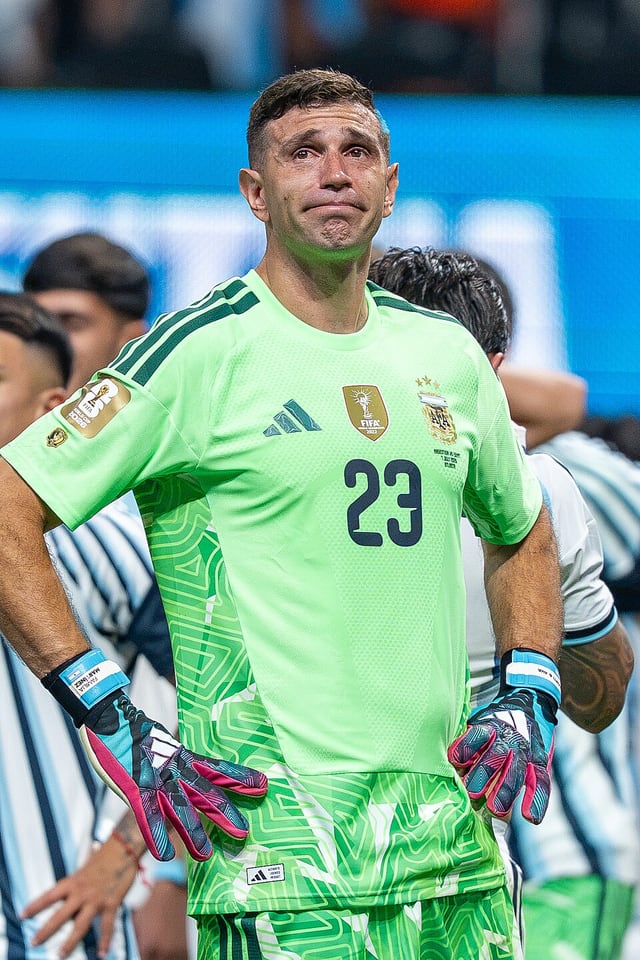
Emiliano Martínez: The Goalkeeper Who Owns the Last Chance
Emiliano Martínez's Chelsea, Aston Villa, Arsenal and Argentina career, with the 2022 final save, penalty technique and 2026 World Cup run explained.
Summary
Emiliano Martínez waited a decade for a lasting club role, then became the goalkeeper Argentina trusted when a match came down to one shot.
Quick facts
- Position
- Goalkeeper
- Current club
- Chelsea, number 1 (contract through 2029)
- Aston Villa record
- 255 appearances before the 2026 Europa League final
- Club peak
- 2025/26 Europa League winner and Team of the Season selection
- Argentina honours
- 2022 World Cup; Copa América 2021 and 2024; 2022 Finalissima
- World Cup record
- 2022 champion and Golden Glove; 2026 runner-up
- Profile
- Patient one-on-ones, penalty preparation and long distribution
The 123rd minute explains the career, but not the whole goalkeeper
Randal Kolo Muani was through in the 123rd minute of the 2022 World Cup final. The ball dropped beyond Argentina’s defence, and the next touch should have decided the tournament. Emiliano Martínez moved forward, held his position and spread just as the shot arrived. His left boot stopped it.
That save has become the short version of his career. It contains the patience, the large blocking shape and the appetite for a moment that leaves no time to recover. It also risks hiding how long Martínez needed to reach such a stage.
He spent roughly a decade at Arsenal without establishing himself as the permanent first choice. Loans took him through several levels of English football and a season in Spain. His sustained Premier League opportunity arrived at twenty-seven. Within another two years he had won the Copa América and World Cup with Argentina.
The rise looks sudden only if the waiting years are removed.
Arsenal was an education without a settled job
Martínez was born in Mar del Plata on 2 September 1992 and developed at Independiente before moving to Arsenal in 2010. The transfer gave a teenager access to an elite training ground, but no clear route through a senior goal already occupied by established players.
He went on loan to Oxford United, Sheffield Wednesday, Rotherham United, Wolverhampton Wanderers, Getafe and Reading. Some spells brought regular matches; others provided only a short look. The clubs asked different questions. Could he handle crosses and contact in the lower English divisions? Could he recover after an error? Could he play when the next loan did not feel like career progress?
Goalkeepers can train at a high level for years and still lack the evidence that only competitive minutes produce. Martínez accumulated that evidence in fragments. He learned to direct unfamiliar defenders, deal with a noisy penalty area and enter a team without months of preparation.
Arsenal’s 2020 farewell interview said he had been with the club for eleven years. It also captured the contradiction: he was leaving just as supporters had finally seen him look like a lasting first-choice goalkeeper.
The 2020 chance changed his market, not his technique overnight
Bernd Leno’s injury in June 2020 opened the Arsenal goal during a compressed season. Martínez played through the final league matches and the FA Cup run. Arsenal beat Manchester City in the semifinal and Chelsea in the final, with the goalkeeper looking secure under crosses and calm when the game became stretched.
He then started the Community Shield win over Liverpool. Those months did not create a new goalkeeper from nothing. They placed years of work inside matches large enough for other clubs to trust.
Martínez wanted a guaranteed starting role rather than another internal competition. Aston Villa offered it in September 2020. Arsenal received a fee for a player who had finally proved his level; Villa received a goalkeeper entering his prime with relatively little top-flight wear.
The decision has aged well for both Martínez and the club that signed him.
Aston Villa made the position his every week
Martínez kept a clean sheet on his Villa debut and quickly outgrew the penalty-specialist label attached to his Arsenal cup run. Weekly Premier League football required him to deal with a wider range of problems: deep defending, open transitions, crosses under pressure and long periods when Villa asked him to begin attacks.
His long passing is an important part of that work. Martínez can drive the ball toward a forward or full-back without forcing the team to play short through every press. The pass is less about producing an assist than changing where the next contest happens.
Villa’s May 2026 Europa League final preview listed 255 appearances since his 2020 arrival. The exact figure has already moved because he started the final a day later, so 255 belongs with its date. What matters is the scale: the player who spent years borrowing club shirts had made one goal his own for six seasons.
Chelsea opened the next club chapter
Martínez left Villa after six seasons and 256 appearances. Chelsea announced his signing in August 2026 on a three-year contract, making the London club his first permanent move since Villa gave him the weekly role he had sought. He debuted against Brighton wearing 26, then switched to the number 1 shirt after Robert Sánchez left on loan.
The transfer changes the current-club line, not the historical record above it. His Villa chapter still includes the 2025/26 Europa League title; the Chelsea chapter is too new for a meaningful performance verdict as of September 5, 2026.
His one-on-one technique starts with waiting
Martínez is strongest when he can close space without throwing himself at the ball. He advances in small steps, keeps his torso high and makes the forward reveal the finish. Only then does he spread his legs and arms.
The shape is deliberately wide. A low shot may hit a boot or trailing leg; a lifted finish finds his chest and hands still available. If the goalkeeper drops too early, the attacker can touch around him. If he stays on the line, the target remains large. Martínez works between those errors.
The Kolo Muani save was an extreme example, not a separate trick. The same movement appears in ordinary league matches. What changed in Lusail was the cost of getting it wrong.
This is where a comparison with Thibaut Courtois is useful. Both can delay the shot and cover an unusual amount of goal. Courtois tends to make the geometry look quiet; Martínez brings more visible emotion to the same basic confrontation.
Argentina arrived when the club breakthrough did
Martínez had played only a handful of senior international matches before 2021. Lionel Scaloni nevertheless made him Argentina’s goalkeeper for the Copa América, and the semifinal against Colombia created the reputation that followed.
The match went to penalties after a 1-1 draw. Martínez saved three of Colombia’s five kicks. Argentina then beat Brazil in the final and won its first senior men’s trophy since 1993.
The shootout reflected studied tendencies rather than a collection of guesses. He delayed his movement and used conversation to make the taker feel the wait. The performance gave his teammates a simple belief: if they converted their own penalties, he was likely to find a save.
Argentina added the 2022 Finalissima before going to Qatar. By then Martínez was not filling a vacancy. He was part of the team’s emotional structure.
The penalty reputation is built on preparation and theatre
Penalty analysis often collapses into psychology because the physical action is so brief. Martínez does use the theatre around the kick. He moves along the line, makes the taker wait within the referee’s control and celebrates saves loudly. Those actions attract attention because they are visible.
The quieter work comes first. Goalkeepers and analysts study run-ups, preferred corners and how a taker responds after changing pace. Martínez waits as long as possible, then uses a strong first push or a leg save when the strike stays central. His reach allows him to cover ground without showing the choice too early.
CONMEBOL’s 2024 technical study counted eighteen shootout penalties faced for Argentina through that Copa América. Eight were saved and one missed the target. The four shootouts all ended in Argentina victories. That record included three saves against Colombia in 2021, two against the Netherlands in 2022, one against France in the final and two against Ecuador in 2024.
The numbers explain why opponents notice the performance around the kick. They also show that performance would mean little without repeated contact with the ball.
Qatar turned a specialist reputation into a complete tournament
Argentina lost its opening match to Saudi Arabia at the 2022 World Cup. The response required seven matches without another defeat, and Martínez’s influence grew as the margins narrowed.
He saved the Netherlands’ first two penalties in the quarter-final shootout. In the final, France recovered from 2-0 and 3-2 down before Kolo Muani received the last open chance. Martínez’s boot carried the match into penalties.
He then saved Kingsley Coman’s kick. Aurélien Tchouaméni missed wide; Martínez did not save that attempt, a detail worth keeping clear when the shootout is retold. Argentina converted four times and became world champion.
FIFA awarded Martínez the Golden Glove and later named him The Best FIFA Men’s Goalkeeper for 2022. Lionel Messi led Argentina’s attack and tournament story, but the title also depended on a goalkeeper solving the final action twice: once in open play and once from the spot.
The celebrations made him divisive
Martínez’s emotional style is not universally admired. His Golden Glove celebration and behaviour around penalties were criticised after the final. Some viewers see competitive personality; others see needless provocation.
The distinction matters because analysis should not require approval of every gesture. His value can be measured in positioning, saves and results. His behaviour can be discussed separately, including the risk that an official punishes a delay or judges an action to cross the line.
Football later tightened goalkeeper restrictions during penalties. Martínez adapted because the skill was never only movement before the kick. Preparation, patience and reach still apply when the laws narrow the theatre.
Villa gave him a European club night of his own
Martínez’s international record became so large that it threatened to overshadow his club work. Aston Villa’s return to the Champions League helped rebalance the picture. In October 2024 he denied Bayern Munich, including a late Harry Kane header, as Villa won 1-0.
The 2025/26 Europa League run went further. Villa’s official preview credited him with five clean sheets in ten appearances before the final. He started in Istanbul as Villa beat Freiburg 3-0, winning the club’s first European trophy in forty-four years and first major trophy in thirty.
UEFA selected him as the goalkeeper in its Europa League Team of the Season. The honour joined a team result, which is the important part. A goalkeeper whose biggest club memory had long been an FA Cup won the continental competition he had spent the spring trying to finish.
The 2026 World Cup final was resistance without the reward
Argentina returned to a World Cup final in 2026, this time against Spain. The match offered a different test from Qatar. Spain controlled possession and repeatedly reached shooting positions while Argentina struggled to create.
Martínez saved from Pau Cubarsí, Pedri and Nico Williams, then pushed away a Lamine Yamal free kick. FIFA’s report makes the pattern plain: Spain kept asking and the goalkeeper kept the score level. Argentina did not record a shot before extra time.
The resistance ended in the 106th minute. Nico Williams supplied Ferran Torres, whose finish beat Martínez for the only goal. Spain and Unai Simón became champions; Argentina finished runner-up.
Losing does not turn every save into a victory. It does explain Martínez’s fifth place in our current goalkeeper ranking. His twenty tournament saves and final performance were current evidence, not borrowed prestige from 2022.
Fifth right now, with an unusual historical case
David Raya built the strongest domestic clean-sheet record of 2025/26. Simón won the World Cup Golden Glove. Courtois and Gianluigi Donnarumma brought elite club-season evidence. Martínez sits behind them because a current ranking has to reward the full season rather than one final.
His wider legacy is harder to place. The all-time goalkeeper ranking values long club dominance, technical influence and completed careers. Martínez’s claim is narrower but unusually vivid: two Copa América titles, a World Cup, another World Cup final and a collection of late saves that changed Argentina’s recent history.
He did not arrive early enough to build the conventional prodigy story. He arrived when the last chance appeared, and stayed there.
Sources
Sources checked
- Chelsea - Emiliano Martínez signs on a three-year deal
- Chelsea - Summer 2026 transfer register
- Chelsea - Emiliano Martínez switches to number 1
- Aston Villa - Martínez previews the 2026 Europa League final
- UEFA - Aston Villa win the 2026 Europa League
- UEFA - 2025/26 Europa League Team of the Season
- Arsenal - Martínez farewell interview
- FIFA - 2022 Best Men's Goalkeeper finalists
- FIFA - Spain 1-0 Argentina in the 2026 World Cup final
- CONMEBOL - Copa América 2024 technical study
FAQ
Which club does Emiliano Martínez play for?
Martínez plays for Chelsea and wears number 1. He joined from Aston Villa on a contract through 2029 after making 256 appearances for Villa.
What was Emiliano Martínez's save in the 2022 World Cup final?
In the 123rd minute, Martínez spread himself and blocked Randal Kolo Muani's close-range shot with his left boot. Argentina then won the penalty shootout.
How many World Cups has Emiliano Martínez won?
He won the 2022 World Cup and its Golden Glove. Argentina reached the 2026 final but lost 1-0 to Spain after extra time.
Why is Emiliano Martínez good at penalties?
He combines opponent study with late movement, a wide blocking shape and the confidence to turn the wait before a kick into part of the contest. CONMEBOL recorded eight saves from 18 shootout penalties through the 2024 Copa América.
When did Emiliano Martínez become Arsenal's first-choice goalkeeper?
His sustained first-team chance arrived in 2020 after Bernd Leno was injured. Martínez helped Arsenal win the FA Cup and Community Shield before moving to Aston Villa.
What happened to Martínez in the 2026 World Cup final?
He repeatedly denied Spain and kept Argentina level until Ferran Torres scored in the 106th minute. Spain won 1-0, leaving Argentina as runner-up.