
player
Gianluigi Donnarumma: The Goalkeeper for the Decisive Moment
Gianluigi Donnarumma's Milan, PSG, Manchester City and Italy career, with EURO 2020, the 2025 Champions League and his playing style explained.
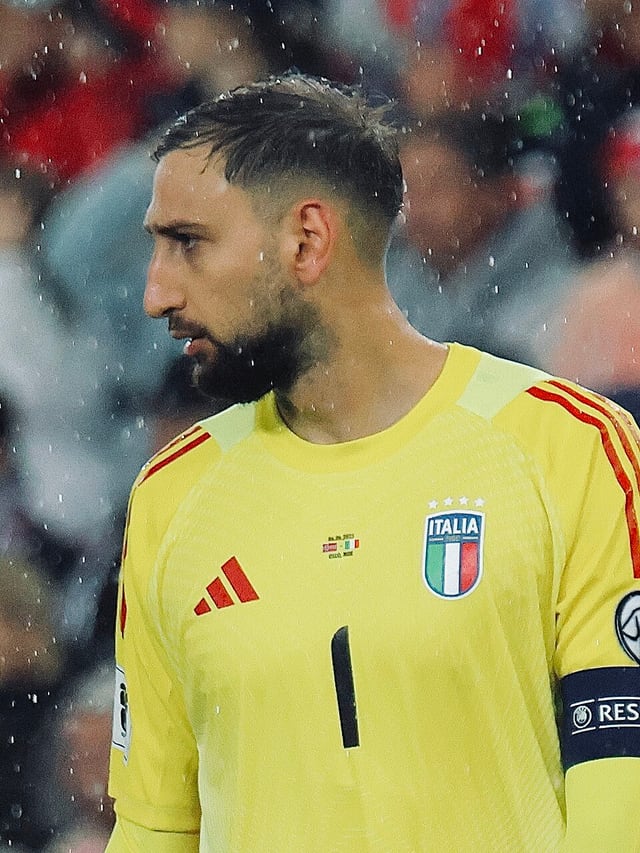
Summary
Gianluigi Donnarumma has spent his career arriving early: Serie A at sixteen, Italy at seventeen and decisive penalty saves before most goalkeepers reach their prime.
Quick facts
- Position
- Goalkeeper
- Current club
- Manchester City (checked September 30, 2026)
- Manchester City contract
- Five years, through summer 2030
- 2025/26 club record
- 43 matches, 18 clean sheets and 99 saves in all competitions
- Italy record
- 81 senior appearances through May 28, 2026 (FIGC media kit)
- Major peaks
- EURO 2020 Player of the Tournament; 2025 Champions League winner
- Profile
- 1.96-metre reach, one-on-one resistance and penalty saves
His career has rarely waited for the normal age
Gianluigi Donnarumma was a Serie A goalkeeper at sixteen. He played for Italy at seventeen. At twenty-two, he saved the last penalty of a European Championship final and was named Player of the Tournament.
Early achievement can distort the rest of a career. A player who reaches the top before adulthood is judged as if every later season should look finished. Donnarumma’s record is more uneven and more interesting than that. Milan trusted him before he had senior habits. Paris Saint-Germain saw spectacular saves alongside costly mistakes, then received the best goalkeeper in its first Champions League-winning team. Manchester City signed him after that peak and immediately asked whether a large, reactive goalkeeper could fit a club associated with an extra passer in goal.
The common thread is not perfection. It is the scale of the moment he has repeatedly survived.
Milan put a sixteen-year-old in goal
Donnarumma was born in Castellammare di Stabia on 25 February 1999. He began at ASD Club Napoli before joining AC Milan’s academy in 2013. Within two years, he was training and travelling with the first team.
He started against Sassuolo on 25 October 2015 at 16 years and 242 days. UEFA records him as the second-youngest goalkeeper to start a Serie A match. The number is striking, but the decision behind it matters more: Milan replaced an experienced senior goalkeeper with a teenager because his physical and technical level already made the risk defensible.
Donnarumma was 1.96 metres tall, quick across the goal and unusually calm when a forward entered the box. He still had to learn the slower parts of the job: setting a defensive line, judging when to leave the goal and making the simple pass after a save.
Milan gave him six seasons to do it in public. PSG’s official career record lists 251 appearances for the club, including 215 in Serie A. The total turned a startling debut into a body of work.
The size is useful because he can stay upright
A tall goalkeeper does not automatically cover the goal well. If the feet become fixed or the body drops too early, height can make a late change of direction harder. Donnarumma’s best one-on-one saves begin with patience.
He advances enough to reduce the angle, keeps his chest high and waits for the attacker’s striking movement. His arms and legs can then spread across a large area without committing to one corner too soon. A finish that would pass a smaller goalkeeper’s hip may meet an elbow, knee or trailing foot.
The technique also helps at close range. Donnarumma does not need a full dive to reach a shot near his body. He can block first and solve the rebound second. When his balance is wrong, the same frame can look slow toward a low corner. When it is right, the striker sees very little goal.
That distinction places him near Thibaut Courtois in the modern goalkeeper conversation. Both use exceptional reach and delayed commitment. Courtois is often quieter in his setup; Donnarumma’s interventions can look more explosive.
Italy gave him Buffon’s shirt before his twenties
Donnarumma made his senior Italy debut against France in September 2016 at 17 years and 189 days. He became the country’s youngest senior goalkeeper, then inherited the position after Gianluigi Buffon retired from international football.
The succession was difficult to discuss without comparison. Buffon’s case rests on two decades of authority and the 2006 World Cup. Donnarumma had the first name, the size and the early records, but none of that made him a copy.
His game is more visibly reactive. Buffon often reduced danger through a settled position and clean handling. Donnarumma is capable of reaching the finish after the situation has become less tidy. Italy did not replace one goalkeeper with the younger version of the same design.
FIGC’s June 2026 media kit lists Donnarumma with 81 senior appearances, using statistics updated through 28 May 2026. He remains active, so 81 is that dated checkpoint rather than his current or finished national-team total.
EURO 2020 made the early promise concrete
Italy entered EURO 2020 after missing the previous World Cup. Roberto Mancini’s team played with more possession and attacking freedom than the familiar defensive stereotype, yet the knockout rounds still required its goalkeeper.
Donnarumma saved Álvaro Morata’s penalty in the semifinal shootout against Spain. In the final at Wembley, he denied Jadon Sancho and Bukayo Saka as Italy beat England 3-2 on penalties after a 1-1 draw.
His reaction after the final save became part of the image. Donnarumma later told UEFA that he had not immediately understood that Italy had won. That explained the delayed celebration.
UEFA named him Player of the Tournament. He played 719 minutes, kept three clean sheets, conceded four goals and made nine saves. A goalkeeper winning the overall award is rare because the position has fewer chances to accumulate visible actions across seven matches. Donnarumma’s shootout influence made those actions decisive.
Leaving Milan complicated the celebration
Donnarumma left Milan when his contract expired in 2021 and joined Paris Saint-Germain. The move came three days after Italy’s European title; his first Yashin Trophy followed later in 2021. The transfer did not carry universal goodwill. Many Milan supporters judged the free transfer as a rejection of the club that had trusted him so young.
Paris created a different problem. Keylor Navas was already an established Champions League goalkeeper, so Donnarumma did not walk into an uncontested role. Rotating goalkeepers can preserve competition, but it can also deny both of them the weekly rhythm the position depends on.
The first seasons contained major saves, league titles and errors under pressure. Real Madrid’s 2022 Champions League comeback began when Karim Benzema pressed Donnarumma near his own goal. That mistake should not define four Paris seasons, but leaving it out would make the later European run too smooth.
Goalkeeping development does not always move in a straight line from talented to secure. Donnarumma’s PSG career moved through competition, criticism and a clearer starting role before the largest club prize arrived.
Paris needed him before the final
PSG’s 2024/25 Champions League final was a 5-0 win over Inter. Donnarumma made a sharp second-half save from Marcus Thuram, while João Neves helped the midfield keep Inter from establishing sustained pressure. The final itself was not the main evidence for Donnarumma’s selection in UEFA’s Team of the Season.
The route there was harder. Paris lost the first leg of its round-of-16 tie against Liverpool, won 1-0 at Anfield and reached a shootout. Donnarumma saved two penalties. In the quarter-final, Aston Villa pushed PSG to the edge in the second leg. Arsenal created pressure in the semifinal. The goalkeeper repeatedly protected an aggregate lead that had become uncomfortable.
The 2025 title changed his club case. Earlier seasons could be divided into domestic trophies and individual moments. The Champions League run connected the saves to the campaign PSG had spent years trying to complete.
The Paris Saint-Germain profile now treats that win as the first half of consecutive European titles. Donnarumma belonged to the breakthrough team; he moved before the defence in 2026.
The Paris record ended at 161 matches
PSG record 161 appearances, 56 clean sheets and ten trophies across four seasons. The 2024/25 campaign supplied 47 matches and a historic quadruple: Champions League, Ligue 1, Coupe de France and Trophée des Champions.
UEFA selected Donnarumma in its Champions League Team of the Season. The Yashin Trophy followed in September 2025, his second after the 2021 award. He finished ninth in the Ballon d’Or voting.
Those honours capture the peak before a change of club. PSG signed Lucas Chevalier in August 2025, and Donnarumma joined Manchester City the following month. Manchester City presented an unusual destination because Pep Guardiola’s teams had treated distribution as a central requirement.
Donnarumma did not move to a club willing to ignore the ball at his feet. He moved to one that would test it constantly.
City accepted a different type of goalkeeper
Manchester City signed Donnarumma at the end of the 2025 summer window on a five-year contract through 2030. He made his debut on 14 September in the Manchester derby and kept a clean sheet in a 3-0 win.
City’s previous elite goalkeepers were often discussed first as passers. Donnarumma’s first claim is different. His long distribution can clear a press and his short passing is functional, but the career has been built on protecting the goal rather than becoming an extra midfielder.
That difference does not make him incompatible with possession football. It changes the trade. City lose some of the disguise and passing range associated with Ederson; they gain a larger one-on-one barrier and a goalkeeper comfortable facing a high-value chance when the press is broken.
The Manchester City profile places his arrival at the end of Guardiola’s decade and before Enzo Maresca’s first season in charge. Donnarumma therefore sits across a handover rather than inside one unchanging tactical period.
The first English season was substantial
Manchester City’s official 2025/26 review gives Donnarumma 43 appearances, 18 clean sheets, 41 goals conceded and 99 saves across all competitions. His save percentage was 75.47, and he stopped two of the four penalties he faced.
In the Premier League, he played 34 matches and kept 15 clean sheets. Only David Raya, with 19, finished above him in the Golden Glove standings. Raya did it for the champions and across a slightly deeper league sample, which is why he leads their direct current-form comparison.
City still won both domestic cups. Donnarumma’s season was not a quiet adaptation hidden behind an established starter. He entered in September, took the position and played enough to make the numbers representative.
The most useful statistic may be the gap between 15 league clean sheets and 18 in all competitions. He contributed across the full schedule rather than building the profile through one competition.
What the ball-at-feet criticism gets right and wrong
Donnarumma is not the most natural short-passing goalkeeper of his generation. His first touch can invite pressure, and a tall frame sometimes requires an extra adjustment before a pass across his body. Opponents remember the Benzema sequence because the punishment was immediate.
The criticism becomes lazy when it treats every touch as a flaw or assumes a modern goalkeeper must imitate one model. Donnarumma can play into centre-backs, strike long and support possession. The question is whether those actions create the same tactical advantage as his saving creates at the other end.
With Alisson Becker or Raya, distribution is part of the first sentence. With Donnarumma, the decisive save comes first. Manchester City chose that order knowingly.
Third in the current ranking, outside the all-time ten
Donnarumma is third in The Top Football’s best goalkeepers in the world right now ranking. Raya’s title season and Unai Simón’s World Cup Golden Glove put them ahead. Donnarumma follows with 15 league clean sheets, a strong first English season and a recent European peak that neither needs to be projected from potential.
He is not in the all-time top ten. Buffon, Yashin, Neuer, Casillas and the rest have completed records built across longer periods. Donnarumma turned twenty-seven in February 2026. His career is advanced in appearances but still open in historical meaning.
The path is already unusual: Milan starter at sixteen, European champion and tournament MVP at twenty-two, Champions League winner and two-time Yashin recipient before twenty-seven. The remaining question is not whether the early promise became real. It is how long the decisive version can last.
Sources
Sources checked
- Manchester City - 2025/26 goalkeeper review
- Manchester City - Donnarumma's five-year contract
- Paris Saint-Germain - Donnarumma joins Manchester City
- UEFA - 2024/25 Champions League Team of the Season
- UEFA - PSG's route to the 2025 Champions League title
- UEFA - EURO 2020 Player of the Tournament
- FIGC - Italy media kit, June 2026
- Premier League - Donnarumma career appearances by season
- UEFA - Donnarumma joins Paris after EURO 2020
- PSG - Lucas Chevalier signs for five seasons
- Manchester City - Donnarumma wins the 2025 Yashin Trophy
- Manchester City - September 2025 derby and Donnarumma debut
FAQ
Which club does Gianluigi Donnarumma play for?
Donnarumma plays for Manchester City. He joined from Paris Saint-Germain in September 2025 on a five-year contract through summer 2030.
How many clean sheets did Donnarumma keep in 2025/26?
Manchester City recorded 18 clean sheets in 43 appearances across all competitions. Fifteen came in 34 Premier League appearances.
Did Donnarumma win the Champions League?
Yes. He won the 2024/25 Champions League with Paris Saint-Germain and was selected in UEFA's Team of the Season.
Why was Donnarumma Player of the Tournament at EURO 2020?
He kept three clean sheets, conceded four goals and made decisive shootout saves against Spain in the semifinal and England in the final as Italy won the title.
How many games has Donnarumma played for Italy?
FIGC's June 2026 media kit lists 81 senior appearances, with statistics updated through May 28, 2026. That cutoff is the date of the record, not the date this profile was checked.
What are Donnarumma's main strengths?
His strongest traits are reach, a wide one-on-one blocking shape, reactions at close range, penalty reading and the ability to make a high-pressure save after quiet periods.