
player
Khvicha Kvaratskhelia: The Winger Who Changes the Angle
Khvicha Kvaratskhelia's career from Georgia and Napoli to Paris Saint-Germain, with his dribbling, Champions League rise and tactical role explained.
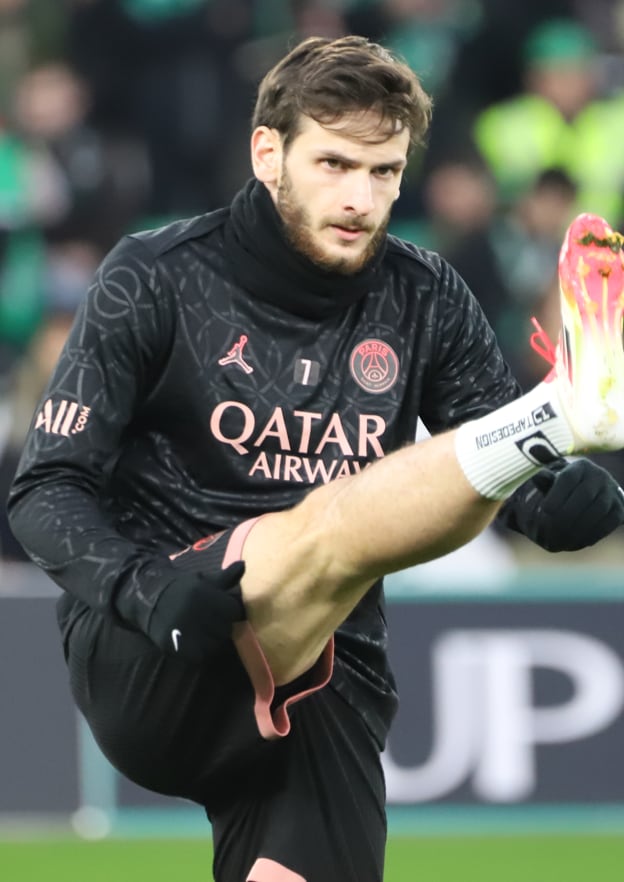
Summary
Kvaratskhelia slows the defender before accelerating past him, using changes of pace and angle rather than one repeated dribble. His route from Georgian football to Napoli and Paris turned that improvisation into elite-level production.
Quick facts
- Primary role
- Left winger / wide forward
- Current club
- Paris Saint-Germain, number 7; contract through 2029
- Date of birth
- February 12, 2001
- Birthplace
- Tbilisi, Georgia
- Major club breakthrough
- Serie A champion with Napoli in 2022/23
- European peak
- 2025/26 Champions League Player of the Season
The pause is part of the dribble
Khvicha Kvaratskhelia rarely needs to rush the first move. He can receive on the left, bring the ball almost to a stop and wait for the full-back to plant his feet. If the defender edges closer, Kvaratskhelia can go down the line. If the defender guards that route, the winger carries inside onto his right foot.
The tricks catch the eye, but the damage usually comes from a change of pace or angle. Once the defender shifts his weight, Kvaratskhelia has room to shoot, slide a pass into the box or draw another opponent before finding an overlapping teammate.
That habit travelled with him from Georgian football to Napoli and then Paris Saint-Germain. The teams became stronger and the instructions more demanding. His improvisation stayed, but he learned to use it within sides expected to control the ball and collect trophies.
2026 Ballon d’Or case
Kvaratskhelia is an official 2026 Ballon d’Or nominee with a particularly strong European case. UEFA’s Player of the Season report records ten goals and six assists in 16 Champions League appearances. Those are competition figures, not totals for every PSG or Georgia match.
The question is how that club peak compares with the combined club and international evidence of the leading candidates. We discuss it in the 2026 Ballon d’Or ranking. His position there need not match the current-form list below: the award has its own assessment period and gives priority to individual performance.
Georgia offered no standard route to the elite
Kvaratskhelia was born in Tbilisi on February 12, 2001. He began his senior career with Dinamo Tbilisi and Rustavi, then stepped up to a stronger weekly level at Rubin Kazan. Russia’s invasion of Ukraine changed that path. He returned to Georgia and joined Dinamo Batumi.
From Paris, that spell may now look like a detour. At the time, he had to keep his career moving while events outside football changed his club situation. Napoli signed him in 2022 even though he did not have the long top-league record normally associated with a replacement for established attacking stars.
Napoli learned the name immediately
Any uncertainty disappeared during his first Serie A season. Napoli had found a left-sided attacker who could unlock a settled defence and still threaten space after a turnover. Victor Osimhen occupied the centre-backs. Kvaratskhelia pulled the opponent’s right side wider and attacked the gaps that followed.
Napoli won the 2022/23 Serie A title and ended a thirty-three-year wait. The memorable dribbles were only part of Kvaratskhelia’s contribution. His goals, final passes and carries moved attacks from the touchline into the penalty area. Supporters called him “Kvaradona”, a nickname that captured the excitement of his arrival rather than a serious attempt to equate him with Diego Maradona.
The next seasons were messier. Opponents sent cover toward his flank earlier, Napoli changed coaches and the title-winning structure came apart. By then, nobody was surprised by him. He had to find answers against teams that planned for his strongest moves.
Why the left wing does not confine him
The wide starting position lets Kvaratskhelia see the defender and receive facing forward. From there, he can threaten either direction, although his best attacks seldom remain in a single lane.
An inside move forces the full-back to choose whether to follow. If a midfielder comes across, a passing route can open behind him. If both players hold their position, Kvaratskhelia can shoot from the edge of the area. Even before he touches the ball again, the defence has shifted to account for him.
He is neither a touchline crosser nor a central playmaker parked on the wing. He is a wide forward who beats or unsettles the first defender, then decides whether the attack calls for a shot, a combination or another carry.
Paris asked for the same talent inside a collective
Kvaratskhelia joined Paris Saint-Germain in January 2025 on a contract through 2029.
Paris Saint-Germain’s post-superstar attack relied on coordinated movement, not one player waiting to receive every possession. Ousmane Dembélé rotated through central areas, while João Neves and the midfield looked after the space behind the forwards. Kvaratskhelia had to press, swap positions and release the ball before an individual move slowed the whole attack.
Paris now had two very different dribblers. Dembélé could attack from either flank or move through the middle. Kvaratskhelia held the left, invited pressure and tried to break that line. With Achraf Hakimi and Nuno Mendes providing width from full-back, the forwards could move closer to goal without crowding the centre.
Paris won consecutive Champions League titles in 2025 and 2026. UEFA named Kvaratskhelia the competition’s Player of the Season for 2025/26. The award showed that his role had grown well beyond that of a useful supporting player.
The current-form ranking still requires a wider window
Kvaratskhelia sits just outside the Top 10 in our best players in the world right now ranking, despite winning the Champions League award. It was a narrow call. The ranking considers the full club season, the World Cup window, availability and how much responsibility each player carried across competitions.
His best European performances compare with anyone above him. What matters next is whether he carries that level into the opening months of 2026/27. The order can change as the new season supplies more evidence.
Georgia changes the scale of the international task
Georgia cannot surround Kvaratskhelia with the depth available to Europe’s largest national teams. He therefore carries more of the creative load, while his international output is difficult to compare directly with forwards in stronger squads.
Georgia’s progress moved his reputation beyond club football. He had to receive under heavy attention, carry transitions and create without the territorial control he often enjoyed at Napoli or Paris. International opponents were preparing for Kvaratskhelia himself, not merely for one part of a club system.
Caps, goals and tournament records can change at every international window, so those figures need a date beside them. His basic job is more stable. Georgia expect Kvaratskhelia to turn a difficult possession into an attack.
What separates him from other elite wingers
There are faster wingers, more prolific scorers and safer passers. Few offer as many solutions from the same starting position. A defender can see Kvaratskhelia standing over the ball on the left and still struggle to read whether the next touch will go outside, inside or backward before a run into the gap.
The uncertainty only counts if the next action helps the team. At Paris, Kvaratskhelia has learned to connect his one-on-one skill with the movement around him. His Champions League award recognised how well that balance worked. Sustaining it would turn one exceptional season into his usual level.
Sources
Sources checked
- UEFA - Official 2026 Ballon d'Or shortlist
- UEFA - Khvicha Kvaratskhelia named 2025/26 Champions League Player of the Season
- UEFA - Paris retain the Champions League
- Paris Saint-Germain - Khvicha Kvaratskhelia player profile
- UEFA - Kvaratskhelia's January 2025 move and contract through 2029
- UEFA - 2022/23 technical report: Napoli and Kvaratskhelia
FAQ
Which club does Khvicha Kvaratskhelia play for?
Khvicha Kvaratskhelia plays for Paris Saint-Germain, wearing number 7. He joined in January 2025 on a contract through 2029; the club profile was rechecked on September 23, 2026.
What position does Khvicha Kvaratskhelia play?
He is primarily a left winger who attacks inside onto his right foot, although he can interchange across the front line.
Why is Khvicha Kvaratskhelia called Kvaradona?
Napoli supporters used the nickname because his dribbling and immediate impact recalled Diego Maradona. It is a fan comparison, not a claim that their careers or roles are identical.
What is Kvaratskhelia's biggest individual award?
UEFA named him the 2025/26 Champions League Player of the Season after Paris retained the trophy.