
player
Marquinhos: The Organiser at the Heart of Paris
Marquinhos' career from Corinthians and Roma to Paris Saint-Germain, with his defensive organisation, captaincy and two Champions League titles explained.
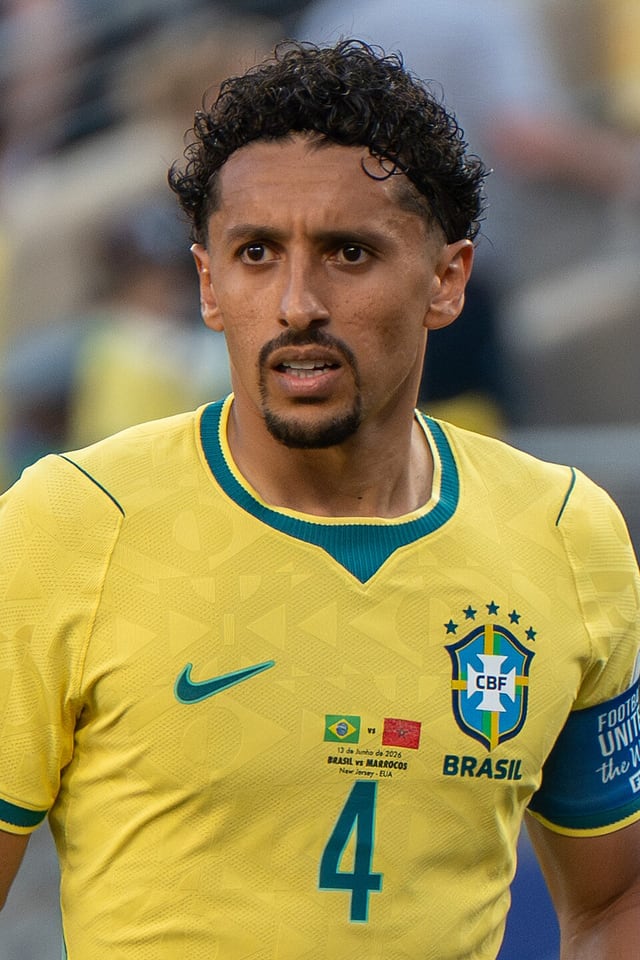
Summary
Marquinhos' value is easiest to see in the movement around him. He holds the central distance, passes runners between defenders and gives Paris a stable reference while the full-backs attack.
Quick facts
- Primary role
- Centre-back
- Current club
- Paris Saint-Germain, number 5 (checked August 30, 2026)
- Born
- May 14, 1994, São Paulo, Brazil
- Paris role
- Captain since 2020 and the club's all-time appearance leader
- European peak
- Back-to-back Champions League winner in 2025 and 2026
Organisation begins before the cross arrives
Marquinhos does not wait for the final action to start defending. He checks the position of the full-back, the run beyond his partner and the space the goalkeeper can attack. By the time a cross enters the box, Paris Saint-Germain’s central defender is often solving a movement that began several passes earlier.
That awareness makes him the reference point of an aggressive back line. Nuno Mendes and Achraf Hakimi can attack high, but the space behind them must be redistributed. Marquinhos decides whether to slide across, hold the centre or pass a runner to Willian Pacho.
Our current defenders ranking places him sixth after Paris retained the Champions League and UEFA selected him in the 2025/26 Team of the Season.
A fast route from Corinthians to Europe
Marquinhos was born in São Paulo and developed at Corinthians. He moved to Roma while still a teenager, spending only one senior season in Italy before Paris signed him in 2013.
The transfer placed a young defender inside a club trying to move immediately into Europe’s elite. He had Thiago Silva beside him, expensive competition around him and little room for a slow introduction. His ability to cover more than one position helped: Marquinhos could play centre-back, step into defensive midfield or fill a full-back role.
Versatility opened the door, but central defence became his home. He learned how a dominant team can look secure for most of a match and still expose its defenders to one decisive transition.
Leadership became a structural job
Marquinhos became Paris captain in 2020. The armband added public responsibility, but his most important leadership remained positional. A centre-back can make a team-mate faster by giving the instruction early enough: step, hold, leave the runner or close the passing lane.
Paris went through several tactical identities during his time at the club. Some teams depended on star forwards and defended with fewer players behind the ball. The later Champions League winners relied more heavily on collective pressing and rotation. Marquinhos had to adapt his distances without losing authority.
His longevity is exceptional in a squad repeatedly rebuilt around new coaches and new headline signings. The club now identifies him as its all-time appearance leader, while his number of trophies reflects both that endurance and Paris’ domestic dominance.
Defending when the full-backs leave
An attacking full-back changes the centre-back’s job. If Hakimi is near the opposition box, Marquinhos may have to protect the right channel while still guarding the central striker. Moving too early opens the middle; moving too late gives the winger a direct run.
The solution is collective. A midfielder can drop into the vacated space, Pacho can narrow from the left and the nearest forward can counter-press the first pass. Marquinhos reads which protection is actually present rather than assuming the planned structure survived the turnover.
He is not the fastest defender in every race or the largest in every aerial duel. His advantage is arriving with the body prepared and the next defender already connected to the action.
Passing is part of keeping the team compact
Marquinhos usually chooses the pass that lets Paris keep its shape. He can switch the ball or step forward, but he does not need every possession to become a vertical gamble. A safe pass can draw the press to one side and give the full-back time to move.
When the forward line blocks the obvious route, he can carry into the space and force a midfielder to engage. The pass after that movement is more valuable because an opponent has left position to stop him.
His calm distribution supports Pacho’s left-footed angles and allows the midfield to receive facing forward. It also reduces the number of transitions Paris have to defend—a centre-back’s safest intervention is sometimes the pass that prevents the ball from being lost.
The European ending changed
For years, Marquinhos’ Paris career included painful Champions League exits. That history made the 2025 breakthrough more than another trophy in a domestic collection. As captain, he lifted the club’s first European Cup.
Paris retained the title in 2026, beating Arsenal on penalties after the final finished level. The club credited Marquinhos with 122 European appearances at that point and a second successive Champions League as captain. UEFA’s technical observers then placed him in the Team of the Season.
Those wins do not make every earlier criticism disappear. They show that Marquinhos remained central long enough for Paris to build a more balanced champion around him. His current case rests on the same quality as his long club record: adaptation without losing the organising role.
Sources
Sources checked
FAQ
What position does Marquinhos play?
Marquinhos is primarily a centre-back. He has also played as a defensive midfielder and full-back during his career.
Which club does Marquinhos play for?
Marquinhos plays for Paris Saint-Germain, where he wears number 5 and serves as captain. His status was checked on August 30, 2026.
Is Marquinhos PSG's record appearance holder?
Yes. Paris Saint-Germain's official profile identifies him as the club's all-time appearance leader.
Has Marquinhos won the Champions League?
Yes. He captained Paris as the club won its first Champions League in 2025 and retained the title in 2026.