
player
Willian Pacho: The Recovery Defender Behind Paris' Width
Willian Pacho's career from Ecuador to Antwerp, Frankfurt and Paris, with his left-footed defending, recoveries and two Champions League titles explained.
Summary
Pacho gives Paris a left-footed first pass and the recovery range to protect attacks built around adventurous full-backs. His rise from Ecuador through Belgium and Germany was fast, but each step added a different defensive demand.
Quick facts
- Primary role
- Left-sided centre-back
- Current club
- Paris Saint-Germain, number 51 (checked August 30, 2026)
- Born
- October 16, 2001, Quinindé, Ecuador
- European route
- Royal Antwerp and Eintracht Frankfurt before Paris
- European peak
- Back-to-back Champions League winner in his first two Paris seasons
Paris attack wide because Pacho can defend wide
Willian Pacho is most visible when a Paris Saint-Germain attack breaks down. The full-back is ahead of the ball, the opponent looks for the open channel and Pacho has to leave the centre without opening a direct route to goal.
He covers that space with speed, but the action is not a simple foot race. Pacho must curve his run, keep the attacker outside and wait for Marquinhos or a midfielder to restore the centre. Winning the ball is ideal; delaying the attack until Paris regain shape can be just as important.
That repeatable recovery work put him seventh in our ranking of the best defenders in the world right now. Paris won the Champions League in each of his first two seasons, and his minutes showed that he was part of the platform rather than depth behind it.
2026 Ballon d’Or case
Pacho’s inclusion in the official 2026 Ballon d’Or shortlist recognises a defender in a field led by attackers. His recovery work and left-footed passing help Paris commit players forward without leaving every lost ball to become an emergency. The relevant comparison is his contribution to that structure, not a goals-and-assists contest with a winger.
Team trophies alone cannot settle the individual ranking, especially with several PSG teammates nominated. Our Ballon d’Or 2026 guide gives the wider field and explains why the defensive case needs role and match evidence alongside the medals.
Independiente del Valle built the first platform
Pacho was born in Quinindé and developed at Independiente del Valle, the Ecuadorian club known for moving academy players into senior responsibility. He won domestic and continental honours before leaving South America.
Royal Antwerp was the next step. Belgian football exposed him to a more direct mix of aerial duels, pressing and transition play. Pacho helped the club win a league-and-cup double, then moved to Eintracht Frankfurt after one season.
The Bundesliga increased the space and speed of the attacks he faced. Frankfurt defenders could be asked to step high, defend runners toward the touchline and recover after aggressive pressing. Paris signed him in 2024, completing three international moves in as many summers.
The left foot creates an exit
Pacho usually starts on the left of the central pair. His stronger foot lets him receive facing the full width of the pitch and find the left-back without turning back toward his own goal.
That first angle matters against a press. If the forward tries to block Marquinhos, Pacho can carry into space. If the winger closes Nuno Mendes, the pass inside may open. The goal is not to force the most ambitious ball; it is to make the opponent reveal which route it has left unprotected.
Pacho’s passing is functional before it is decorative. He supports Paris’ possession by moving the pressure, then staying positioned to defend if the next pass fails.
Recovery numbers need tactical context
Across the completed 2025/26 Champions League, UEFA listed Pacho as Paris’ minutes leader with 1,560 and the competition leader with 105 ball recoveries. The volume supported what the matches showed, but recoveries are not a standalone verdict.
A centre-back can record many recoveries because his team loses the ball often, because he plays more minutes or because opponents target his area. Pacho’s case is stronger when the number is joined to the role: Paris advanced both full-backs, pressed high and trusted him to collect the pass released behind that pressure.
The same evidence can reveal a risk. If Pacho has to make every recovery at full speed, the structure is asking too much. The best version of his game mixes open-field defending with earlier interceptions and calm possession.
A partnership divided by angle, not status
Marquinhos carries the captaincy, the club record and the larger store of Champions League experience. Pacho does not need to imitate him. Their partnership works because the younger defender can cover the left channel while the captain organises the central line.
When Achraf Hakimi attacks from the right, Marquinhos may slide outward and Pacho narrows behind him. When Mendes advances on the left, those responsibilities reverse. Each centre-back has to read the other full-back as well as the striker in front of him.
Pacho’s speed gives Paris room for correction, but his development will be measured by how rarely correction is required. Positioning can turn a sprint into a short step and a tackle into an interception.
Two European titles changed the scale quickly
Pacho joined a club that had never won the Champions League and became a starter in the side that won it in 2025. Paris retained the trophy in 2026, making his first two seasons at the club consecutive European Cup campaigns.
The honours arrived faster than the long-term reputation. That distinction matters. Two winning seasons establish Pacho at the elite level, but the next stage is sustaining the role as opponents adapt and Paris adjust the balance around their full-backs.
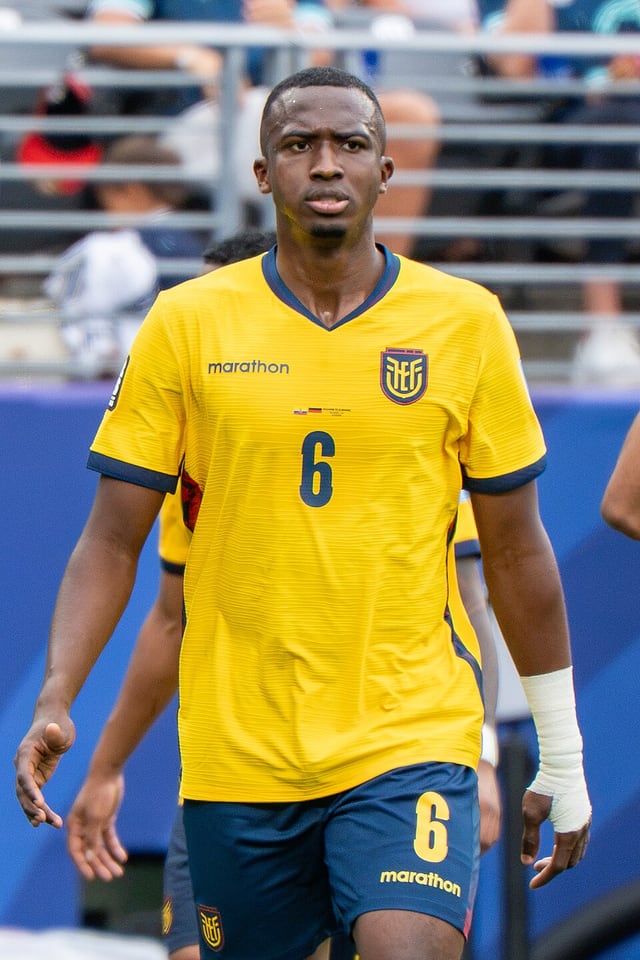
Ecuador also ask him to defend in a different context, with less possession and more prolonged pressure. Moving between those environments should sharpen the same central skill: identifying which space is dangerous before using his speed to close it.
Sources
Sources checked
FAQ
What position does Willian Pacho play?
Pacho is a centre-back who usually plays on the left side of the pairing.
Which club does Willian Pacho play for?
Pacho plays for Paris Saint-Germain and wears number 51. His current club profile was checked on August 30, 2026.
Where did Willian Pacho play before PSG?
He developed at Independiente del Valle, then played for Royal Antwerp and Eintracht Frankfurt before joining Paris in 2024.
Has Willian Pacho won the Champions League?
Yes. Paris won the Champions League in each of Pacho's first two seasons, 2024/25 and 2025/26.