
player
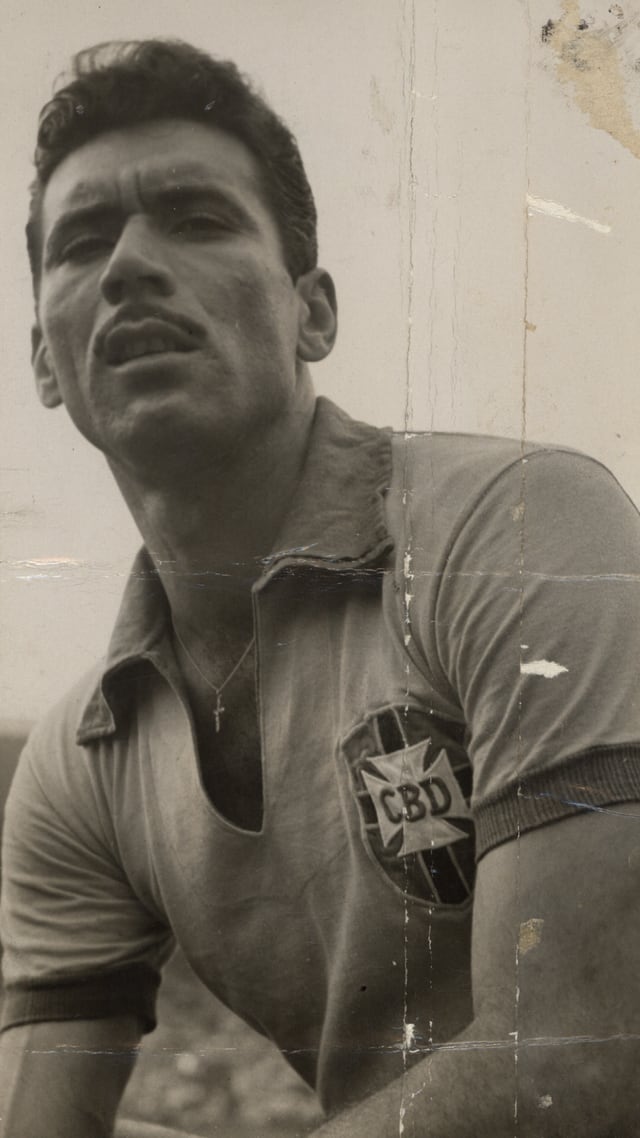
Nilton Santos: The Full-Back Who Chose His Moment
Nilton Santos's Botafogo and Brazil career, with two World Cups, 723 club appearances and his influence on the attacking full-back role explained.
Summary
Nílton Santos expanded the left-back role without abandoning its defensive work: wait, read the winger, then carry the ball into the space the game offered.
Quick facts
- Primary role
- Left back
- Only senior club
- Botafogo, 1948-1964
- Botafogo record
- 723 appearances and 11 goals
- World Cups
- Four squads; champion in 1958 and 1962
- CBF historical register
- 86 Brazil appearances and four goals
- Profile
- Positioning, clean tackling, ball carrying and selective forward runs
He moved forward because the space was there
Nílton Santos did not play like a modern wing-back dropped into the 1950s. He was a defender first. He watched the winger, controlled the distance to his centre-back and protected the route toward goal. The change came after his team won the ball.
Most full-backs of his era were expected to release it and return to their post. Nílton sometimes kept going. He carried into midfield, exchanged a pass and, if the route remained open, appeared near the penalty area. The advance was striking because it began from a secure defensive decision rather than from permanent attacking licence.
That distinction explains his influence better than calling him the first modern full-back and stopping there. He widened the job without pretending the old work had disappeared.
An attacker was sent to the back line
Nílton dos Reis Santos was born in Rio de Janeiro on 16 May 1925. He played as a forward in local football and while serving in the Brazilian Air Force. A route through military football eventually brought him to Botafogo for a trial in 1948.
The museum’s earlier biography described club official Carlito Rocha looking at his build and directing him toward defence. Nílton wanted to attack; Botafogo saw a player with the body and composure to start deeper. The tension between those two ideas shaped the career.
He made the first team in 1948 and helped Botafogo win the Campeonato Carioca that year. Coaches initially tried to restrict his forward movement. Nílton kept choosing moments to step beyond the winger because he could see a useful action rather than because he wanted to ignore the plan.
The club became his only senior team. CBF and Botafogo record 723 appearances and 11 goals between 1948 and 1964. Sixteen seasons at one club matter here: the attacking habits survived different teammates, coaches and versions of Brazilian football.
The nickname was about information
The Football Encyclopedia sounds like a tribute to technical range. It also describes how early he understood the next phase of a move.
Nílton did not chase every feint. He waited for the winger to make the ball reachable, then stepped in with enough balance to play after the tackle. If he won possession facing his own goal, he could turn away from pressure. If he received side-on, his first touch opened the field.
That made the attack from full-back less reckless than it appeared. He was not starting with a blind sprint. He had already read the opponent’s position, the cover behind him and the teammate ahead.
The nickname stuck around 1957, when Botafogo ended a nine-year wait for the state title. By then the label did not mean that Nílton knew football as trivia. It meant he seemed to have an answer while the move was still forming.
Garrincha’s trial became part of both careers
In 1953, an unknown winger named Manoel dos Santos arrived for a Botafogo trial. Nílton marked him. Garrincha put the ball through the established defender’s legs early in the session.
CBF’s retrospective says Nílton urged the club to sign him. The familiar punchline is that he preferred having Garrincha as a teammate to facing him in a full stadium.
The story survives because it fits both players. Garrincha’s dribbling was immediate and disruptive. Nílton was secure enough in his status to recognise the talent rather than defend his pride.
Their partnership also changed Botafogo’s shape. Garrincha held the right side and attacked defenders repeatedly. Nílton supplied intelligence and progression from the opposite flank. Didi connected the middle. The team did not need its two wide threats to look alike.
Four World Cup squads contained three different roles
Brazil selected Nílton for the 1950 World Cup, but he did not play. Augusto started at left back as the host reached the decisive match and lost to Uruguay at the Maracanã.
By 1954, Nílton was the starter. He played against Mexico, Yugoslavia and Hungary. The quarter-final with Hungary became the Battle of Bern, a 4-2 defeat filled with confrontations and three dismissals. Nílton was one of the players sent off.
The tournament gave him World Cup experience but no gentle origin story. Brazil left in the quarter-finals, and the full-back’s first edition on the field ended in the ugliest match of the competition.
Four years later, he arrived in Sweden as a senior defender in a team ready to change Brazil’s World Cup history. In 1962 he returned at thirty-seven, no longer the new idea on the flank but one of the players responsible for keeping the champions stable.
The Austria goal made the argument visible
Brazil opened the 1958 World Cup against Austria. Nílton received on the left and carried forward. The run continued past midfield, beyond the next challenge and into the penalty area. He finished with a lifted touch over the goalkeeper for Brazil’s second goal in a 3-0 win.
His autobiography supplied the scene that became football folklore. Coach Vicente Feola called for him to come back while he advanced, then changed his approval once the ball went in. The story is an autobiographical account rather than a live recording.
The goal mattered beyond novelty. It showed that a defender could identify an unguarded route and complete the attack without waiting for permission attached to his position. Nílton scored only once at a World Cup. One was enough to make the tactical point.
Brazil then drew 0-0 with England and won four consecutive matches. Nílton started the 5-2 final victory over Sweden. Pelé supplied two goals, Garrincha stretched the right side and Brazil won its first World Cup.
Sweden was not only the story of the forwards
The images of 1958 belong naturally to Pelé, Garrincha and Didi. The defensive line gave their freedom a base. Nílton’s work with captain Bellini, Orlando and goalkeeper Gilmar helped Brazil concede four goals in six matches.
His attacking reputation can hide the restraint inside that run. He did not attempt to recreate the Austria goal every afternoon. Against England, Wales and France, he often chose the simpler pass and remained available behind the move.
That choice is part of the innovation. A player changes a position most effectively when teammates can trust the decision. If every run exposes the defence, the coach removes the run. Nílton kept the freedom because he knew when not to use it.
At thirty-seven, he was still the starting left back
Nílton played every Brazil match at the 1962 World Cup. FIFA records him at 37 years and 32 days when Brazil beat Czechoslovakia 3-1 in the final, making him one of the oldest players to win the tournament on the field.
Pelé was injured during the group stage, so Brazil had to alter its attack. Garrincha became the decisive forward, Amarildo entered the team and Zagallo continued balancing the left side. Nílton’s experience mattered because the structure changed without allowing the defence to become unsettled.
The group match against Spain produced another famous piece of gamesmanship. The museum’s earlier biography described Nílton fouling Enrique Collar at the edge of the penalty area, then stepping outside before the referee made his decision. A free kick was awarded instead of a penalty. It is a sharp story about awareness, although it should not be mistaken for proof that the foul itself was legal.
The final was his last appearance for Brazil. He left the national team by starting a World Cup victory, not through a ceremonial friendly added later.
The national-team totals need their label
CBF’s historical profile lists 86 appearances and four goals. Botafogo’s idol page also uses 86 games but lists three goals. Several international databases use a narrower senior A-match definition and publish 75 appearances with three goals.
This page keeps the CBF line in the quick facts because it is the federation’s own historical register. It does not describe that number as a universally standardised cap total. Earlier international schedules included representative matches whose status is handled differently by modern databases.
The disagreement does not touch the World Cup record: four squads, appearances in three editions and winner’s medals in 1958 and 1962. It changes how a reader should quote the career total. The number needs its source and scope beside it.
Botafogo had the whole club career
Nílton won the Campeonato Carioca in 1948, 1957, 1961 and 1962. Botafogo also won the Rio-São Paulo tournament in 1962 and 1964. He retired after the latter season.
The 723-match total spans a football calendar that included state competition, interstate tournaments and many fixtures outside today’s league-centred record system. Comparing it directly with a modern league-appearance number would be careless. It remains the club’s all-match record for a player who wore no other senior club shirt.
Botafogo later placed his name on its home. The former Estádio Olímpico João Havelange became commonly known as Estádio Nilton Santos in 2015, and the naming was made official in 2017. A statue outside the ground carries the connection from player to place.
His route was different from later Brazilian full-backs
Carlos Alberto Torres reached the 1970 World Cup final from right back and completed one of the tournament’s most famous team goals. Cafu made repeated overlaps and recovery runs a ninety-minute demand. Roberto Carlos added extraordinary acceleration and shooting power.
Marcelo moved even farther toward playmaking, combining inside and accepting that teammates would have to cover the space behind him. Those players did not simply repeat Nílton’s game with better fitness or newer boots.
What Nílton supplied was permission. A full-back could enter the attack as a thinking player rather than as an emergency runner. Each later generation changed the frequency, speed and risk of the movement.
Eighth in a ranking with no single full-back ideal
Nílton sits eighth in The Top Football’s best full-backs of all time ranking. His case cannot rely on the detailed event data available for modern defenders. It rests on tournament footage, contemporary accounts, a sixteen-year Botafogo record and the visible change in what his position attempted.
Placing him above every later full-back would require assumptions the evidence cannot settle. Leaving him out because the statistical trail is older would create a different error. The position’s history makes less sense without him.
The strongest point is modest and durable. Nílton Santos defended the flank well enough to earn trust, then used that trust to leave it at the right moment.
Sources
Sources checked
FAQ
Why was Nilton Santos called the Football Encyclopedia?
The nickname referred to his broad reading of the game. He could defend, carry the ball, combine in midfield and recognise when a full-back should join the attack.
How many World Cups did Nilton Santos win?
He won two, in 1958 and 1962. He was also in Brazil's 1950 squad without playing and started at the 1954 tournament.
Did Nilton Santos play only for Botafogo?
Yes. His senior playing career ran from 1948 to 1964 at Botafogo, where the club and CBF record 723 appearances and 11 goals.
How many games did Nilton Santos play for Brazil?
CBF's historical tribute lists 86 appearances and four goals. Some databases apply a narrower official-match definition and publish 75 appearances and three goals, so the scope should accompany the number.
What was Nilton Santos's famous goal at the 1958 World Cup?
He carried the ball from left back into Austria's penalty area and chipped the goalkeeper in Brazil's 3-0 opening win, an unusual attacking action for a full-back in that era.