
player
Robert Lewandowski: The Striker Built on Preparation
Robert Lewandowski's career from Poland to Dortmund, Bayern, Barcelona and Chicago Fire, with the movement and preparation behind his Bundesliga and Champions League goals.
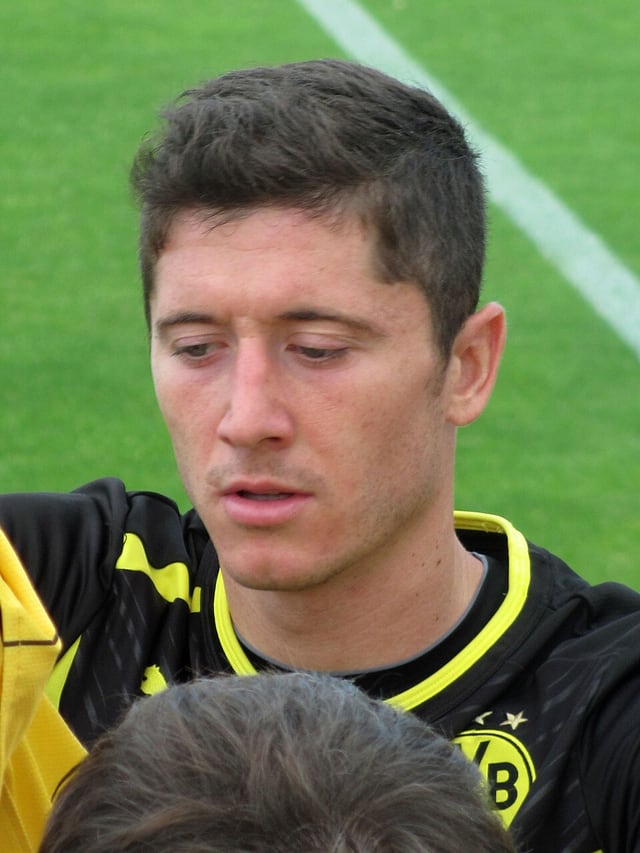
Summary
Lewandowski's simple-looking finishes were prepared early. He scanned before the cross, adjusted against the defender's blind side and shaped his first touch so the shot needed no rescue.
Quick facts
- Primary role
- Centre-forward
- Defining clubs
- Borussia Dortmund, Bayern Munich and Barcelona
- Bundesliga
- 312 goals in 384 appearances
- Champions League
- 109 goals through the end of his Barcelona spell in 2026
- Poland
- 89 goals in 167 matches at UEFA's 2026-06-04 snapshot
- Current club
- Chicago Fire FC; signed June 29, 2026
- Chicago contract
- Through the 2027/28 MLS season
- Barcelona record
- 120 goals in 193 appearances, 2022-2026
The finish begins before the pass
Robert Lewandowski has scored so often that the routine can hide what he is doing. A cross arrives, one touch settles it and the next sends it at goal. The chance seems to have found him.
Usually, Lewandowski found it first. While the wide player looked up, he checked the centre-back’s shoulder, slipped half a step out of sight and adjusted his body. The ball entered the box after the hard choices were already made.
The same habits survived every rise in level, from Poland’s lower divisions to Borussia Dortmund, Bayern Munich and Barcelona. His Bundesliga record stopped at 312 goals in 384 appearances. UEFA records 109 Champions League goals through the end of his Barcelona spell in 2026, placing him third on the all-time list.
His Barcelona spell ended after the 2025/26 season with 120 goals in 193 appearances. Chicago Fire FC announced his signing on June 29, 2026, as a Designated Player under contract through the 2027/28 MLS season.
Poland provided the long route
Lewandowski did not arrive from one of Europe’s famous academies. He played for Znicz Pruszkow in Poland’s lower divisions, then moved to Lech Poznan. UEFA notes that he finished as a leading scorer in Poland’s third, second and first tiers.
Each promotion shortened the time available for a first touch or shot. Lewandowski was learning the position in sides that might create only a few clean chances, long before a dominant Champions League team could supply him all evening.
Lech won the Polish league in 2009/10. Lewandowski then moved to Borussia Dortmund, where the job expanded under Jurgen Klopp. Pressing, running and combination play became conditions of selection, not useful extras.
Dortmund made him work outside the box
Lewandowski’s first Dortmund season did not make him an automatic star. He spent time behind Lucas Barrios and learned how Klopp wanted the forward to connect the press and the attack.
Klopp’s centre-forward closed passing lanes, chased centre-backs and offered midfield runners a wall pass under pressure. Lewandowski learned to hold off a defender, cushion the ball and turn toward the box for the return.
Dortmund won consecutive Bundesliga titles in 2010/11 and 2011/12. The second side also won the German Cup, with Lewandowski scoring a hat trick against Bayern in the final.
On 24 April 2013, Lewandowski scored four against Real Madrid at Signal Iduna Park. Dortmund won the first leg of the Champions League semi-final 4-1. There was a close-range finish, a run across the line and a drag followed by a turn in traffic. Real Madrid did not concede the same goal four times.
Dortmund reached the final and lost to Bayern at Wembley. Lewandowski left a year later, having shown that his scoring could survive a pressing system, a title race and Champions League knockout football.
How Lewandowski prepares the shot
Large runs give defenders time to react, so Lewandowski often works in inches. He stays close to a centre-back, slips toward the blind side and waits for the defender to glance at the crosser before attacking the ball.
Body position saves another fraction. Arrive square to goal and an extra touch may be needed. Lewandowski tries to reach the pass with one hip open, allowing the first contact to prepare the shot instead of merely stopping the ball.
Both feet are credible enough that a defender cannot simply close one side. For headers, Lewandowski creates separation before he jumps and worries about direction as much as power. A pass behind him can still produce a quick turn or an improvised contact because he rarely loses his balance.
Outside the box, he can connect with midfield and continue toward goal. That part of the game became essential at Dortmund and remained useful when opponents defended deep against Bayern and Barcelona. He is a penalty-box striker, but he does not wait there disconnected from the move.
Five goals in nine minutes
Bayern trailed Wolfsburg 1-0 at half-time on 22 September 2015. Lewandowski came off the bench and scored five times between the 51st and 60th minutes.
The clock made the performance famous, but the finishes are worth another look. A square pass, a rebound, a strike from outside the box, another delivery and an acrobatic volley produced the five. Wolfsburg kept finding a different problem.
Lewandowski read a match that had changed speed. After the first goal, Bayern attacked with more conviction and Wolfsburg’s defensive distances loosened. He kept arriving before the shape recovered.
Nine minutes is a poor way to summarise a long career. It is a good way to see why the phrase “consistent finisher” leaves too much out.
Bayern turned the skill into scale
Lewandowski scored 344 goals in 375 appearances for Bayern across all competitions. In the Bundesliga, he scored 238 for Bayern after 74 with Dortmund, producing the league-career total of 312 in 384 matches.
The scopes are different. The Bayern figure covers eight seasons and every competition; the Bundesliga figure covers twelve league seasons at Dortmund and Bayern.
Bayern’s territorial dominance brought many crowded penalty areas. Opponents often defended close to their own goal, leaving less space for the straight runs seen in transition. Lewandowski learned to work between two centre-backs, step away to combine and return after the defence had followed the ball.
The Bayern Munich profile covers the wider run of domestic titles and European campaigns. Lewandowski’s role was to make that pressure count even when the first attack stalled. A blocked cross did not end the danger if he could reset his position before the second ball arrived.
Forty-one goals and the 2020 treble
Gerd Muller scored 40 Bundesliga goals in 1971/72, a record that stood for nearly half a century. Lewandowski reached 41 in 2020/21, scoring in the final league match to move past it.
That is one version of his peak. In 2019/20, Bayern had won the Bundesliga, German Cup and Champions League with Lewandowski leading the scoring in all three competitions.
The Champions League run took place across the interrupted pandemic season and ended in the Lisbon tournament. Competition format and calendar were unusual, but every club faced the same knockout finish. Lewandowski scored 15 times in the competition and contributed to a side that won every Champions League match it played.
The treble ties his goals to the largest team prizes. The 41-goal league season shows the weekly scoring needed to break a record that had resisted several generations of elite forwards.
Muller’s Bundesliga career record of 365 remained out of reach. Lewandowski stopped at 312 and second place.
Poland asked him to carry more
UEFA’s profile, checked on 4 June 2026, recorded 89 goals in 167 appearances for Poland. Older official pages contain lower totals because they were captured earlier.
Poland could not reproduce Bayern’s weekly control of the ball. Lewandowski often had to receive farther from goal, protect longer passes and wait for support. Opponents could focus more defensive attention on him because the next threat was less predictable.
That makes his international role broader but sometimes less productive by club standards. He has led Poland through several major tournaments and became the country’s record scorer. The work includes goals, but also the awkward minutes when a star striker must help his team reach the area before he can finish inside it.
Barcelona changed the rhythm again
Lewandowski was 33 when he joined Barcelona in 2022. He won La Liga in his first season and led the league in scoring. The move took him outside the Bundesliga after his physical peak and gave the old habits a different setting.
Barcelona often faced deep blocks, but their possession routes differed from Bayern’s. Lewandowski had to connect with young wide players, occupy centre-backs and create room for midfielders arriving around him. He could not base the entire job on repeated sprints behind the line.
The official final archive records 193 appearances and 120 goals from 2022 to 2026. He won three league titles, one Copa del Rey and three Spanish Super Cups. The last season brought 19 goals across all competitions before the club confirmed his departure in May 2026.
The Barcelona profile places those seasons inside an academy-led reset. Lewandowski gave that changing side an experienced penalty-box reference while younger attackers learned around him.
The next step took him to Chicago Fire in MLS. The move extended his club career beyond Europe after four seasons at Barcelona.
Champions League longevity
UEFA’s all-time table listed Lewandowski third with 109 Champions League goals at the research date, behind Cristiano Ronaldo and Lionel Messi. He also scored in 15 consecutive Champions League seasons from 2011/12 through 2025/26.
The total belongs to three versions of Lewandowski. Dortmund needed the pressing forward who combined with midfield. Bayern asked him to turn constant pressure into goals against deep defences. Barcelona got an older player who leaned harder on timing and position.
That continuity is a major part of his all-time case. European knockout football did not always end with the trophy, but his goals were not confined to one dominant team or one brief peak.
Where Lewandowski belongs among strikers
Lewandowski belongs in the all-time striker ranking because he repeated the work for so long. Yet the repeated outcome came from several different solutions.
He developed through several levels in Poland, learned a demanding collective role at Dortmund, turned Bayern pressure into historic scoring seasons and remained productive through four years at Barcelona. The five goals against Wolfsburg show range in one burst. The 41-goal league season shows a peak. The 109 Champions League goals show how long the work held up.
Harry Kane has built more of his identity around dropping into midfield and passing runners through. Erling Haaland attacks depth and the six-yard box with greater physical force. Lewandowski’s signature sits in the preparation between those pictures: one scan, a half-step away from the defender and a body already shaped for the finish.
Sources
Sources checked
- UEFA - Lewandowski finishes his Barcelona spell with 109 Champions League goals
- Chicago Fire - Robert Lewandowski signing and contract
- FC Barcelona - Robert Lewandowski says goodbye on 120 goals
- FC Barcelona - final Robert Lewandowski archive profile
- Bundesliga - all-time top scorers
- Bundesliga - Lewandowski's German career
- UEFA - Champions League all-time scorer table
- UEFA - Lewandowski career and Poland record
FAQ
What is Robert Lewandowski's current club?
Lewandowski plays for Chicago Fire FC. The club announced his signing on June 29, 2026, with a contract through the 2027/28 MLS season, after his four-year spell at Barcelona.
How many Bundesliga goals did Robert Lewandowski score?
Lewandowski scored 312 goals in 384 Bundesliga appearances for Borussia Dortmund and Bayern Munich. He is second on the competition's all-time list.
How many Champions League goals did Robert Lewandowski score?
UEFA records 109 Champions League goals through the end of his Barcelona spell in 2026, placing him third on the all-time list. This total can change if he returns to the competition.
Did Robert Lewandowski score five goals in nine minutes?
Yes. He came on at half-time for Bayern against Wolfsburg on 22 September 2015 and scored five times between the 51st and 60th minutes.
What is Robert Lewandowski's playing style?
Lewandowski is a centre-forward who prepares finishes with early scanning, blind-side movement and small body adjustments. He can score with either foot, in the air and after linking with midfielders outside the box.