
player
Romario: The Striker Who Shot Before the Goalkeeper Set
Romario's career through PSV, Barcelona, Brazil and the 1994 World Cup, with his penalty-box movement, toe-poke finishing and goal totals explained.
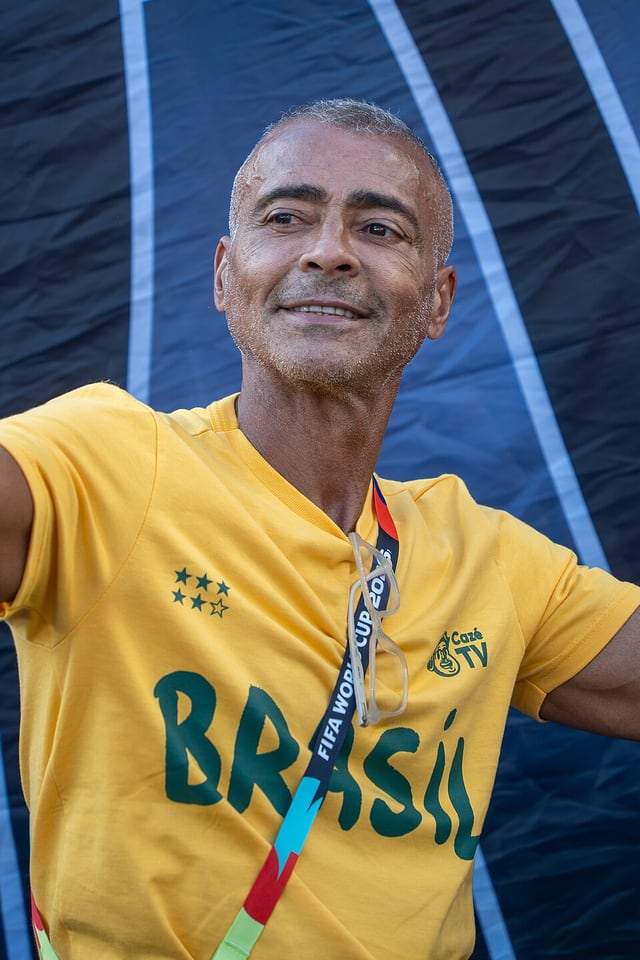
Summary
Romario did not give the goalkeeper a full shooting cue. His run found the defender's blind side, and his finish often came with a toe-poke, chip or short swing before the goal was properly set.
Quick facts
- Primary role
- Centre-forward
- Defining clubs
- PSV, Barcelona and Vasco da Gama
- Barcelona
- 39 goals in 65 appearances; 30 league goals in 1993/94
- Brazil
- 55 goals in official matches, according to CBF
- World Cup 1994
- Champion, five goals and Golden Ball winner
- Profile
- Blind-side movement and short-action finishing inside the box
The finish arrived before the usual warning
Romario rarely needed the full shooting action a goalkeeper expected. The last touch might be a toe-poke, a short swing or a chip taken while everyone else was waiting for him to set the ball.
That early contact was possible because the run had already done part of the work. Romario moved close to a defender without staying in the defender’s sight. A step across the blind side put him on the ball first, even when the pass travelled only a few metres.
At 1.69 metres, he was not built to pin two centre-backs and wait for crosses. His advantage was lower to the ground and faster to change. He could stop, turn or move the ball around a goalkeeper without taking the wide preparation step that gave the challenge away.
The result could look casual because the hardest work happened before the shot. His positioning had already removed the need for a bigger action.
Vasco gave him the penalty-area education
Romário de Souza Faria was born in Rio de Janeiro on 29 January 1966. After an early start with Olaria, he joined Vasco da Gama and became a senior scorer in the football culture that would keep pulling him back to Rio throughout his career.
Brazilian penalty areas offered little quiet space. Centre-backs stayed close, and the second defender often arrived before the striker could complete a turn. Romario learned to receive with the next contact already planned.
His movement did not always look busy. He could stand near a marker, wait for the defender to look toward the ball and move at that instant. A run of two or three metres was enough if it began outside the defender’s vision.
PSV took him to the Netherlands in 1988. The move placed that penalty-box game inside a team expected to attack regularly, but also against European defenders who were larger and more comfortable holding a line.
The toe-poke shortened the whole exchange
A conventional finish often asks the striker to place the standing foot, bring the striking leg back and hit through the ball. Each stage gives the goalkeeper information.
Romario could remove most of that sequence. The toe-poke travelled from a neutral running position and contacted the centre or underside of the ball before the goalkeeper read a side-foot or laces finish. It was especially useful when a defender was close enough to block a longer swing.
He had other finishes. A chip punished a goalkeeper who moved early. A low side-foot finish followed when the angle was clean. Quick feet let him move around a challenge in a very small area.
The toe-poke became the signature because it matched the rest of the game. Romario did not want to make the chance look complete. He wanted the shot away while the keeper was still waiting for the chance to become complete.
PSV gave the movement five seasons
Romario spent five seasons at PSV. The club credits him with three Dutch league titles, two KNVB Cups and one Super Cup.
PSV’s own archive publishes two different goal summaries. Its Our heroes page says 98 goals across the five seasons. A separate retrospective records 127 goals in 143 matches. The pages do not give matching competition boundaries, so this profile does not combine them or choose one as a universal PSV total.
The match evidence is clearer. Against Steaua Bucharest in the 1989 European Cup, Romario carried the ball through a series of defenders and the goalkeeper before finishing into an empty net. The goal showed that close-range craft did not mean he was limited to the six-yard box.
Dutch football gave him more space than he would later find in Spain, but the five seasons also taught him how European back lines moved together. By 1993, Barcelona were buying a striker who already understood when the line would step and what appeared behind it.
Barcelona needed a scorer for the Dream Team
Johan Cruyff had built Barcelona’s Dream Team around positional movement, midfield control and attackers who could exchange roles. The side had won three consecutive league titles and the 1992 European Cup before Romario arrived.
The missing element was a centre-forward who could turn possession into goals without requiring the whole structure to change. Romario did that immediately. FC Barcelona records 30 goals in 33 league matches in 1993/94, when the club won a fourth consecutive La Liga title.
He could remain quiet while the midfield moved the defence, then appear between centre-back and full-back as the final pass was released. Barcelona did not need him to dominate the ball. They needed him to recognise the moment when all the earlier passing had opened one lane.
The most famous domestic performance came in a 5-0 win over Real Madrid, when he scored a hat trick. One finish included a drag around the defender before a toe-poke. It captured the job in a few touches: shift the marker, shorten the strike, do not let the goalkeeper reset.
The Barcelona club profile covers the larger Dream Team era. Romario’s part was concentrated. FC Barcelona gives him 39 goals in 65 appearances before his departure in 1995.
Brazil needed him before the World Cup began
Romario’s 1994 tournament story starts in qualifying. Brazil reached the final match against Uruguay still needing a result to secure a place in the United States. Carlos Alberto Parreira recalled the striker and started him at the Maracana.
Romario scored both goals in a 2-0 win. The match restored him to the centre of the national team and settled Brazil’s route to the finals.
At the World Cup, he played beside Bebeto rather than as an isolated number nine. One forward could move toward the ball while the other attacked the line. Their distances stayed close enough for quick exchanges, and both understood that the useful run was often the one a defender noticed half a second late.
Brazil’s midfield was more controlled than the country’s most romantic teams. Dunga, Mauro Silva, Mazinho and Zinho protected possession and shape. Romario supplied the box action that turned that control into a scoring threat.
Five goals carried different match pressures
Romario scored against Russia in Brazil’s opening match, then added another against Cameroon. His third came in the 1-1 group draw with Sweden.
The round-of-16 win over the United States finished 1-0 without a Romario goal. In the quarter-final against the Netherlands, he met Bebeto’s bouncing cross with an outstretched foot to open the scoring. FIFA identifies it as his fourth toe-poke goal of the tournament, an unmatched single-World-Cup total for that finish type.
Brazil beat the Netherlands 3-2 and met Sweden again in the semi-final. The match stayed goalless until the 80th minute. Romario moved between taller defenders and headed Jorginho’s cross into the corner.
Five goals in seven matches do not approach the single-tournament totals of Just Fontaine, Sandor Kocsis, Gerd Muller or Eusebio. Their value lies in distribution. Romario scored in the group stage, quarter-final and semi-final, then remained Brazil’s main box threat through the final.
The semi-final header broke the expected picture
Sweden knew Brazil’s main scorer was 1.69 metres tall. That did not make the cross harmless.
Romario began outside the central defender’s clear view, then moved across the gap as Jorginho prepared to deliver. The timing let him meet the ball before the larger players could use their height.
Heading is often discussed as a physical contest. This one was an arrival contest. Romario did not need to out-jump a stationary defender from the same starting point. He needed the first clean route to where the ball would fall.
The goal sent Brazil to its first World Cup final in 24 years. It also showed why describing him only as a toe-poke specialist misses the work that came before contact.
The final had no goal and still belonged in his tournament
Brazil and Italy finished the 1994 final 0-0 after extra time. Romario had chances, including a close-range opportunity in extra time that went wide. The match was tense and short of clean attacking space.
In the shoot-out, he took Brazil’s second penalty and scored off the post. Taffarel saved from Daniele Massaro, Dunga converted, and Roberto Baggio’s miss completed Brazil’s fourth World Cup title.
FIFA awarded Romario the Golden Ball as the tournament’s best player. The award recognised more than the shoot-out. His five goals, partnership with Bebeto and repeated ability to produce the first shot in crowded matches had carried Brazil from the group stage to Pasadena.
That campaign is the core of his place among the greatest World Cup players. It is also a different Brazil case from Pele, whose three winning tournaments covered changing roles across twelve years, or Ronaldo Nazario, whose 2002 return centred on recovery and eight goals.
Fifty-five Brazil goals need the scope beside them
The Brazilian federation credits Romario with 55 goals in official national-team matches. Broader record books may show a different total because they include matches the CBF does not place in that official scope.
Every one of those goals happened. Record books differ over which matches belong in the same statistical table, so this page keeps the federation label attached to the number.
Internationally, the 1994 World Cup is the peak, but the career also included Copa America titles in 1989 and 1997. He was not selected for the 1998 World Cup after an injury and did not return to the finals after 1994.
That leaves a tournament record built almost entirely in one summer: one appearance in 1990, then five goals and the title in 1994.
The later club route became fragmented
Romario left Barcelona for Flamengo in 1995. He later had a short return to Spain with Valencia and several spells in Brazil, including Vasco, Flamengo and Fluminense. There were also brief stops in Qatar, the United States and Australia.
A full list can make the later career sound more coherent than it was. The clear peaks were Vasco, five seasons at PSV, the 1993/94 Barcelona title and the Brazil run in 1994. Later goals extended the record without producing another club period of the same international weight.
FC Barcelona’s profile records that he finished playing with Vasco at 42 in 2008. By then, the public count of his goals had become a story of its own.
The thousandth goal was a ceremony, not one database total
Romario celebrated his 1,000th goal in 2007 after scoring a penalty for Vasco. Play stopped, family and officials entered the pitch, and the milestone was treated as a major event.
The count included youth football, friendlies and testimonial matches alongside senior competitive goals. It therefore cannot be placed next to a modern competitive total without explanation.
The ceremony recorded how Romario and those tracking his career chose to remember the full body of scoring. Comparison work needs a narrower boundary: use the official club or federation scope attached to each number, such as Barcelona’s 39 in 65 or the CBF’s 55 official Brazil goals.
Why Romario is sixth among the all-time strikers
Romario is sixth in our ranking of the best football strikers. The strongest case joins a long scoring career to one season in which the highest club and international stages aligned.
He scored 30 league goals for Barcelona, won La Liga, qualified Brazil with two goals against Uruguay, scored five times at the World Cup and left the tournament with the trophy and Golden Ball.
The career outside that peak is harder to compare cleanly. Club spells became shorter, record scopes disagree, and he did not have another World Cup run after 1994. Those limits keep him below forwards with a longer uninterrupted period at the highest European level.
Inside the box, the argument remains distinctive. Romario found the blind side, reached the ball first and used a finish too short to announce itself. The goalkeeper often saw the shot only after the expected shooting cue had already been removed.
Sources
Sources checked
FAQ
How many goals did Romario score for Brazil?
The Brazilian federation credits Romario with 55 goals in official national-team matches. Broader international totals can use a different match scope.
How many goals did Romario score at the 1994 World Cup?
Romario scored five goals in seven matches as Brazil won the 1994 World Cup. He also received the Golden Ball as the tournament's best player.
How many goals did Romario score for Barcelona?
FC Barcelona records 39 goals in 65 appearances. Thirty of those goals came in 33 league matches during the 1993/94 title season.
Did Romario score 1,000 goals?
Romario celebrated a broad career count of 1,000 goals in 2007. That total includes youth, friendly and testimonial matches, so it is not the same as 1,000 competitive senior goals.
What was Romario's playing style?
Romario was a centre-forward who found the defender's blind side and finished with very little backswing. Toe-pokes, chips and early touches helped him shoot before the goalkeeper was set.