
player
Jurgen Klinsmann: The Run That Survived Three World Cups
Jurgen Klinsmann's Germany, Inter, Tottenham and Bayern career, with his 11 World Cup goals, forward movement and major honours explained.
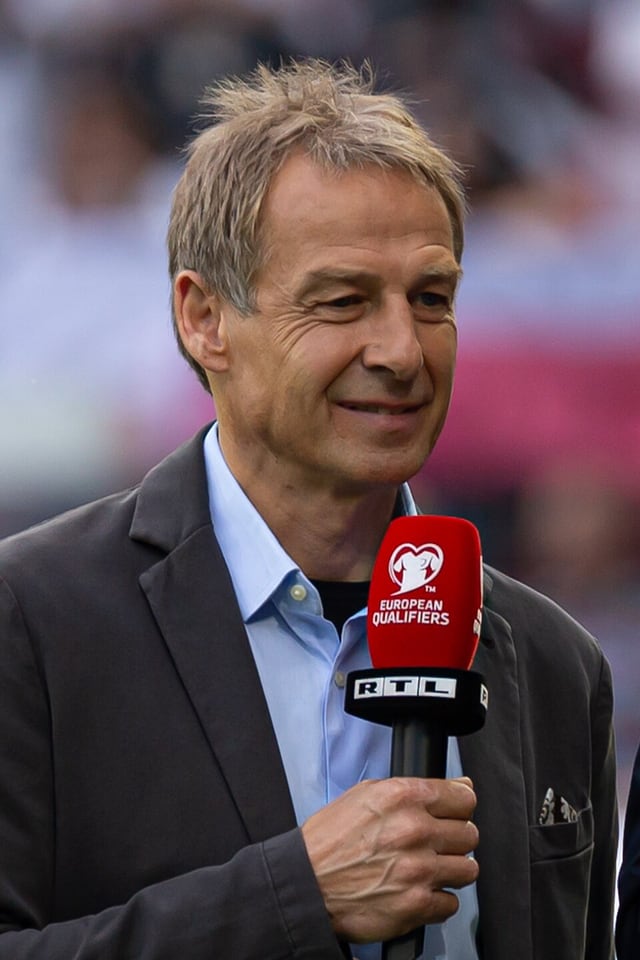
Summary
Klinsmann carried the same basic threat through changing teams: start the run early, attack the delivery at speed and finish before the defender recovered.
Quick facts
- Primary role
- Centre-forward
- Germany
- 47 goals in 108 senior internationals
- World Cup
- 11 goals in 17 matches across 1990, 1994 and 1998
- International honours
- 1990 World Cup and Euro 1996
- Tottenham
- 38 goals in 68 matches across two spells
- Profile
- Early runs, aerial aggression and first-time finishing
The run was usually older than the pass
Jürgen Klinsmann made a career from arriving at speed. The ball might still be with a full-back when he started across the centre-back. By the time the cross came, the defender was turning and Klinsmann was attacking it.
That movement produced diving headers, first-time volleys and finishes that looked more improvised than they were. The contact could be untidy because the run had already created the advantage. He did not need to stop, control and restart the action.
FIFA records 11 World Cup goals across three tournaments. Three came in 1990, five in 1994 and three in 1998. Different teammates supplied them and Germany changed around him, but the forward’s job remained recognisable.
A bakery apprenticeship ran beside the football one
Klinsmann grew up near Stuttgart and trained as a baker in the family business while his football career developed. The detail is often used as a neat origin story, but it also shows how unglamorous the early route was.
He played senior football for Stuttgarter Kickers in the second division before joining VfB Stuttgart in 1984. The Bundesliga exposed his pace against higher defensive lines and gave him the service of a team willing to attack quickly.
By 1987/88 he was the Bundesliga’s leading scorer. Stuttgart also reached the 1989 UEFA Cup final, losing to Napoli over two legs. Klinsmann’s domestic work and European run made the move to Inter a progression rather than a famous name buying potential.
Inter put him inside a German core
At Inter, Klinsmann joined West Germany teammates Lothar Matthaus and Andreas Brehme. Serie A in that period asked forwards to solve compact marking and accept fewer clean chances than the open Bundesliga often offered.
Klinsmann could not rely on a straight race every week. He learned to move across a marker, contest aerial balls and finish from awkward deliveries. Inter won the 1991 UEFA Cup, giving him a European trophy before his later move through Monaco, Tottenham and Bayern.
Lothar Matthaus controlled matches from deeper areas and carried the ball through midfield. Klinsmann supplied the final run. Their shared club work helped West Germany arrive at the 1990 World Cup with connections already in place.
Three goals belonged to the 1990 title
Klinsmann scored against Yugoslavia and the United Arab Emirates in the group stage, then against the Netherlands in the round of 16. The Dutch match was the most important of the three.
Rudi Voller was sent off in the first half alongside Frank Rijkaard. West Germany needed a forward to cover ground with ten players, and Klinsmann gave them both pressure and an outlet. His second-half goal opened the scoring in a 2-1 win.
He did not score in the final against Argentina. Brehme’s late penalty decided it. Klinsmann’s title case therefore rests on the whole route, not a rewritten claim about the final. Three goals and the performance against the Netherlands helped the team reach Rome.
The forward changed clubs more easily than roles
Klinsmann left Inter for Monaco in 1992. He then moved to Tottenham in 1994, later played for Bayern Munich and Sampdoria, and returned to Spurs during the 1997/98 season.
The list looks restless, yet his football translated. He could lead a counterattack in Germany, attack a technical pass in Italy or chase a direct ball in England. Managers did not have to redesign the forward before using him.
His weaknesses travelled too. He was not a playmaker who wanted every possession. When the team could not progress the ball, he might spend long periods away from the match. The value appeared when a pass, cross or loose ball gave him something to attack.
Five goals in 1994 proved the title was not the whole record
Germany arrived at the 1994 World Cup as defending champions. Klinsmann scored five goals in five matches: one against Bolivia, one against Spain, two against South Korea and one in the round-of-16 win over Belgium.
The quarter-final defeat to Bulgaria ended the campaign. Klinsmann did not score in that match, and Germany did not reach another final. Even so, five goals made 1994 his largest tournament total.
The distribution matters. He scored in all four matches before the quarter-final and against four opponents. This was not one hat trick carrying an otherwise quiet tournament. The forward kept giving Germany an early route to goal until the final game.
Tottenham turned the dive joke around
Klinsmann arrived in England with a reputation for going to ground easily. He answered the hostility with a self-mocking goal celebration, diving onto the grass after scoring on his debut. The joke opened the door; 29 goals in all competitions kept him popular.
Tottenham’s official history records the 1994/95 season as enough to earn the Football Writers’ Player of the Year award. His partnership with Teddy Sheringham joined two different forward ideas. Sheringham could drop, combine and slow the action. Klinsmann wanted the defence moving toward its own goal.
At Anfield in the FA Cup quarter-final, Klinsmann first set up Sheringham and later scored the winner. The combination showed why the pair worked: one forward could receive and read the next pass while the other attacked the space it created.
Bayern brought another UEFA Cup
Klinsmann joined Bayern in 1995 and won the UEFA Cup in his first season. He scored heavily through the campaign, giving the club a central runner who could turn midfield service into chances without several touches.
Bayern also won the Bundesliga in 1996/97. The spell was productive rather than peaceful, and Klinsmann left for Sampdoria after two seasons. His club career rarely settled into one long institutional identity.
That movement can reduce a player’s place in club-specific histories. It can also show portability. Klinsmann won UEFA Cups with Inter and Bayern, a World Cup and European Championship with Germany, and became a Tottenham favourite without spending a decade at any of those clubs.
Euro 1996 added the captain’s trophy
Klinsmann captained Germany at Euro 1996. He scored three goals during the tournament, although injury kept him out of the semi-final against England. He returned for the final against the Czech Republic as Germany won through Oliver Bierhoff’s golden goal.
The European title broadened the international record beyond 1990. Klinsmann was no longer the younger runner beside Matthaus and Voller. He carried the armband and remained the first-choice forward.
The DFB records 47 goals in 108 senior internationals. Only part of that total came in tournaments, but the World Cup line is unusually consistent: at least three goals at every edition he entered.
The return to Spurs was about survival
Klinsmann returned to Tottenham from Sampdoria in December 1997. The team was fighting relegation, and the second spell carried none of the novelty of his first arrival.
He scored nine league goals in fifteen appearances. Four came in a 6-2 win at Wimbledon in the penultimate match, the result that secured safety. Tottenham records his final two-spell total as 38 goals in 68 matches.
The Wimbledon performance is a useful late-career picture. Klinsmann was thirty-three, no longer at his fastest, and still knew where the next delivery would land. The run had shortened, not disappeared.
Three more goals in 1998 completed the World Cup line
Klinsmann scored against the United States and Iran in the group stage, then equalised against Mexico in the round of 16. Germany won that match 2-1. Croatia eliminated them 3-0 in the quarter-final.
His last international goal was therefore also a knockout goal that kept Germany alive. It took the World Cup total to eleven and the national-team total to forty-seven.
FIFA’s current table lists 17 World Cup appearances. Klinsmann scored in ten of them, with only the South Korea match in 1994 containing two goals. The record was built through regular contact with the score sheet rather than repeated multi-goal bursts.
Eleven goals sit behind different kinds of records
Klinsmann shares eleven World Cup goals with Sándor Kocsis and Cristiano Ronaldo in the current ranking. The totals came by different routes. Kocsis scored all eleven in 1954. Ronaldo spread his across six editions. Klinsmann used three tournaments and scored at least three in each.
Above them, Just Fontaine owns the single-edition record with thirteen, Gerd Muller reached fourteen in two tournaments, and Miroslav Klose later built Germany’s record across four.
Klinsmann ranks eleventh on the site’s World Cup all-time scorers table because the page orders total goals first and preserves the tied group. The profile adds what the number cannot: he scored in three different German tournament cycles, one of them a champion.
What his movement asked from defenders
Klinsmann did not wait beside a centre-back and then challenge from a standing start. He moved away first, giving himself room to accelerate into the contest. A defender tracking the ball could lose the separation before noticing it.
He attacked crosses aggressively. Diving headers were a practical response to balls arriving ahead of him, not a performance for the camera. He also used acrobatic volleys when the delivery sat behind his stride.
The first touch was often the finish. That saved time and kept the goalkeeper from setting. It also produced misses that looked wild. The same appetite that reached difficult balls did not guarantee clean contact every time.
The coaching career is a separate argument
Klinsmann later coached Germany to third place at the 2006 World Cup and led the United States at the 2014 tournament. He also managed Bayern, Hertha and South Korea. Those jobs changed how later audiences saw him, sometimes for the worse.
They do not belong in the player ranking. The eleven World Cup goals, 47 for Germany and major trophies were complete before the coaching debates began.
As a player, Klinsmann’s case is straightforward. He found a useful run in 1990, repeated it in 1994 and still had it in 1998. Three tournaments changed the team around him without removing the threat.
Sources
Sources checked
FAQ
How many World Cup goals did Jurgen Klinsmann score?
FIFA records 11 goals in 17 matches: three in 1990, five in 1994 and three in 1998.
How many goals did Jurgen Klinsmann score for Germany?
The DFB records 47 goals in 108 senior internationals from December 1987 to July 1998.
Did Jurgen Klinsmann win the World Cup?
Yes. He was part of West Germany's 1990 winning team and scored three times during the tournament.
How many goals did Jurgen Klinsmann score for Tottenham?
Tottenham records 38 goals in 68 appearances across his 1994/95 season and his return in 1997/98.
Which clubs did Jurgen Klinsmann play for?
His senior European career included Stuttgarter Kickers, VfB Stuttgart, Inter, Monaco, Tottenham, Bayern Munich and Sampdoria.