
player
Luis Suarez: The Striker Who Made Bad Angles Work
Luis Suarez's career through Liverpool, Barcelona, Atletico, Uruguay and Inter Miami, with his goals, movement, honours and major bans in context.
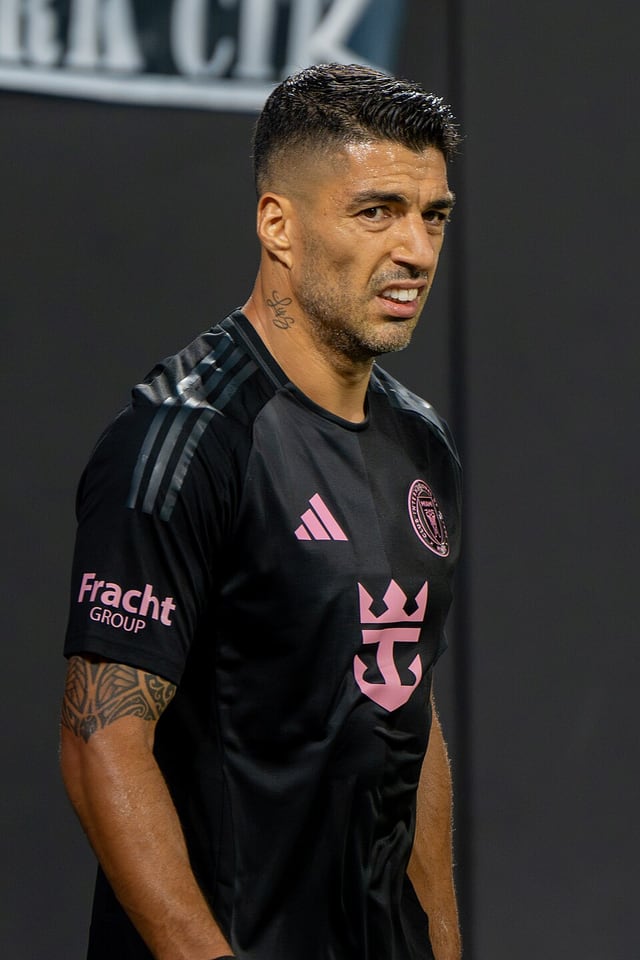
Summary
Luis Suarez liked chances that barely looked like chances. One poor touch from a defender could give him all the room he needed.
Quick facts
- Primary role
- Centre-forward
- Current club
- Inter Miami CF (checked September 30, 2026)
- Liverpool
- 82 goals in 133 appearances
- Barcelona
- 198 goals in 284 official matches
- Uruguay
- 69 goals in 143 senior matches, according to AUF
- Major club honours
- Champions League winner; five La Liga, one Eredivisie and two Uruguayan league titles
- Profile
- Pressure, improvisation and early finishing from awkward angles
Where the bad angle became the chance
Luis Suarez liked a move with a loose end. Maybe the pass arrived behind him, or the centre-back had already leaned into his back. Even with the obvious finish covered, he would have a swing.
Sometimes he put the ball through a defender’s legs first. Sometimes he poked at a ricochet or shot while falling away. Either foot worked. The striking detail was not the choice of foot; it was how little preparation he required.
He chased centre-backs with a purpose. The run closed the easy pass, and the next heavy touch put him close enough to steal. Winning the first collision against Suarez did not end the problem. He was usually waiting for the loose ball.
Four clubs asked for four versions of him. Liverpool handed him much of the attack. Barcelona used him between Lionel Messi and Neymar. Atletico Madrid bought an older striker for a title race, and Inter Miami now keep his work closer to the box. The appetite for a half-chance survived each change.
Ajax let him roam before Liverpool let him run everything
Born in Salto on 24 January 1987, Suarez started out with Nacional. His European route moved quickly: Groningen in 2006, Ajax a year later.
Ajax did not keep him between the posts. He wandered wide, came back to join the passing and then ran at the last man. That freedom suited a forward who wanted a hand in the buildup before the final touch.
Atletico Madrid’s career summary puts his Ajax return at 111 goals in 159 matches. In 2009/10 alone, he scored 35 league goals and led the Eredivisie. By the time Liverpool called, Suarez was used to building chances as well as taking them.
The Ajax years also brought the first incident in a pattern Suarez never fully escaped. He bit PSV midfielder Otman Bakkal late in 2010 and received a seven-match domestic ban. Liverpool signed him the following January.
At Liverpool, the attack ran through him
In three and a half years at Liverpool, Suarez played 133 times and scored 82 goals. Those totals miss the distance he travelled inside each attack. He dropped between lines, carried the ball and worked off Daniel Sturridge while the opposition were still arranging themselves.
A nutmeg could open the lane. A goalkeeper standing two steps too high invited the shot from distance. When space ran out, Suarez nudged the ball just beyond one boot and struck before another could reach it.
The numbers peaked in 2013/14: 31 goals, 13 assists and 33 league matches. Not one goal came from a penalty. Liverpool finished two points short of Manchester City, leaving Suarez with a famous season but no Premier League medal.
Sturridge could run beyond or come short, and both strikers were comfortable scoring. Steven Gerrard hit the early pass; Raheem Sterling supplied another burst ahead of the ball. Suarez remained the hardest piece to map because he might start the move outside the box and finish it inside.
Pressing created shots
The pressing was more than a show of effort. Suarez picked the defender he wanted to hurry, bent his run across the easy outlet and tried to arrive just before the ball escaped tackling range.
The next action was rarely tidy. A shoulder challenge might leave him stumbling. The ball could bounce off a shin. He kept playing through the contact and was quick to recognise which side of the defender had opened.
Many of the scruffier goals began there. A compilation can make them look accidental, yet Suarez kept turning up beside the same unstable touches. The chips and long shots displayed the technique. Rebounds and panicked clearances kept him dangerous when his team were passing badly.
Uruguay: 69 goals, 143 matches and no simple story
Suarez’s AUF line stops at 143 caps and 69 goals. Colombia were the opponents for his February 2007 debut; Paraguay faced him in the 0-0 farewell on 6 September 2024.
The 2011 Copa America was his best fortnight with Uruguay. His goal started the 3-0 final win over Paraguay, and the tournament award went home with him. For Uruguay, the trophy was continental title number fifteen.
One year earlier, he had scored three times on Uruguay’s way to the World Cup semi-finals. Against Ghana, however, he deliberately handled the ball on the goal line. The red card followed. Asamoah Gyan hit the penalty against the bar, and Uruguay won the shootout. An illegal intervention had kept them alive.
The usual straight-line tribute does not fit. There are 69 goals, a Copa America and years beside Edinson Cavani. There are also incidents that changed games and brought severe bans.
The bans cannot be filed under competitiveness
In December 2011, the FA commission upheld an aggravated misconduct charge involving Patrice Evra. The sanction was eight games. Suarez then bit Branislav Ivanovic in Liverpool’s April 2013 game against Chelsea. This time the FA imposed ten games, adding seven to the normal violent-conduct punishment.
At the 2014 World Cup, he bit Giorgio Chiellini in Uruguay’s match with Italy. FIFA’s punishment covered nine Uruguay games and four months away from football activity. CAS later let him train, but the ban on playing stood.
Calling all of this competitive excess would be evasive. Opponents were harmed, Suarez missed matches and his teams lost the use of their striker. The Evra case concerned discriminatory language, a different issue from losing control in a tackle or argument.
Suarez’s football after 2014 became more controlled, but a career assessment cannot use the later goals to edit the earlier record. Sporting brilliance and serious misconduct are both true here.
Barcelona’s front three worked because the jobs were different
Suarez joined Barcelona in 2014 and entered a front line with Lionel Messi and Neymar. Putting three gifted attackers on the same teamsheet was only the beginning. They still had to divide the pitch without wasting one another’s best positions.
Messi could move inside from the right and become the main creator. Neymar attacked from the left and carried past the first defender. Suarez stayed central more often, occupied the centre-backs and ran through the gap created when either wide forward drew attention.
He did not disappear into a poacher’s role. Suarez could bounce a pass back to Messi, move outside the box to open the central lane or attack the far post when Neymar carried inside. His willingness to run without receiving helped keep the front three from crowding the same space.
His first Barcelona season finished with three trophies. In the Champions League final, Gianluigi Buffon parried Messi’s shot into Suarez’s path. The rebound put Barcelona 2-1 ahead, and the match with Juventus ended 3-1.
Forty league goals in 2015/16
Barcelona counted 198 Suarez goals across 284 competitive games and six seasons. The club also credits him with 97 assists. He returned plenty of the service he received from the two wide forwards.
His league count hit 40 in 2015/16, which brought him the European Golden Shoe. The award had become familiar territory for Messi and Cristiano Ronaldo. For that season, Suarez finished ahead of each.
There was no single route to the 40. Headers, first-time hits and rebounds all counted, as did finishes after a difficult first touch. Barcelona created plenty, but the central lane was crowded and every defender knew who was waiting there.
Six seasons brought four league titles, four Copas del Rey and the 2015 Champions League. The partnership with Messi lasted after Neymar left and remained productive, though Barcelona’s later European defeats made the end of the period less complete than the first three seasons.
Atletico needed one season, and got it
Barcelona allowed Suarez to leave in 2020, and Atletico Madrid signed him. He was 33, had lost some of the speed needed to cover large distances and no longer pressed every phase with the same force.
Diego Simeone could live without the old Liverpool workload. Smart box movement and a dependable final touch were enough. The return was 21 league goals in 2020/21.
Atletico remember goals 20 and 21 best. Number 20 arrived in the 88th minute against Osasuna, rescuing the next-to-last fixture. Number 21 won the final game at Valladolid. The two-point margin over Real Madrid made Atletico champions.
He no longer had to carry every part of the attack. Strip the job back to reading the box and finishing, though, and enough of the old striker remained to decide a championship.
The Inter Miami role is smaller
Suarez went back to Nacional in 2022, played the next year at Gremio and reached Inter Miami in 2024. On the night Miami secured the Supporters’ Shield, his league numbers stood at 18 goals and six assists with two fixtures remaining. MLS Cup followed in 2025.
The latest contract lasts through the 2026 MLS campaign. We checked the senior roster on 30 September 2026 and found Suarez still listed there.
The current game is narrower. Suarez cannot repeat the running volume of Liverpool or the complete Barcelona peak. He stays close to the box, combines with familiar teammates and relies on the first few metres of movement rather than a long carry.
Age has reduced the number of actions. It has not removed the habit of seeing a useful finish inside a poor angle.
Why he sits ninth among our all-time strikers
We place Suarez ninth among the best football strikers of all time. His case has several peaks: Liverpool’s 31 league goals without a penalty, 40 in La Liga for Barcelona, the 2015 Champions League, the Atletico title finish and 69 Uruguay goals.
Players above him have stronger World Cup peaks, cleaner long-term European records or a more concentrated case as the defining striker of an era. The disciplinary record also cannot be separated from availability and judgment.
At his best, though, Suarez gave a team more than finishing. He disturbed the first pass, created from central areas and attacked the loose ball before anyone else accepted that it had become a chance.
The football case still belongs in the top ten. Other forwards waited for the angle to improve; Suarez often shot before it did.
Sources
Sources checked
- Liverpool FC - Luis Suarez player archive
- Premier League - Luis Suarez's 2013/14 season
- FC Barcelona - Suarez reaches 500 club goals
- FC Barcelona - Suarez transfer and honours
- UEFA - 2014/15 Champions League season review
- Atletico Madrid - 2020/21 title retrospective
- Atletico Madrid - Suarez's 2020/21 season award
- AUF - Luis Suarez national-team record
- Inter Miami - Luis Suarez contract through 2026
- Inter Miami - current Luis Suarez roster profile
- MLS - 2024 Supporters' Shield match and season totals
- UEFA - Suarez's 2010 domestic suspension
- The FA - 2013 disciplinary decision and reasons
- CAS - Luis Suarez, Barcelona and AUF v FIFA award
FAQ
What club does Luis Suarez play for?
Inter Miami list him on their forward line. His contract covers the 2026 MLS season; we checked the club roster and contract announcement on September 30, 2026.
How many goals did Luis Suarez score for Liverpool?
The Liverpool total is 82 goals from 133 games. His 2013/14 league return was 31 in 33.
How many goals did Luis Suarez score for Barcelona?
Barcelona's own database gives him 198 goals from 284 competitive games between 2014 and 2020.
How many goals did Luis Suarez score for Uruguay?
His AUF record finishes at 69 goals and 143 senior caps. Cap 143 came against Paraguay on September 6, 2024.
What were Luis Suarez's major suspensions?
He received an eight-match FA ban after an aggravated misconduct charge involving Patrice Evra, a ten-match FA ban for biting Branislav Ivanovic, and a nine-match international suspension plus a four-month playing ban after biting Giorgio Chiellini at the 2014 World Cup. CAS allowed him to train during that last ban.